Blog

  • How to smoke a cigar

    How to smoke a cigar

    cigar

    In 1492, during the famed Christopher Columbus expedition, there was a young crewman on board by the name of Rodrigo de Jerez. Now, Rodrigo sailed on The Santa Maria and is not a well known historical figure — not nearly as famous as Columbus — but it was actually Jerez who was not only responsible for discovering tobacco but was also it’s first documented addict.

    Take that, Columbus.

    In October of 1492, Jerez and his crew landed in what is now the island of San Salvador in the Bahamas and when they arrived the natives of the island brought the explorers gifts — pottery, fish, berries as well as bundles of a dried leaf that the natives burned for fragrance. The crew took the gifts, but quickly discarded the leaves as they saw no use for them.

    A month later — November of that same year — Jerez noticed the natives were smoking these very leaves. They would take the leaves and pack them tightly inside of palms, light the ends and suck in the smoke. Jerez was amazed at this and later described the act as; drinking in the smoke.

    Jerez tried smoking. He liked it.

    When Rodrigo de Jerez returned to Spain — this time on The Nina — he brought his new habit and a large supply of tobacco with him. This supply was soon in huge demand as Jerez introduced many of his friends and neighbors to smoking tobacco.

    Everything went well for Jerez — for a while — until many of his neighbors became concerned. After all, everyone knew that only The Devil could breath smoke. This opinion was also shared by members of The Spanish Inquisition — who were very active at the time and were not known for their tolerance of new things.

    Rodrigo de Jerez was arrested and held in prison for questioning.

    His questioning lasted seven years.

    HOW TO SMOKE A CIGAR:

    Smoking a cigar is a very social act — much different then smoking a cigarette. One of the main reason  for this is that a cigar is so tightly packed that it takes much longer to smoke then a cigarette — in fact, depending on the size, a cigar can take anywhere from twenty minutes to an hour to smoke. Which is plenty of time to golf nine holes, catch a few fish, play several hands of cards or simply sit around the fire and trade some lies. A cigar is something to be savored. Enjoyed.

    Cut the cigar. A cigar comes with an open end — to light — and a closed end — to draw in. The closed end will need to be cut in order to smoke the cigar and, yes, in desperate situations we have all simply bit the end of the cigar off. It works. But you will be spitting bits of cigar paper and tobacco out all night. A cigar cutter is a little guillotine- like device that’s sold in cigar stores — for usually less then a dollar. It creates a smooth straight line at the end of the cigar.

    Light the cigar. A true cigar aficionado will tell you that a cigar will need to be lit by a match — preferably a wooden one — and never lit by a lighter. The reason is that it’s believed the butane smell can transfer through to the cigar — think of the difference between cooking a steak over charcoal as apposed to cooking it on a gas grill.  Also, as you are lighting it, rotate the cigar so the end is lit evenly.

    Hold the cigar. The say — you know, them, the experts — that the right way to hold a cigar is between your index finger and thumb. But that way always felt strange to me. I always hold them between the pointer and the ring finger — just like you would a cigarette.

    Don’t inhale. Now, you’re not supposed to inhale the smoke from your cigar and you’ll know it when you do. Cigar tobacco is pretty tough stuff and your throat will scream if you pull it in. Simply draw into your mouth, enjoy the flavor and draw out.

    When to quit. There is no set place when to put the cigar out — no filter like on a cigarette. But you will know. Either when the flame is too hot against your hand or when the taste becomes too strong — usually down to the last third of the cigar — it’s time to put that baby out. When putting out a cigar don’t crush it on an ashtray like a cigarette. Just place it in an on the rim of the ashtray and allow it to go out on it’ s own.

  • The five things our grandfathers would kick our tails for

    The five things our grandfathers would kick our tails for

    grand

    There is an old story about two frogs. The first frog was tossed into a pot of boiling water. He screamed — Yeah, I looked it up, frogs can actually scream — http://conservationreport.com/2009/03/03/nature-screaming-frogs/ — and then he jumped out of the pot. He checked himself over. He took a few frog breaths, and then he moved on with his frog life.

    But the second frog was different. He was tossed into the pot while the water was still cool. The frog swam around. He checked everything out and saw nothing to be concerned about so he settled in. Then the burner under the pot was turned on, the water all around the frog began to heat up, slowly. But the frog doesn’t seem to notice or care. Bit by bit the water temperature increased. There were no frog screams. There were no frog escape attempts. The frog simply remains in the pot until the water boiled. And until —. Dead frog.

    Now, this phenomenon is often referred to as creeping normalcy or a shifting baseline and it describes the state that occurs when change occurs slowly, in small steps, over time. And because we only see the parts of the change not the total change itself, we don’t react to it.

    Every day. Every moment. Our lives change. What is normal today was not normal only a few years ago.

    Now, yes, technology has something to do with this.  But the big changes, the sweeping changes, the dead frog changes, have very little to do with technology. These changes are driven by shifting priorities and varying acceptance.

    Now let’s turn back the clock a bit. Let’s take a look at our normal, everyday lives through someone else perspective. Let’s go back in time but not simply to the generation before us  — born in the 1950’s — but to the one before that — the ones born in the 1920’s and ’30’s. This is the generation that fought in World War II. This is the generation that fought in Korea — in fact, many WWII vets volunteered to fight again in Korea. This is the generation that was raised through The Great Depression. This is the generations that struggled and sweated and built the structure of this country and is the one that lead Tom Brokow to deem it as “…the greatest generation any society has ever produced.”

    If we are going to look at the everyday structure of our society, then what better generation to view it through than the eyes of that group of men.

    Through the eyes of our grandfathers.

    Now, these changes are not large cultural and world changes — because the big changes are not the interesting ones. What’s fascinating is the little stuff. The tiny insignificant items that move and wiggle and shift all around us until one day we wake up and see it all as normal. But this version of normal would cause our grandfathers to smack us on the back of the head.

    So what would these men — our grandfathers — think of the every day, the basic, the routine, aspect of our lives today?


    THE FIVE THINGS OUR GRANDFATHERS WOULD KICK OUT TAILS FOR.


     1. Bottled water.

    This is one of those dead frog changes that has built up slowly for the last few decades and is now so embedded in our culture that we don’t even notice it. But think about it. We are paying —- for water.

    The stuff that comes out free from sinks and water fountains and garden hoses?

    Water.

    Which means that in a factory some place, someone turns the tap on, filters the water for taste — because our sensitive twenty-first century palate wants all our water to taste the same — squirts it into a plastic bottles and we buy it by the truck loads.

    In fact, the bottled water industry is a 60 Billion dollar industry. But did you realize that we buy more bottled water than we buy milk? And ready for a real surprise? We also buy more bottled water than we do — beer.

    So, say we yanked a solider out of the battlefield of World War II and brought him to the modern day. Then we gave him three bucks and said, Okay, go to that convenient store and buy me a bottle of water.

    The soldier would look at you strangely. He would walk into the store and open the cooler. He would pick up the water and look at the money you gave him and then look at the bottle of water. He would check the ingredients — nope, just water. And then he would walk back to you.

    “No,” he’d say. “I can’t do it.

    It would be so foreign to him that he wouldn’t be able to do it.

    http://www.bottledwater.org/economics/bottled-water-market

    2. The backyard deck.

    Backyard decks are great places. It’s where we entertain family and friends. It’s where we barbecue and it’s the place we often relax. But in our grandfathers day there was a place called the front porch and this was a social place. An open and connected place to sit and visit with neighbors.

    During this time it was very common to finish dinner and take a walk. And during this walk you would stop and visit with the folks sitting on their porch. You would connect with the neighborhood. Hear the gossip and check up on people. When you had visitors at your home, you often sat on the porch. When you listened to the ball game, you did it on the front porch so anyone could stop and listen with you.

    The front porch was open. The front porch was inviting.

    When the front porch became a merely decorative place, our neighborhoods became less involved with us and we became less involved with them. Now, we can now drive into our driveway, hit the electronic garage door opener, drive into the garage and never see our neighbors.

    3. Logos

    Your grandfather probably had a set of ESSO Put a Tiger in Your Tank coffee mugs. They were thick and white and very common and he probably had a few of them. Why? Because they gave them away free when you purchased ESSO gas. Your grandfather had the coffee cups with the ESSO tiger logo on it because they were free. No other reason. If they had offered to sell those same mugs — even at a very low cost — your grandfather would have sneered.

    Why would I pay to buy someone’s name on a mug?

    But today we do. We actually pay — and pay quite a bit — for the right to wear clothing, coffee mugs, key chains or hats that says Aeropostale, Harley Davidson or Nike.

    And I haven’t even gotten into the sports logos yet. With sports we pay for the right to promote our favorite sports teams. And what would your grandfather say when you spent eighty bucks to wear your favorite quarterbacks jersey?

    What?

    Your grandfather would want to know why any man would want to put another man’s name on his own back?

    What’s wrong with your own name? —he’d ask. What’s wrong with doing something you are proud of instead of pretending to be someone else?

    4. Credit

    Now before you argue, that there wasn’t credit available in your grandfather’s day, you’re wrong. Of course there was. There has always been credit. The only difference is that in your grandfather’s day, credit was seen as a weakness not a reward. In his day, the people who used credit were the ones who could not afford to pay in cash. They were looked down on because a man in debt was no man at all.

    Credit meant bad planning. Credit meant that you didn’t earn enough to take care of yourself and your family. The men that lived through The Great Depression and fought in foreign lands and came back home to raise families had only one rule. If you can’t afford it — meaning you don’t have the cash money to buy it — then you go without it.

    5. T-shirts  

    Yes, your grandfather owned t-shirts — he wore them under his dress shirts. And the only time you saw him in wearing only it, was when he was sitting in his chair listening to the ball game, or when he was mowing the lawn. And if someone came to the door, he would grab his dress shirt and pull it on before opening the door.

    When your grandfather went out to eat, he wore a tie. Even if he was a blue collar guy there was a sense of pride that he had.

    Whether you were a ditch digger or a doctor, a lawyer or a shoe shine man, there was a sense of pride in appearance.

    Now it’s casual —- well, that’s what we call it — but casual has long fallen into a new category. Now we have work clothes and everything else. We don’t dress for dinner at a restaurant, much less dress for dinner at our home.

    Your grandfather did. He would often dress to eat dinner with his wife and family. Because it was an event. He was proud to have earned the money for the food. He was proud of his home and wife and his children.

    Your grandfather had pride.

    And that’s probably what it boils down to. Pride. Our grandfathers had it and we as modern men are lacking it.

    Why did they have it? Because they deserved it. They fought and sacrificed and planned for it.  They earned that pride — it wasn’t given to them, they paid for it several times over.

    When is the last time we sacrificed or went without? When is the last time that we felt real pride in something — not simply in the pride in a new car we owe on or of what comforts we can rent. But true, bone deep pride?

    … for most of us, it’s been a long time.

  • How to build a Hobo Stove

    How to build a Hobo Stove

    hobo

    If you are under the age of eighty, then you — like most of us — have not lived through a true worldwide economic depression. Oh, we have all seen economic challenges — layoffs, rightsizing and recessions — but few of us were alive to experience the prevailing effects of The Great Depression of the 1930’s.

    During this time, jobs did not simply become scarce, they just vanished. Banks collapsed. Manufacturing stopped. Crop prices were cut in half and virtually overnight the country changed and remained changed for nearly a  decade.

    Imagine what happens when a country of men wake up and in spite of their best intensions and efforts, they can no longer take care of themselves or their families. Over time, the strain broke many of these men — because underneath subsistence is survival but underneath survival is hopelessness.

    Very few of us know what it’s like to live in a world when money was not simply hard to come by, but for many American’s it just didn’t exist any longer. Bartering became a common method of commerce and many people simply worked for food and shelter.

    Ironically, the group of people that faired the best during this time was the  American farmer — those located outside of the dustbowl Midwest. Even with low crop and meat prices, the American farmer had enough food for his family as well as had goods to trade with.

    With these farms surviving, migratory workers would travel and seek out the seasonal seeding and harvest work available. This was fueled by the fact that with homes being foreclosed on and with little cash for rent, there were more people living a transitory lifestyle then ever before — moving from town to town seeking what work could be found.

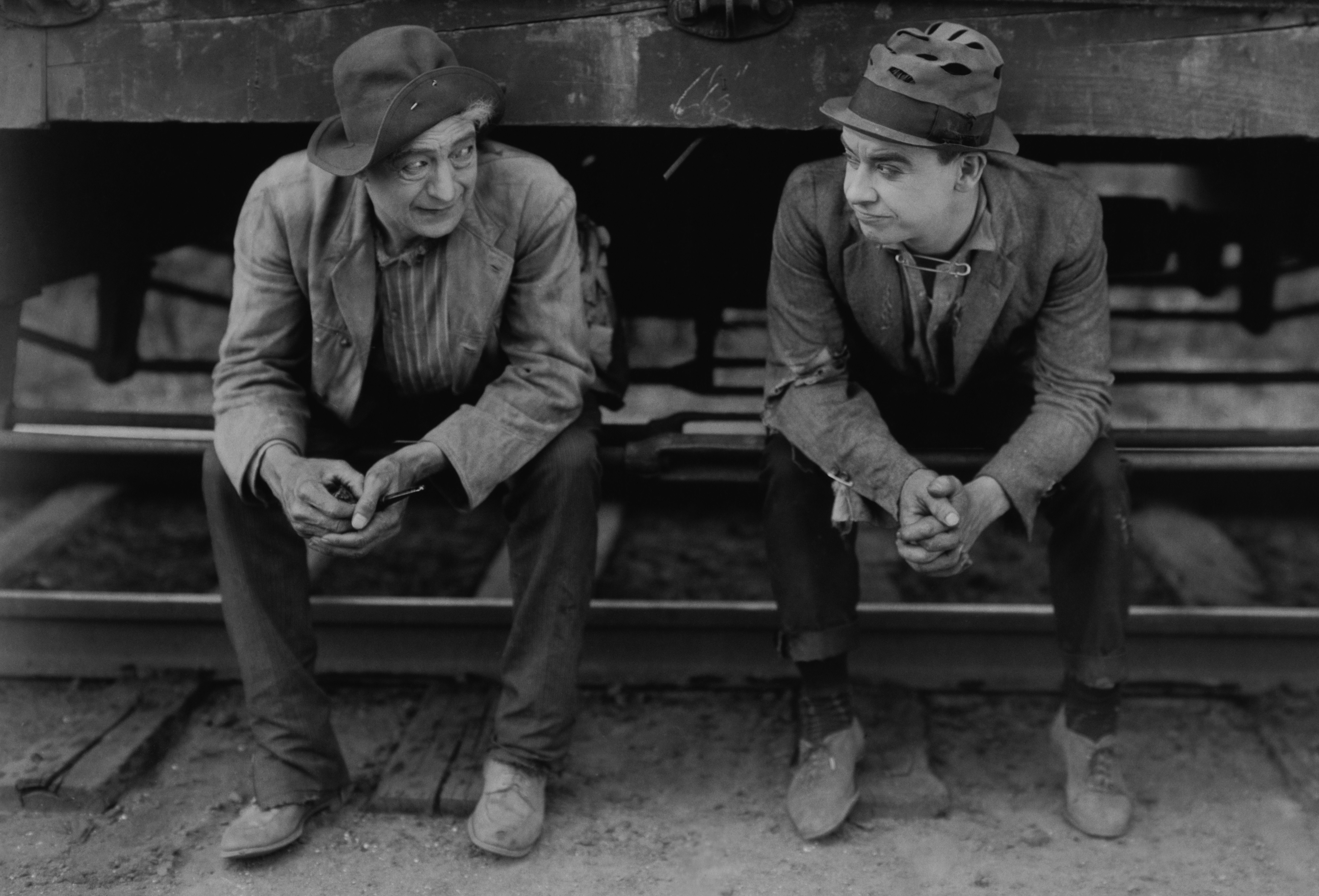
    Now, the most colorful group of travelling men during this time was the American Hobo. The term hobo is believed to come from the phrase ho-boy, referring to the great groups of farm and field workers that competed for migratory work. These men would travel light and stay on the move — often by sneaking aboard freight trains — looking for work, a meal and if possible a little adventure.

    The modern term hobo is often used when referring to anyone homeless but this is not accurate.

    Remember …

    A hobo is someone that travels looking for work.

    A tramp is someone that travels but does not work.

    And a bum neither travels nor works.

    The general philosophy of the hobo — and of many American’s during The Great Depression — was simple: waste nothing, throw little away and make do with what you can find.  And from this, the hobo stove was born.

    Now, there is no evidence that the hobo stove was actually created during the 1930’s. It’s such a simple design — made simply from old cans — and a stove similar to it was used in World War I. But it was commonly used during this period and often associated with it.

    A hobo stove is a simple stove made from discarded food cans — a coffee can is often used but you can build the stove with larger or smaller cans — that allows air to ventilate it and an area to feed fuel in. These stoves are cheap, easy to make, relatively efficient and can be burned at no cost because they burn sticks, pine cones, wood scraps, cardboard, pretty much anything you find along the way. And because they burn pretty much anything, you will never run out of fuel.

    In the modern world, Hobo Stoves are great little devices to have. They can be used during power outages, as a camping stove, while hiking or backpacking, to distill water in or as part of a survival kit.

    Now there are many designs to a hobo stove, but here is a real simple one — and remember, they don’t need to be too pretty they just need to work.

    [amazon asin=1586489011&template=iframe image][amazon asin=B00IK6HKFE&template=iframe image][amazon asin=B000HEKR98&template=iframe image][amazon asin=B007WHCFC0&template=iframe image]

    HOW TO BUILD A HOBO STOVE:

    1. Find a base can for your stove and a slightly smaller top can. You can make this stove as large or as small as you want. I wanted to build a light backpacking stove here, so I used a spaghetti sauce can for the base and a dog food can for the top, but I’ve seen these stoves made out of large #10 food cans for those wanting full sized camp stove.

    2. With a ‘church key’ style can opener, place some holes along the bottom base can. These are to draw air in and up through the stove — it’s important to have some space between holes though so you have stability at the base of the can.

    3.  With a nail, punch some holes in the side of the can, center, for ventilation, as well as four additional holes  — an inch from the top — for the support pins. The small holes in the center will add some additional ventilation and the four peg holes need to be directly across from each other as the pegs that will support the top half will rest on it. Make sure the holes are equal distance across, as you want this stove to be as stable as possible so the pot on top of it is centered.

    4. Place two pins across the can for support of the top can. Metal tent poles work great for this and you can even use coat hangers but you’ll need to find the thicker, heavy coat hangers to use. A standard coat hanger will be too thin and not work here. Remember, this is where the top can, the pot and a few cups of water will be supported. The ones I used metal from a metal bathroom shelf that I rescued from the trash. I cut off a few tent pole sized pieces, straightened them and bent the edges down.

    5. Cut the bottom out of the top-can so it becomes a metal tube. You can try to use a can opener on some cans but this one had a rounded edge so I just poked a hole in it and then used tin snips. Bend the sharp edges in with pliers.

    6. Cut a “V” shaped section out of the top can. This will be used to feed the fuel down into the stove as well as allow the opposite side of the can to become a wind screen. Bend any sharp edges back with pliers.

    7. Set the top-can down into the bottom-can until it rests on the pins. You want your pins to be across parallel with each other not making an X. Although by crossing them might be more stable, you will be placing fuel down past the pins and don’t want anything to get hung up.

    8. Find the pot you will be using. This should really be done earlier in the process, then you can identify the size stove you want based on the pot you will be using — as well as the place it will be stored. But I got lucky here and found this great little coffee pot in my basement — it had a small pinhole in the side that I patched with some J-B Weld and it worked great. The size of the pot was small enough but the right size so the entire stove fit perfectly inside of it — even allowing room for my silverware, fire starters, and other items to be stores. It’s difficult to tell in these photos, but this pot is very compact and is only 6” high. The perfect size for a small backpacking stove.

    9. Cover stove and pot with high temperature spray-paint. You don’t have to take this step, but by covering both the stove and the pot you are not only protecting it but making it more difficult for the tars and oils from the fire to build up on the surfaces. High temperature spray paint can be found in any hardware store.

    Test your gear. If you need to make modifications it’s easier to do this at home. Try the stove at least once before using it in the field and anything you don’t like, just change and tweak until you have it exactly the way you want it.

    I tried this stove and I had water boiling in about four minutes — using just a handful of twigs and leaves from my backyard as fuel. Total cost ended up being zero because I recycled the cans and pegs and found the coffee pot in my basement.

    Remember: keep the design of the stove simple as you don’t need a device to simmer a five hour brisket in. These stoves were designed to quickly cook a few  stolen eggs before breaking down camp and catching the next freight out of town.


    BIG ROCK CANDY MOUNTAIN

    First recorded by Harry McClintock.

    1928

    The Hobo Theme song.

    One evening as the sun went down
    And the jungle fires were burning,
    Down the track came a hobo hiking,
    And he said, “Boys, I’m not turning
    I’m headed for a land that’s far away
    Besides the crystal fountains
    So come with me, we’ll go and see
    The Big Rock Candy Mountains

    In the Big Rock Candy Mountains,
    There’s a land that’s fair and bright,
    Where the handouts grow on bushes
    And you sleep out every night.
    Where the boxcars all are empty
    And the sun shines every day
    And the birds and the bees
    And the cigarette trees
    The lemonade springs
    Where the bluebird sings
    In the Big Rock Candy Mountains.

    In the Big Rock Candy Mountains
    All the cops have wooden legs
    And the bulldogs all have rubber teeth
    And the hens lay soft-boiled eggs
    The farmers’ trees are full of fruit
    And the barns are full of hay
    Oh I’m bound to go
    Where there ain’t no snow
    Where the rain don’t fall
    The winds don’t blow
    In the Big Rock Candy Mountains.

    In the Big Rock Candy Mountains
    You never change your socks
    And the little streams of alcohol
    Come trickling down the rocks
    The brakemen have to tip their hats
    And the railway bulls are blind
    There’s a lake of stew
    And of whiskey too
    You can paddle all around it
    In a big canoe
    In the Big Rock Candy Mountains

    In the Big Rock Candy Mountains,
    The jails are made of tin.
    And you can walk right out again,
    As soon as you are in.
    There ain’t no short-handled shovels,
    No axes, saws nor picks,
    I’m bound to stay
    Where you sleep all day,
    Where they hung the jerk
    That invented work
    In the Big Rock Candy Mountains.
     

  • How to remove a splinter

    How to remove a splinter

    splinter

    There is a story in my family about my great, great, grandfather — or maybe he was a great, great, uncle. It doesn’t matter. So this grandfather — or uncle — got married and lived with his wife in a cabin on a small farm. This cabin had a rough wooden floor and if you had stocking feet — or worse yet, bare feet — you would end up with a foot full of splinters. Every stinking time.

    Now, the first few years on the farm were tough. Sometimes the two of them barely had enough to eat, but they worked through it and this grandfather — or uncle — and his wife, gave birth to their first child. Time went by and life did not become any easier, especially with another mouth to feed. Until one day, after a few additional years of struggle — as well as of a few more years of yanking splinters out of his feet — the grandfather-uncle had finally had enough. So he went to his wife and said, Maggie — I’m guessing at her name is Maggie because that sounds like the right kind of name. He said, Maggie, we’re not making a go of it here. So this is what I’m proposing. You go back to your people. I’ll go back to my people. We’ll leave this marriage and we’ll leave this farm the same way that we came into it. As separate people.   

    And Maggie — being a very wise women, said; Okay, fine. We’ll leave the marriage the same way we came into it. Which means that I came into it without a child. So you’ll be taking the boy with you.

    Now, as kids, when we would hear this story, the first thing we noticed was that when the story ended, every time, all the adults laughed. Every one of them.

    And we, the children of the family — possibly concerned with the knowledge of starving being only slightly worse than parenthood — never laughed. Ever.

    But the even more disturbing part of the story was that my grandfather-or-uncle and his wife deciding to stay together because being a parent was only slightly better than a foot full of splinters. In fact, the two made the farm work and even remained married for over forty years and — here comes the good part —- they had nine more children.

    All the adults always laugh at this part, too.

    Us kids? Not so much.

    But the mental image of this that has stayed with me all these years is the idea of a foot full of splinters.

    Can you imagine a foot full of splinters? — actually, that sounds like a great country song — because the truth of it is that even a single splinter, just one, is bad. And if I woke up each morning with a foot – or possibly two feet — full of them, I would probably loose my mind too.

    HOW TO REMOVE A SPLINTER.

    The rule about removing splinters is simple. The bigger the splinter, the easier it is to remove. The smaller the splinter, the more it will want to hunker down and get cozy. So let’s focus on the small and nasty splinters here because the larger ones usually come out quickly or they get lazy and take care of themselves.

    The aspect that has always made removing a splinter a largely male thing is that very often the splinter is in deep enough to need to force the splinter end through the skin — i.e. the needle method — or of clipping away parts of sensitive skin with nail clippers or small shears in order to get to it. This is the worse part, because you are often causing pain to someone who is in pain.

    But if you do this right, you can do it almost painlessly.  

    Now, over the years I have seen many methods of removing splinters. I’ve seen people use duct tape, use glue, I had an aunt that was pretty good at removing them with an uncooked sliced potato. I’ve seen people soak bread overnight to draw the splinter out, use egg shells, place bacon fat over the splinter and even knew a little league coach of mine, who kept a cut piece of ladies stocking in the first aid kit. He would use the stocking to snag the end of the splinters we always received from the wooden bats, enough to pull the splinter out with tweezers.

    And although I’ve seen most of these methods work, they have not always worked for me. So, for me, there are only two ways to remove a splinter. The dry method and the wet method.

    DRY METHOD

    1. Wash your hands, wash the area with the splinter as well as a pair of tweezers and a pin. Now, this is easy if you’re in your kitchen, but many times you get a splinter in the woods, on a camping trip or off of a canoe panel and don’t have that luxury. If you have a first aid kit use some peroxide or alcohol wet naps to clean the area of the splinter and tweezers. Or run the end of the tweezers and pin over a flame for to sterilize. If none of these options are available, get the splinter out and then clean when you can to avoid infection.

    2. Feel for the end of the splinter. This is the key. A splinter can be removed easily if you can get to the end of it. If you can find the end, try and get the tweezers around it and gently pull out in the path it came in on.

    3. Get to the end of the splinter. If the splinter is in too deep to get a pair of tweezers around it, then you have to either get the end up with a pin, or cut away the skin around to get to it. Not always as easy as it sounds but if the area is very sensitive you can numb with some ice or if you have any bee or wasp sting spray that works well. Enough ice and this will pretty painless. But the main thing is to focus and remove the splinter.

    4. Clean the area again — or as soon as you can — to avoid infection.

    WET METHOD

    There are many wet methods of removing a splinter but the ones I have used on my kids involves a simple baking soda paste — I’ve used this to get bee stings out as well.

    1. Mix baking soda and water together. You are looking for paste constancy.

    2. Place the paste over the splinter and cover with a band aid, or with gauze and tape. Let the paste stay over the splinter for an hour or two.

    3. Remove the gauze. More than half of the time, the splinter has been removed. For the other half you can try the dry method or ….

    … or, you can do nothing.

    Splinters will want to remove themselves naturally — through our movements and the movements of the skin they will eventually want to back out. It’s just a question of how bad the splinter is and how quickly we want them gone.

  • How to change a tire

    How to change a tire

    tire

    In 2011 US News reviewed a study performed by AutoMD that looked at trends of new drivers. One of the most interesting discoveries the study uncovered was that two-thirds — over sixty percent — of all new drivers from the age of 16 to 19 could not change a flat tire.

    In fact, the study went on to state that the same percentage — over sixty percent — of these teen drivers were also unable to jumpstart a dead battery or even check their oil. This means two thirds of us starting out in our driving careers are incapable of performing the most rudimentary maintenance tasks or make basic field repairs on our vehicles.

    Now this is not a truly shocking statistic — younger drivers aren’t as experienced as more seasoned ones. So what? Younger drivers just need road experience to be able to develop skills such as changing a tire. But add that to my own personal study of the four dozen or so of men that I have stopped to help change tires over my life. Half of them were older than me and they still had no idea on how to change a tire.

    Now it’s understandable. A skill such as changing a tire isn’t one you can really practice. And in theory, if we replace our tires when they are worn and never hit a bottle or a nail or never go hard over a curb, it’s possible that we could never need to change a tire.

    It’s always possible.

    But why take a chance? If you know the basics, then you can actually be able to change a tire without having to yank a tire off your car and practice a few times. If you understand the process, you’ll be ready when it comes time to act on that knowledge.

    HOW TO CHANGE A TIRE.

    Get to a flat place or a safe place that will allow you to work on the tire. If you have to change a tire alongside a busy highway, this may be difficult. It’s important to get your car as far away from traffic as possible — to a place that will allow you the space to jack up the car and work on it SAFELY. Pull over or even ride the car on the rim if you need to until you find a place that’s safe. I’ve seen guys on the side of the road trying to change a tire with their legs spread halfway into the road. The cost of a tow or a new wheel is a steal, compared to the cost of your life. If it doesn’t feel safe, don’t do it. Call a tow truck.

    Put the parking brake on. With an automatic transmission, put the parking brake on and leave it in park. If you have a manual transmission, put the parking break on and leave the car in reverse as an extra precaution. You can also slide something under the front and back tires to prevent it from rolling.

    Locate the spare tire. This may not be as easy as it seems. At one time spare tires were in the trunk. Period. But many cars such as hatchbacks and mini vans don’t have trunks. In those cases, the spare tires are often mounted under the carpeting of the back, or under the car itself with a release under the mat in the car. When in doubt consult the car’s manual. When you do find the spare don’t be surprised if it is an emergency spare or donut — a small spare tire that is meant to get you to a garage and is only meant to be used for a limited amount of miles. With the exception of large SUV’s and trucks, few cars come equipped with a full sized spare tire.

    Locate the tools. When you find the tire, you will most likely find a scissor jack and tire iron as well. If not, many cars have side compartments where the tools are kept.

    Loosen the lug nuts. Many people think you jack the car off the ground and then start loosening the lug nuts. Nope. By doing that not only are the lugs harder to loosen, but the shaking and moving of the car could make it unstable. Get the lug nuts loose — or what they call breaking the seal — and then jack the car up. And don’t be tricked by those fancy wheel covers that look like lug nuts. Check to see if there is a hubcap to be removed first.

    Jack the car up. This may seem intimidating at first, but it’s not. Get the jack under the frame near the tire that has to be changed. Most frames will have a slot cut into them next to each tire where the top of the jack will fit perfectly. Place the jack directly under that notch and twist the lever to start opening the jack. Most scissor jacks allow you to insert the tire iron into a slot to be used as a handle. Start cranking. And remember, you don’t need the car six feet off the ground. Getting the tire a few inches off the ground is often enough. You can always adjust once you get the old tire off.

    Remove the lug nuts. Use the tire iron and remove the nuts and set aside.

    Remove the old tire.

    Replace with spare tire. Once the spare is on, place lug nuts back on and hand tighten. Then you want to lower the car slightly so the spare is just touching the ground. This will allow you to tighten the lug nuts without the tire spinning.

    Tighten the lug nuts. You’ll want to tighten the lug nuts in star pattern. Tighten one slightly, then go to the one directly across from it. Repeat. Then the one next to that, then to the one across from that. Don’t tighten one lug nut completely and then go to the next, otherwise they will be tightened unevenly and the tire will wobble — or even come off while driving. .

    Drive the car to a shop and get a new tire put on.

    Voilla.

    http://www.usnews.com/education/blogs/high-school-notes/2011/09/19/two-thirds-of-teen-drivers-dont-know-basic-auto-repair