Category: Reviews

  • Film REVIEW: ‘The Wizard of Lies’

    Film REVIEW: ‘The Wizard of Lies’

          When we are born — when we first arrive in this world — we show up in this well-designed, well equipped, totally tricked out, vehicle. A body that already has all the functionality, all the processing power, all the hardware, that we will need for the next eighty years.

    We begin life, in our one-piece human launch pod. An eight pound, micro version of ourselves that immediately upon arrival will begin to develop and grow and analyze and take in data.

    So, one question that has always remained is, what exactly is the base code contained in that vehicle? — what are the aspects of life that are hard wired into us and simply need to be activated, and what are the blank sheets that we create ourselves?

    And in 2014, Michigan State University decided to answer that very question. They created a research project whose goal was to determine which are the cognitive traits that we are born with — what are the standard features? The base programming? — and what is learned?

    And during this two year study one of the most significant areas they uncovered, one aspect of life that we do not come into life with — one aspect of the human experience that is 100% learned — is self-hatred. The newborn brain does not have this programming or ability. At all. In any way.

    But as we grow, as we look around, as we compare, as we measure — we begin to develop — self-loathing thoughts. Not insecurity. Not lack of confidence, but the pure sense of hatred of certain areas about ourselves — from us, to us.

    Now, hatred in all forms, is an extremely destructive force within the human psyche. To actually hate someone else, requires large amounts of emotional, mental, and spiritual energy. And this force is difficult to contain, to create, and often oozes out to other areas of life — shackling, limiting and destroying.

    But the interesting question about hatred is, it’s easy to track what happens when we hate others, but what occurs to us when we are the receiver of it? What happens when someone else — hates us?

    And this is the theme of the new HBO film, ‘The Wizard of Lies’, which is based on the life of Wall Street fraudster, Bernie Madoff. It stars Robert De Niro and Michelle Pfeiffer and it raises two very important life questions.

    What happens when you do something so horrible, so destructive, so inconceivably damaging, that the entire world — hates you?

    And, what happens if you do something so horrible, so destructive, so inconceivably damaging, that the entire world hates — your wife and your two sons just as much?

    Just because they are connected to you.

    Now, if you’re not familiar with Bernie Madoff, he is currently serving a 150-year prison sentence for committing the largest financial fraud in U.S. History; having bilked over 65 Billion — yes, that’s Billion, with a ‘B’ — dollars from investors.

    Madoff had achieved the very height of Wall Street success. He was rich, successful, respected — in fact, many of the regulations of the financial industry, were written by Madoff himself. So, when the once chairmen of NASDAQ, pleaded guilty to 11 federal felonies that ran over the course of twenty years, it not only became the biggest Ponzi scheme in US History, but the longest running one.

    A Ponzi scheme is simply this. Money is taken in to be invested, only this money never makes it that far. Instead, it is used to pay off earlier investors — in order to keep them happy and telling others about their healthy returns — and the balance is used to cover expenses and line the pockets of those that run the scheme. So, the scam works, as long as new money keeps flowing in.

    Which is why most Ponzi’s implode after only a few years — when all the new money has dried up. When no more cash can go into the top of the funnel, then it can’t continue on. But Bernie’s Ponzi ran for over twenty years, largely due to the Billions of dollars in Hedge Funds he had at his disposal.

    In fact, even at the end, the reason Madoff was caught —  was Madoff himself. It was his confession — to his shocked and unsuspecting family — that lead to his arrest the very next day; when Madoff’s two sons turned him into the FBI.

    Now if you watch ‘The Wizard of Lies’ looking for the intimate details of The Madoff Scandal — look somewhere else. That’s not the film that Barry Levinson — the creator of Rainman, Good Morning Vietnam, and Diner — set out to make. And although the facts surrounding the film are fairly accurate, they only provide the props needed for the deeper film. The more disturbing one.

    Bernie Madoff, was well aware that the company he created —  Bernard L. Madoff Investments — was a complete scam. A shell. A lie. In fact, most of Madoff’s legitimate work, actually lost money. But he needed a glitzy, New York, investment showplace to parade new investors through to lure them into the web. Into the business he ran secretly, behind locked doors, two floors below them. It was the work on the 17th floor that financed everything on the 19th floor — as well as churned out fake investment statements for all their clients.

    So the fascinating aspect is, that since Madoff’s business was all a scam, why did he place his two sons, his brother, even his niece and nephew, into very key positions within his firm? — his fake, illegal, scam of a company? Positioning them high up, visible, and right in harm’s way.

    Why?

    If you were committing the largest financial crime in history — one that if caught, you knew would result in you spending the rest of your life in prison —  why would you want the people you cared about the most, to be connected to it? Why would you not want them far away? Why not create such a huge distance? — to make such a buffer zone — that they would all be safe no matter how wide the blast crater became?

    But Madoff didn’t do that. At all. Bernie kept everyone close and under his authority, even up to the end. In fact, he became angry with his son Andy when he wanted to leave the company and start his own firm — only a month or so before it all crashed.

    When the story broke, when Madoff came clean and admitted what he had done, the world hated him. And then the world hated Madoff’s wife and two sons. And this is the core of ‘The Wizard of Lies’. It’s not about a man who pulled off the biggest financial crime in history. It’s about what happens when the world — hates you. What happens when the innocent — are hated. And what happens when the one person who did it all — does not.

    It’s about a man whose damage was so vast, that he actually should have had some self-hatred — just a little bit of self-loathing — but was not capable of it.

    Bernie Madoff says he is remorseful for what he did. But his actions do not support this. He has destroyed hundreds of lives and left many investors broke. And his family — which Madoff has stated were the most important aspect of his life — are all gone. His son Mark, committed suicide on the two-year anniversary of Bernie’s arrest. His son Andy, died of cancer after disowning his father. His wife, Ruth, and his brother Peter, have cut all ties with him.

    The Wizard of Lies’ is a great film. It’s life, painted in betrayal. A look at what happens when ego trumps compassion. When control outweighs concern.

    And when being a great man, is far more important than being a good one.

    No matter what the cost.

  • REVIEW: Vacation Spot. Cambridge, Maryland

    REVIEW: Vacation Spot. Cambridge, Maryland

    crab

    My wife and I have never really been vacation people. Not really. I mean, we’ve taken a few vacations over the years. Well — one. We’ve taken one real vacation in twenty-three years. That’s one. We did that, airplane ride, baggage check, reservations through a travel agency, kind of trips when we went to Key West for a week. One time.

    And then when the kids came, we started talking road trips — too many to count actually. We went to museums, water parks, zoos, carnivals, cabins, cities, to visit family, beaches, battlefields. In fact, if it’s within eight or ten hours of us, we’ve been there. And we drove.

    So although we may not be vacation people. We are definitely road trip people. Which I think is just as good.

    And now that the kids are older, Debbie and I try to get away a few times a year, just the two of us. Someplace close — just a quick trip for a few days. And this past weekend — our anniversary — we went to Cambridge, Maryland.

    Now Cambridge, Maryland, is this quaint little, brick paved street, kind of town that sits between the mighty Choptank River — which is the greatest name for a river, ever — and the Chesapeake Bay. It has restaurants, shops, fishing, music, dinner cruises, golf and just about everything you would ever want in the entire quaint little town package.

    But — and this is where it sounds like a bad movie trailer — there is something a little off about the place.

    If you go to Cambridge, the trip will start like this. You’ll drop your things in your room and head downtown — to go to one of the great restaurants, shops or museums that you’ve heard about. And when you get there —.

    You’ll walk into a place that calls itself a wine bar. And you’ll see three bottles of wine sitting towards the back someplace.

    Then you’ll walk through another door that raves about homemade lunches and the lady will have to go and see if they still have a menu.

    Then you’ll decide to try that gastro pub that has such good reviews and you’ll find a dozen college kids drinking around some brewery vats.

    Nothing is how it seems — or how it’s portrayed.

    Now we are all accustomed to businesses, products and shops that exaggerate on what they have to offer — even the old bait and-switch — but here, it seems like the entire town is in on the deal. Every place is smaller, dingier, or in many cases just completely different, then you expect it to be. And the vibe is very odd too.

    In Cambridge, you will see Porsches — and not just any Porsches, models you don’t even recognize — parked next to old Buicks that know people are living in. You’ll see well-dressed tourists and right behind them you’ll see a group of people that spend entirely too much time looking in your car. And there is this extremely strong Stepford Wives kind of feel to the place. As if as soon as you drive out of site, someone will give the signal and they’ll fold it all up and set up shop somewhere else — so when the authorities get there they’ll be harder to find.

    Now if you leave the small downtown area and go the big Hyatt resort a few miles away, everything is clean and pretty and homogenized. Manicured lawns, a luxury golf course and beautiful people — we saw former Eagles player Vince Papale in the hallway. There is nothing strange — or actually interesting — about the place because it’s like all overpriced resorts. Scrubbed of any genuine feel and made safe and clean.

    Now with that said, if you do ever make it to Cambridge, Maryland, one thing that is absolutely a must is to take an hour’s drive from there to a place called Elliot Island. This is a tiny little patch of land — there are only a few homes, a fire station and a church there — but to get to it you’ll need to pass  through hundreds of acres of protected wet lands, and that’s the best part. You will drive for twenty minutes without ever seeing another car — and what few you do see, will wave to you as you pass. We saw bald eagles and huge turtles that sunned themselves on logs and acres and acres of wide open land — which is pretty rare in that part of the world.

    And then, you cross over the tiny bridge to the island. And you see all the little houses that sit next to boats and crab pots. And the GPS shows that large blue area ahead of you that keeps crawling closer.

    Until you roll to a stop.

    At the end of the road.

  • REVIEW: Texas Roadhouse Restaurant

    REVIEW: Texas Roadhouse Restaurant

    texas

    In 1993, a man named Kent Taylor opened a restaurant named Texas Roadhouse in Clarksville, Indiana. His idea was to merge a steakhouse with a barbecue joint and create a family place that you could relax in, have a good meal, and throw your peanut shells on the floor. Since then, 400 other Texas Roadhouse locations have popped up and the number is still expanding.

    As you walk into a Texas Roadhouse, you’ll be surrounded by the standard window dressing for a steakhouse/barbecue joint: rough wooden beams, barrels of peanuts, roadhouse signs on the wall, and a general fun and warm feel. You’ll be shown to your table, brought free peanuts and baskets of rolls with sweet butter, and given a menu.

    Now, having had some amazing barbecue in my life, it’s difficult to judge a franchise on the same level as some of these hole-in-the-wall greats.

    (My all-time favorite by the way? A little beauty in Bluff City, Tennessee called The Original Ridgewood Barbecue, where the walls are bare, the waitresses are rude and the food is the best you will ever have — this place has their smoker locked in a separate building so no one can copy their design.)

    The bad news with barbecue franchises is that there is a flatness that’s bound to occur when you try to mass produce a road food like barbecue. The chains — Famous Dave’s, Smokey Bones, Rod Hot and Blue —  can never play in that space that the great independent barbecue joints do. And in fairness, Texas Roadhouse is a steakhouse as well, so they need to be judged in both arenas.

    With that said, the food at Texas Roadhouse is pretty good. Steaks are savory, sides are flavorful, rolls are soft, (even though they’re a little on the sweet side for me) and the barbecue is both moist and tangy. It’s probably about as good as a franchise can get to, with prices that are fair.

    But there is no sense in wasting time on a review of a chain restaurant unless there is something to be said that hasn’t been said already. And there is.

    [amazon asin=B00004RALL&template=iframe image][amazon asin=B002UKPTVI&template=iframe image][amazon asin=B00BC3UVDK&template=iframe image][amazon asin=B002UKPTRM&template=iframe image]

    If you go to any Texas Roadhouse, anywhere, and you sit at the bar, you will notice something very interesting. First of all, the bartender — usually a woman — will shake your hand, and ask your name. Then, the bartender — no matter how busy — will begin to talk to you. She’ll ask questions. She’ll add insight. She’ll respond, and before you know it you will be in a real conversation with a real person. It’s not forced, it’s not phony, it’s just a natural give and take.

    Now the evidence that the customers are responding to this is to look around the Texas Roadhouse bar while you’re sitting there. Do this and you’ll notice that many of the people there are not drinking alcohol. They’re drinking ice tea, coffee, water, or soda, while they eat. And if you go to a Texas Roadhouse the same time a few nights in a row, you will see the regulars come in for dinner, be greeted warmly by their friend behind the bar — often with a hug — and sit down for a nice meal.

    Texas Roadhouse hires very specific people behind their bar with extremely specific skill sets with an agenda to be naturally but quickly engaging with the guests. Sound sinister? It’s not. Probably every bar in the country strives for this, but Texas Roadhouse gets it. At every franchise.

    My proof? Well, it’s not very scientific, but once I noticed this trend I wanted to verify it. And since I travel a great deal I will often seek out a Texas Roadhouse for dinner or lunch and sit at the bar to eat. I can contest that this phenomenon exists at every franchise I’ve been to — which is probably a few dozen — across seven states. Every one of them. Bartenders are more friendly, more engaging, and are generally more interested in what you have to say at Texas Roadhouse than any other place I’ve seen.

    So the question is how to build such an entity into the process? How do you find the specific people that not only have this ability to draw out strangers but actually want to, and connect with them? And once you find that person, how do you find enough of them for all your locations?

    I have no idea. But they do. I’ve seen it.

    Now, in researching the official stand on this trend, I can find no documentation that Texas Roadhouse acknowledges or promotes it — so if I am blowing a corporate trade secret, I apologize. But in order for it to exist in such a mass way, it would have to be something built in, expected, and designed. It would need to come from the top down.

    So if you’re going to a Texas Roadhouse with someone, get a table and enjoy each other’s company over some good food. But if you’re going alone, sit at the bar, have a beer or an iced tea, and spend a relaxing hour over a pleasant meal with some nice conversation.

  • Book REVIEW: Born To Run by Christopher McDougall

    Book REVIEW: Born To Run by Christopher McDougall

    I spend an enormous amount of time in the car — and I mean an enormous amount. As proof of this, I purchased a new car in February and when I was coming back from my second 5,000 mile oil change from my local garage, the odometer now toping 16,000, I received an e-mail from the dealer telling me that according to the calendar, I may be getting close to my 2,500 mile checkup and should soon bring the car in. And although I have a cell phone and blue tooth and all the toys to stay productive, there is still down time in the car. So I listen to books-on-tape — lots and lots of them.

    I love books-on-tape and I get them from the library three at a time — this is not only so I’m not caught short without one, but although I can watch a bad movie, I cannot read a bad book and a certain percentage of them don’t make the cut.

    With a traditional book I can somewhat control this failure rate by what editors call ‘the first page test’. I can tell within the first page of the book — often within the first paragraph — if a book is written well — it doesn’t matter what the subject matter is, if it’s not written well, what’s the point? But with a book-on-tape you have only the back jacket marketing blurb and can’t experience the writing until you press the CD into the slot.

    So I always take three hopefuls out at a time.

    Last week I had several meetings in Buffalo, NY and from my home in Delaware that meant that I would have at least 14 hours of windshield time on my hands. So I went to the library and got my three books-on-tape.

    The first two were excessively painful and were quickly abandoned but the third, was a keeper.

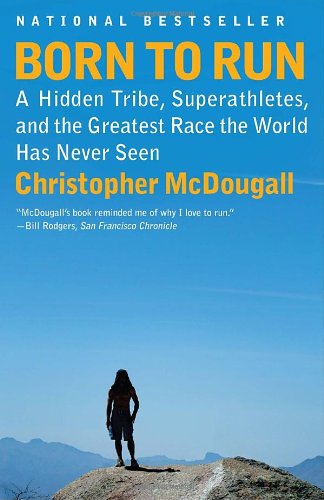
    The book was entitled, Born To Run – A Hidden Tribe, Superathletes, and the Greatest Race the World Has Never Seen.

    [amazon asin=0307279189&template=iframe image][amazon asin=B0098IGRZC&template=iframe image][amazon asin=B006TXCMF8&template=iframe image][amazon asin=B008FPTW3S&template=iframe image]

    Now a good book is a good book. Whether it’s about cooking or boxing or The Civil War or taxidermy — well, maybe taxidermy might be a stretch — and this is a good book.

    Born to Run starts out with this fitness writer trying to determine why he can only run a few miles without experiencing pain, but ultra-runners can travel fifty, even a hundred miles with no pain at all. The book bounces around and is part essay, part term paper and part narrative, but by the time you get to the halfway point — to this secret race in The Copper Canyon in Mexico — it is a serious page turner.

    Born To Run focuses on the Tarahumara Indians of Mexico, who run hundreds of miles in homemade sandals without rest or injury. It describes the ultra-running sport, the cast of characters and the science behind it, but ends in a secret race where America’s top ultra-runners travel to the Copper Canyons for a 50 mile desert foot race — over the world’s least hospitable terrain — against the tribe.

    The books main point is that human beings are literally born to run — and he delves into the research to support this. He covers the jogging movement and takes a few swings at Nike — but comes back to one great question.

    When we were kids we were always told to slow down. Stop running. Then as adults we state that we hate running.

    How did that happen?

    Born to Run shows what can happen when running recovers that childlike joy again and is more game than chore.

    A sign of a great book is when it’s over, when you’ve turned the last page or listened to the last CD, you go through a period of separation — after all, the people you have just spent countless hours with and have learned to care about are now gone. Poof.

    And when this happened here, I went rushing online to research the real life characters of the book: Jenn and the Bonehead, Barefoot Ted and Micah True, just so I could extend the experience a little longer. Just to say goodbye.

    And although I rolled my eyes at the lengthy evolution ‘science’ descriptions – which were a little high-handed — I really did enjoy this book. And when I had finished it, many of the things I thought were impossible in my life, I began to rethink.

    Born to Run shows just what us humans can do if there are no limits.

    If you need a lift, encouragement, or inspiration — and what man doesn’t — read this book.

  • REVIEW: Film: Snowpiercer.

    REVIEW: Film: Snowpiercer.

    snowpiercer-poster

    One of the simplest questions we all get asked is one that I have difficulty answering. It’s one of those in the icebreaker category — you know, not a; where are you from? what do you do? where did you go to school? but the personal tastes and interest question of — what’s your favorite film?

    That’s tough. And is absolutely impossible to answer.

    See, when I find a film that I like — one that is so good that I just can’t get it out of my head — I will watch it about — well, ten gazillion times. I’ll just keep watching and watching it, over and over; experiencing each scene from the beginning in one continuous loop. I’ll look up deleted scenes. I’ll delve into the life of the actors. I’ll download the actual script and look at how it was first written compared to how it was shot. And when I have reached the ten gazillion mark — when every last bit of emotion and beauty has been wrung out of it and all that’s left is the husk — I’ll discard it. I’ll never watch it again. Ever.

    When it comes on TV, I’ll flip past it. When it becomes a topic of conversation, I’ll wait for it to pass. Because I’ve taken too much of it I’ve overdosed. It’s over.

    This is the first reason why we’ve not done a film review on 543skills so far. The second reason is that I can be kind of a jerk when it comes to movies — I admit this. But hey, when you give someone 100 million dollars to do something — which is the average price tag right now to make a feature film — you expect a quality product. A better than quality product. With 100 million dollars you should be able to make something unforgettable, that changes lives. Every time.

    But there are very, very few absolutely amazing films made. And the even worse part is that we seem to be okay with that.

    Which brings us to Snowpiercer.

    Now, I first heard of the film when Tim Ferriss recommended it (and I am allowing a few seconds to build up so you think that Tim and I discussed the movie during a racquetball game; that this is the type of movers and shakers I associate with, but actually I read it in his newsletter.) In fact, Tim Ferriss raved about the film. So did a lot of people and Rotten Tomatoes gave it a 95%. So, I watched it.

    Now the premise of Snowpiercer is this. The world tries to stop Global Warming by introducing this super chemical into the environment. This chemical is a really bad idea and the entire planet freezes over but not before a genius named Wilford builds a mega train where the last of humanity can be saved and travel around the world at breakneck speeds while the frozen planet lies around them.

    There are two classes in this train. There is the first class who spread out among the majority of cars and live a life of luxury and extravagance. And then there are the lower class who in the back and are kept in a crowded windowless car and fed only protein blocks that look like black Jello. But one brave soul from the back named Curtis, has finally had enough of this poor treatment and organizes a rebellion to get his lower class brethren further up in the train where all the food and good stuff is kept.

    Now besides the ridiculous plot holes of Snowpiercer — instead of building a train that travels at 90 around the world with no stops and no real purpose to travel, why not take that technology and build a bigger structure that’s stationary — it’s is not a bad film. Not really.

    It’s not a good film. But it’s not a bad one. Actually, I’m not really sure what it is.

    The end of the film doesn’t leave you with any more answers than you had in the beginning. In fact, the answers that you are given are disappointing at best. You don’t really care about the characters or what happens to them and the few, oh my gosh you’ve got to be kidding, plot twists, don’t work.

    What you do have is some visually appealing scenes and some fairly good acting — but with a flat script it really doesn’t matter.

    Snowpiercer is worth seeing for the imagery. I guess. But that would be it. There are too many plot speed bumps to count and the end of the ride is — well, just plain silly.

    But hey, Tim Ferris said it’s good.

  • REVIEW: Audio Book. Johnny Cash: The Life

    REVIEW: Audio Book. Johnny Cash: The Life


    johnny_cash_the_life2-540x340


    Audio Book:

    Johnny Cash: The Life

    Written by: Robert Hilburn

    Narrated by: Charles Pittard


    As I’ve mentioned, I spend a great deal of time in the car — a great deal. In fact, if I sat down and calculated it, I’d say that I average about 2,000 miles a week.

    My routine is simple. In the morning I get in the car. I drive. I have meetings during the day and then I drive home. That’s my life. And it’s not unusual for an average day to contain six or eight hours behind the wheel — or more.

    And when I get in the car — after I return all the phone calls, send the audio emails and check on my mom at least once — what’s left is pure windshield time. And the majority of that windshield time is spent listening to audio books.

    At any given time if you were to look in my car you would see three different audio books. One of them will most likely not have passed my five-minutes-test and I’ll put it in the backseat and not finish it. The second will most likely be tolerable and the third will be good to possibly great. Depending.

    I just finished  an audio book that was the biography of Johnny Cash. It wasn’t great.

    Now, the first thing to know is that I knew very little about Johnny Cash before this book. I could name a handful of songs but I never really followed him and didn’t see any of the films made about him. So I had a clean slate going in and picked up the book to learn more about the singer.

    As the book opens, we learn about Johnny’s  — then called JR’s — childhood and this beginning had a great few chapters. We looked at the artist’s very early life of growing up in the hills of Arkansas and we saw his family through their struggles and hardships. I enjoyed this part — even though the narration was probably one of the worse I’ve ever heard.

    See, audio books are an art form and there is so much talent in these narrators because you don’t have sound effects or music, you have one person reading the book with all the different voices, characters and accents. And a truly good narrator will allow you to forget that there is only one person reading this book and you would swear that there are a dozen or more.

    This is not the case with this book.

    The narrator — a gentlemen named Charles Pittard — simply reads the book. And he reads the book the same way that you would read a shopping list or instruction on putting together a chair. Drole. Dry. And flat. This is probably the second worse reading I’ve ever heard, next to Juila Roberts when she narrated The Nanny Diaries — it was a long drive and the book was loaned, not my normal choice of books — and I couldn’t get past the first few minutes. She just read it like she had one eye on the clock.

    Now you could get around the narration except that most of the book is written in this flat manner as well. In fact, a few chapters in the book stops being a book and becomes more of a report. A list of all the songs Johnny Cash wrote, recorded and all the places he went. I didn’t feel like I was there, I felt like I was sitting in a Moose Halls listening to  someone’s presentation on the life of Johnny Cash; while watching slides and getting to see the speakers collection of  albums and concert tickets.

    Not a good audio book. Don’t bother.

  • REVIEW: Book: Hughes. By Richard Hack.

    REVIEW: Book: Hughes. By Richard Hack.

    Hughes

    There are certain names in American history that we have a vague knowledge of. Howard Hughes is one of those names. We know that Howard Hughes was the wealthiest man in the country. We know he was a test pilot, a record holding aviator and we know he was a famous recluse in his later years. And after that — the details become foggy.

    In his book Hughes: The Private Diaries, Memos and Letters; The Definitive Biography of the First American Billionaire, author Richard Hack has been able to juggle a few difficult objectives. He has supplied a never ending minutia of detail about the man — from specifics of Hughes’ father in the late 1800’s through day to day accounts of the man himself. But do it in such a way where even the smallest facet is both fascinating and lures the reader deeper down the path.

    Howard Hughes was born in 1905. When his overprotective mother died in 1922 and his workaholic father two years later, Hughes became heir to the Hughes Tool Company fortune — then valued at half a million dollars — at nineteen years of age. At that time his goals were to be the world’s greatest golfer, the world’s greatest pilot and the world’s greatest movie-maker.

    At nineteen, Hughes decides that a serious, young businessman needs a wife so he chooses Ella Rice, a pretty, socially prominent young lady in Houston. Though already in love with someone else, Ella was persuaded by her mother that Howard was a better catch. Soon Hughes was so involved in his golf and movie making endeavors — as well as other women — that he had little time or interest left for Ella or any of his extended family.

    In Hollywood, Hughes produces and directs several films including; Two Arabian Nights that wins an Oscar as well as the infamous Hell’s Angels — considered the best special effects film of the decade. Hughes goes on to make many other profitable films and in 1948 he buys RKO Studios which establishes him as a major film maker.

    Hughes romantic conquests included Lana Turner, Ginger Rogers, Ava Gardner, Ida Lupino, Olivia de Havilland, Katherine Hepburn, Terry Moore, Yvonne DeCarlo, Kathryn Grayson, Bette Davis, Rita Hayworth, Linda Darnell, Billie Dove, and so many more. In fact it wasn’t uncommon for Hughes to actually be engaged to two even three women at once.

    In 1938, prompted by the success of Charles Lindbergh, Hughes set a new record for an around-the-world flight. This won the man a congressional medal, the Harmon Trophy and the Collier Trophy for Aviation. He was also honored with a ticker-tape parade down Broadway in New York City. Hughes — now convinced that air travel had a future —  acquired TWA Airlines.

    But it’s when Hughes develops a case of syphilis, that his already high fear of germs begins to percolate.

    One of the most fascinating aspects of the book is that in his last twenty years of life; when he was a complete recluse; naked in blacked-out rooms devoting days at a time to screening B-movies, dictating long memos to his staff — important memos such as a 22 page procedure on how to open a can of fruit for him — and going through a dozen boxes of Kleenex a day — that his empire actually grew the most. In fact, Hughes orchestrated the purchase of dozens of Las Vegas properties all while being naked on a recliner and never seeing another human being. In fact, his long term aid, Robert Maheu, who had daily — sometimes hourly — contact with the man and managed all of his interests, never even met Howard Hughes in person.

    In the last few decades of life, Howard Hughes liberally injected codeine, his hair and fingernails grew to grotesque lengths, he kept urine in mason jars and his body was covered with bed sores since he would spend entire days at a time in a recliner in the dark.

    By the end of the book you will know Howard Hughes well. You may not like him — because there isn’t a lot to like about the man — but you will know him. And you’ll be thankful to Richard Hack for the introduction.

  • REVIEW: Trivia Crack

    REVIEW: Trivia Crack

    Trivia-Crack-1

    First of all, I have no knowledge of what is cool and what is trendy. It’s important to establish that. In fact, I’m not really sure what a current craze would even look like if I stumbled across it. I don’t have my finger on the pulse of the viral or progressive and I am not aware of what is cutting edge. Actually, the only way I would even have any involvement on trend spotting is that when something is pretty much played out, when it’s already becoming un-cool, that exactly when I’ll first hear about it — Marketing experts call this The Everett Point and they track it on progression and sales curves. It’s also a good way to know when to dump stock.

    But one of the advantages of living with teenaged sons is that if you pay attention, if you look around, you can actually have a front row seat to the relatively new — if only by osmosis but that still counts. And this is one of those times.

    So here it is.

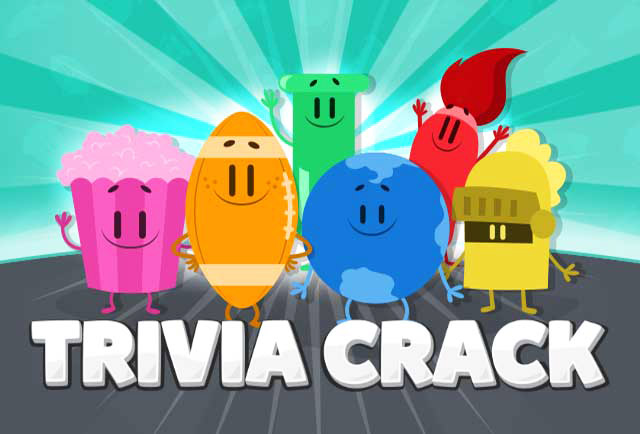
    There is an app called Trivia Crack, that — at the time of this writing — is officially the single most popular app in the country — and we are following Latin America where it is even more widely popular.

    How it works is, you load this app on your phone and then you play against your friends on general trivia questions— you can choose random opponents as well but that takes out the fun of texting those you are playing against and taunting them. You spin the wheel which determines what category question you need to answer; art, science, history, geography, entertainment or sports. You are asked a question and you have a time limit — which is several seconds shy of how long it would take you to Google it. If you answer correctly, then you get another question and another and your opponent has to wait their turn until you get an answer wrong; sitting and watching the screen, hoping you’ll lose so they can get back in the game and save their dignity.

    You need to collect the characters that correspond to each one of the categories that are determined by the wheel and you can steal characters from your person your playing if you challenge them. There are Power-Ups that will help you along with ways to eliminate options of any of the tough 90,000 questions that are constantly updated.

    Now the game itself is pretty fun but that’s not the interesting part about it.

    By definition, because you are playing a real life person, Trivia Crack falls in the category of a social game; meaning that you are competing with a living, breathing people somewhere else. But that title is somewhat misleading because some of the most  anti-social activities can be done with social games — if you are holed up in a room for a weekend playing an interactive game with someone online, this is not exactly a social activity.

    But Trivia Crack is different. First of all it’s very difficult to play the game alone. Meaning you will most likely need help, advice, direction on at least some of the areas that you’re not familiar with. So if you are playing the game in a room with people — even in a room with complete strangers — you can’t help but call out for help. Quick, what Hockey team won the most championships? And someone will answer you.

    Here’s an example. We were playing the game in our living room the other night;  four different games going with four different people that we knew and all of us helping each other win — and we make the ultimate team; Alex is an encyclopedia of sports knowledge, Debbie has a medical and science background Nick is great with pop culture and I have all the weird stuff. So we’re at home playing as a group.

    Now a friend of ours, who is just one of those games going, was in a car with another group of other friends coming back from a trip. They are all screaming out answers to help Dave; helping him play and we are all at home were helping my wife. And — here comes the best part — while they stopped at a restaurant to eat, Dave shouted out a question to Jeff who was ahead of him and a random person heard it and answered — therefore involving even more people.

    Trivia Crack as far as a game is great, but it does what Angry Birds and Candy Crush could never do. It actually gets real people talking to each other in order to play.

  • The 10 films that guys are supposed to like, but aren’t very good.

    The 10 films that guys are supposed to like, but aren’t very good.

    guy

    There are films. There are guy films — and then there are great guy films and sometimes the term great gets placed on a film and we just end up accepting it. Then, twenty years later, these groups of movies are now considered classics and we’re not really sure how that happened.

    This is the list of films of those films. Movies that we are supposed to like. Ones that every testosterone carrying male should be able to discuss and quote on demand and failure to do so could result in serious infractions applied to ones man card.

    But in actuality, many of these films — these classic guy movies — aren’t very good. In fact some are actually quite bad.

    Now the irony here is that being a bad film shouldn’t matter because we men love bad films — a great bad-film is sometimes better than a great good-film — see, Demolition Man, Time Cop or any of the Earnest movies as example .

    But these, this list,  are movies that are not good or not bad in a good way. but we are told they are great.

    … and they’re not.


    1. Point Break.

    Keanu Reeves and Patrick Swayze. Two guys who are very good at playing —. Well — Keanu Reeves and Patrick Swayze; that’s  pretty much it. In a film about an FBI agent who infiltrates a group of bank robbing surfers. It’s a movie that shows a great deal of  surfing scenes along with guys with long flowing locks of hair. And not much else.


    1. Bullitt

    Bullitt is the 1968 Steve McQueen film that every male car lover is supposed to love because of the Mustang chase scene — I actually had to study that exact scene several decades ago in a film class. But in actuality Bullitt is not a very good film. And it’s not even a fun film to watch and is really kind of boring. But it’s one we are supposed to like and now is old enough that we even seem cultured if we’ve seen it.


    1. Slapshot

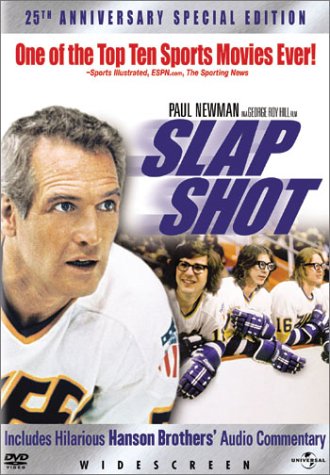
    Slapshot is a 1977 Paul Newman film concerning a small mill town who is about to lay off workers where the town’s hockey team decides to save the day. If you love watching hockey players fight and a lot of toilet humor, Slapshot is for you — but you will loose about three IQ points when you are through — and then you’ll  need to watch Shindlers List about halfway through to even recover.

    The  Grifters

    I really wanted to like The Grifters — a film about traveling con-men, you’re off to a good start — and even saw it at the theatre when it first came out and for the first ten minutes I wasn’t disappointed. Then it just sort of — drifted off and tried to tie in this love story that didn’t work. But the  film now has a cult following and I’m not really sure why. If you feel pressured to watch it, see the first fifteen minutes of it then turn it off and then you can tell everyone what a great movie it is and not be lying.

    1. Days of Thunder

    I guess no one told the male population that Days of Thunder was a marketing stunt — a way to make a quick film on the racing industry to get all those NASCAR fans into movie seats. It’s badly written, quickly produced and has no real heart. But men love this film. And again, it’s now been around long enough that new generations are being spoon fed on what a great film it is.


    5. Matchstick Men

    Another con man movie I wanted to like because I loved the book. But of course, the only thing that was anything like the book was the title. A truly bad attempt and like everything Nicholas Cage has made since The Rock, it sucked.


    1. Blade Runner

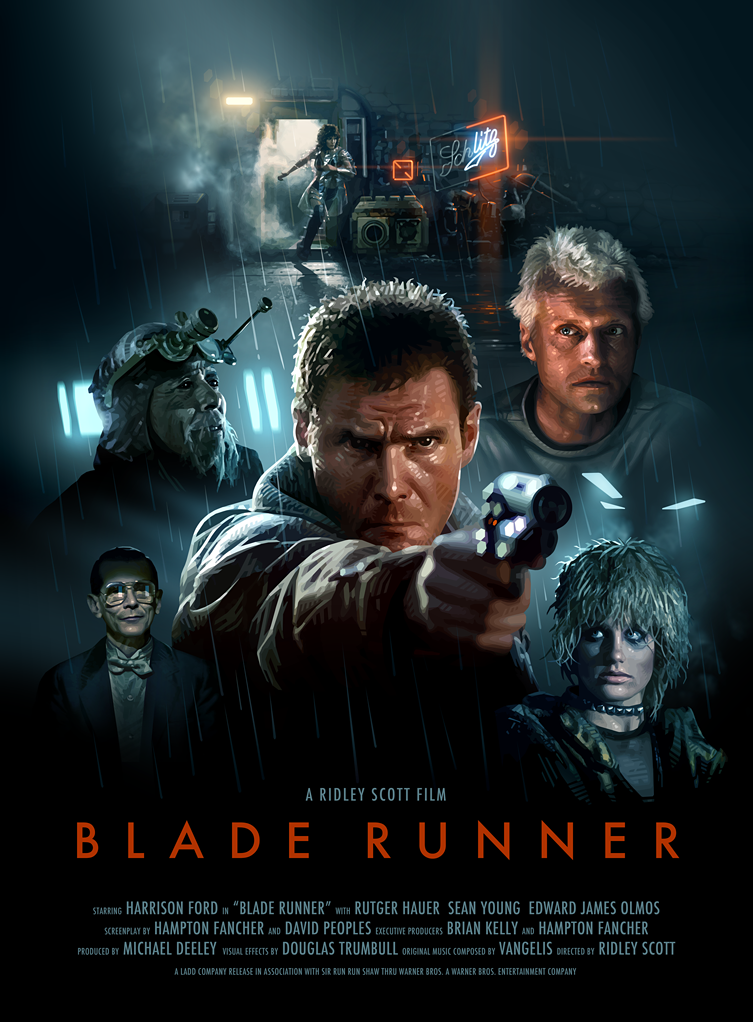
    Every nerd born before 1980 is supposed to love Blade Runner — I actually saw it at the theatre the week it came out in 1982. In fact, I had a Blade Runner poster on my dorm room wall — because that’s what all Sci-fi fans at the time were expected to do. And then later, I realized that I didn’t really like it.


    1. Dances with Wolves

    I’m actually a big fan of all the Kevin Costner films that bombed — Waterworld, The Postman, those are great bad-movies. But the most successful one; Dances with Wolves, is not on that list. It’s a homogenized, preachy story that is a chick flick disguised as a western.

    1. Top Gun

    Want to piss a lot of guys off? Just say you don’t like Top Gun. Go ahead. I dare you.  Well, here goes. I don’t like Top Gun. It’s sterile. It’s forced. And the best acting in it is done by the airplanes. And worse yet, when Goose dies — I really don’t care.


    1. 2001 a Space Odyssey

    Yes, I understand that the monolith is supposed to be a religious symbol. And yes, the bone used by the monkey men to win over the waterhole represents technology. Yes,. But any time a writer or a director answer interviews with —it’s open to interpretation, that’s a cop out. I’ve seen the film several times and I now openly admit that I don’t get it. And I don’t really like it.

  • Austin

    Austin

    pizza

    There are many people in the world that are nice, once you get to know them. Once you peel back a few layers. After you coax them out, develop some trust and gain access to the true individual. But rarer are those souls that are nice — genuinely nice — from the moment you meet them. From the very second you walk into their lives you know you are standing in front of the pure, unguarded, essence of the individual. They have no agendas or desires to impress. These are just balanced and happy and the pleasure of life just spills out. They can’t help it. They are content which makes them nice.

    Al Santillo is one of those truly nice guys. Al owns Santillo’s Brick Oven Pizza, which is located in a small house tucked between a church and an apartment building in Elizabeth, New Jersey — in fact, when I was first trying to find it, I walked in the front door and walked back out; this could not be the place with three pages of raving Yelp reviews for it. It was so small, so —- so, not what I was expecting. I walked in, saw Al, his back to me writing something down at a cluttered table, I didn’t see any lines of people clambering for what I was told was the best pizza in New Jersey, I didn’t see any banners, posters or signs telling the customer how amazing their pie was. So I left.

    When I got to my car I went back to the Yelp search — because this pizza was for Austin and it had to be great. This was going to be his last dinner with us before he moved and I wanted it to be — well, amazing. Austin had had now had his first taste of good pizza a few weeks before this when we had taken him to New York City for his first time, his going away present. So this had to rival that pizza and since I had a meeting in New Jersey— which is close to New York, the capital of Pizza — this is where I would find it. Hopefully.

    Now, we had known Austin was leaving us for a while, several months actually, but denial is a wonderfully comforting thing when you call upon it. And we did. But the day rudely came anyway. On Saturday morning, Austin and his family would begin the 1800 miles trek from Delaware to Colorado to begin a new life.

    Austin came into our lives seven years before this. I had walked into the family room one day and there were three warm bodies in there, instead of only the two male dependents that share my last name.

    “This is Austin,” Nick introduced from behind him. Not taking his eyes off the screen or taking his hand off the controller.

    “Hi,” Austin said, while killing Nick’s character in a blaze of digital gunfire.

    And from that time he was a fixture at our house. But it wasn’t until the first time that this shy and quiet kid looked into our refrigerator and screamed out, “We’re out of ice tea.” And Debbie yelled back. “I’ll get some in the morning.” — was he officially part of the family.

    Over the past seven years Austin would go on family trips with us, vacations and most weekends either he was sleeping at our house or Nick was sleeping at his. In fact, Austin and Nick were in my car when I learned our house was on fire and I broke every speed law in Delaware to get to it. And they both took dates together to the prom.

    With all the electronic gizmos available, Nick and Austin will keep in touch. They’ll face time and game together and do a bunch of other technological miracles that I don’t understand. But first, I had to get him pizza.

    After I had conformed with Yelp that I was at the right place, I walked back into Al’s place. He spent the next thirty minutes telling me about the difference between cheese from Romania and cheese from Wisconsin. Without ever meeting me before, he brought me behind the counter to try a pizza type he was experimenting with, he asked me about my family and where I grew up and he showed me how his huge brick oven works.

    Al is a genuinely nice guy.

    Just like Austin.

    And, oh yeah —. Al’s pizza is absolutely amazing.

  • REVIEW: The Anchor Bar, Home of the Original Chicken Wing

    REVIEW: The Anchor Bar, Home of the Original Chicken Wing

    wings

    Dover, Delaware — the smack-dab center of The First State — is a small city of about 40,000 people. It’s the capital of Delaware, the home of the monster mile NASCAR track, and is part of the Delmarva Peninsula — a massive stalactite of land that hangs down between the Delaware Bay and the Atlantic Ocean.

    Now, if you have ever have the chance to visit our fair town, you’ll be able to see all of it pretty quickly — visit the nearby beaches, take pictures of the track, walk through the historical sites. Those are fine and dandy, but what truly makes Dover great are the subtle cultural differences of our city.

    For example, the law that requires a driver to pull over when an ambulance, fire truck, or police car have their sirens and lights on, doesn’t apply here — I mean, the law does apply, but it’s a silly law and no one knows about it. In fact, if you are ever in Dover and do see an emergency response vehicle behind you  — sirens flashing and horn whaling — just do what we do. Bear down and protect your road space — that obnoxious truck can go around you if he’s in such a gosh darn hurry.

    Because in Dover, we have our own way of doing things. For example, we never say goodbye. In fact, we don’t ever end a conversation at all. Let’s say you run into someone you know in a store or on the street. You’ll stop. Say hello. Talk for a while. And then, when the conversation is slowing down — this is the part where you other people say, talk to you soon, or see you later — we just walk away. Then months later, when we run into that person again, we can start the conversation right where we left it.

    And because Dover is a military town, if you are ever at a Little League game or a Caesar Rodney Basketball or Football game, you will experience a reverence during the national anthem like you have never seen. Once the sound of the swoosh of hats being pulled off is over, the silence that will fall will simply hold you.

    But one of the great paradoxes of Dover life involves the food. It’s…well…it’s bad. No that’s a lie, it’s gawd-awful. But this actually turns out to be a good and a bad thing. It’s a bad thing that it’s so terrible. But it’s a good thing because no one knows it.

    We have very few independent restaurants in Dover, and we have every franchise that’s ever been in existence. It’s all we know and it’s all we compare to. Is the pesto grilled chicken at Olive Garden better than the pesto grilled chicken at Applebee’s? Hmmm?

    [amazon asin=B006UU07MA&template=iframe image][amazon asin=B005Z492PU&template=iframe image][amazon asin=B0000DDU2S&template=iframe image][amazon asin=B000V1H0D8&template=iframe image]

    Which brings us to the chicken wing. Many people believe that a chicken wing — simply a wing, deep fried and covered with sauce — is a chicken wing. Many people believe that these are easy to make and hard to screw up. They’re all the same, right? Worse yet, people even believe that wings at Buffalo Wild Wings, Hooters, or TGI Fridays are real wings.

    Well, I’m here to tell you that these people are wrong — and probably communists.

    If you have never been to a little independent bar or restaurant — and this is where the magic happens, a place where the kitchen can be creative and not follow a franchise recipe — and you have never tasted a great chicken wing then it’s easy to think this. Sure, there is some comfort in not knowing. But, you have a hole in your life that needs to be filled.

    When I was twelve years old I got glasses for the first times. I was sitting in my mother’s car after the doctor’s appointment and I put the glasses on. I can still tell you — forty years later — how my world went from fuzzy and foggy to crisp and in Technicolor in seconds. Pow. But before this moment, I never knew the world was like this. I didn’t know what I was missing. It’s the same with a great chicken wing. Your world will never be the same.

    The history of the chicken wing began on a Friday night in 1964 in a place called The Anchor Bar in Buffalo, NY. Now the story is a little unclear of whether Dominic Bellissimo — the son of the owner, Teressa Bellissimo — was returning from college that night or was actually working the bar. But what is known is that when Dominic’s friends got there, they were all very hungry. So Dominic asked his mother to cook them something. Teressa went into the kitchen and found some chicken wings that were there to make stock. She deep fried them, covered them with a hot sauce mixture, and served them. They were a hit, and Buffalo chicken wings were born. (No, the name has nothing to do with the endangered, horned animal of the great plains.)

    And now, fifty years later, you can have Buffalo wing potato chips and Buffalo wing pizza.

    So the question is, does the birthplace of the chicken wing make the best chicken wing?

    The answer is yes. Yes it does.

    And no.

    Being brought up in upstate New York I have had some great chicken wings in my life, made by some great chicken wing masters. And I will tell you that the wings at The Anchor Bar — the original site on Main Street in Buffalo — are absolutely the best I’ve ever had. Bar none.

    They are crispy, but moist. Flavorful and rich. And the sauce…all I can say is wow.

    Yes, The Anchor Bar makes the best wing.

    But, big stipulation here, only at their original location.

    Recently, The Anchor Bar has expanded and now has several locations; at the Buffalo Airport and other locales across Western New York. I’ve eaten at a few of them and the magic is just not there.

    Now if you travel to Buffalo, you will hear some smack about a place called Duff’s and there is a pretty heated rivalry between Duff’s and The Anchor Bar for the best Buffalo chicken wing. So, I’ve eaten at both and my vote goes to The Anchor Bar, hands down. The sauce at Duff’s is hotter — and I always order my wings suicide-style — but making a sauce hot is not a difficult trick since there are so many pepper extracts on the market.

    So the best chicken wing in the country — and possibly the world — goes to The Anchor Bar.

  • REVIEW: Namco Plug-Play TV Games

    REVIEW: Namco Plug-Play TV Games

    namco

    I am not a gamer.

    I don’t own an X-Box or a PlayStation — even though as a father I’ve paid for several of these over the years — and I have probably logged in less than five lifetime hours on Halo or Call of Duty when my kids have asked me to play — I spend most of my time in corners trying to get my character to turn around and sober up.

    But having been a college student in the early 1980’s, I have spent more than my fair share of hours in dark arcades; dumping quarter after quarter of my Guaranteed Student Loan into various Tron, Xevious and Pitfall games — swearing that this will be the last one and then I’d do my laundry and try to locate where the library.

    I have good memories of these days— usually with a group of people thinking we would be eighteen forever and the world was ours — if we ever got out of the arcade and did any real work. Which we would, right after this game.

    One of my favorite arcade games was one called Dig Dug. I’m not really sure why I liked Dig Dug so much or what it really was about; as the object was to guide a man in a space suit underground to either avoid orange creatures with scuba masks and fire-breathing dragons, or destroy them with a bicycle pump — hey, I’m not saying it’s literature I’m just saying it was fun. So when my kids got one of the Plug-N-Play games as a gift a several years ago — have you ever seen these? They are not a counsel but a square box with a few buttons and a joystick that you just plug into the TV and go — I was excited to see that it had Dig Dug on it.

    We played this game for hours and for the first — and only time — I was the Big Kahuna of video games in our house — smoking them at every turn.

    [amazon asin=B001TNYPQM&template=iframe image][amazon asin=B00EQNP8F4&template=iframe image][amazon asin=B00K59HKIQ&template=iframe image][amazon asin=B00I94IPTW&template=iframe image]

    Then the game broke and the party was over and I went back to my status as game outsider.

    About a month ago I told my wife that I wanted to see if we could find another one of these Plug-N-Play games — for the comradery with my kids of course, I have better things to do — and she found one on e-bay and bought it.

    The unit she bought was by Namco and was called Plug-Play TV Games.

    Now, the great thing about these classic arcade games is that they follow a specific pattern. If you memorize the pattern on Level 1 and react the same way every time, the game will react the same way as well. Every time. So once you mastered that level you would move to level 2 and keep going.

    This game had none of that — which I know exists because the other unit we had reacted as the old game did. Here, each level was random, responding differently every time which meant there was no way to build up skill and move up levels. It was simple luck that may, or may not, allow you to survive. There was absolutely no way to develop any skill in the game.

    Also, the timing was delayed so if you tried to lure an orange guy or a dragon into a corner as you could on the arcade game, this game would simply eat you. But the absolute worse thing about it was in the design of the box itself. The RESET button is on the upper left of the box and is not recessed. So when you gripped the box tightly to fire or move, you often hit the reset button with your hand — usually right in the middle of a game — and the screen would go black and start over.

    I know, I know. It’s just a toy. But there are some of these Plug-N-Play games that react like the old ones did and are pretty fun to play. Not just so you can relive the glory days but because you can get to levels that your wallet wouldn’t allow in the 1980’s — you can go back and remove the limits our finances dictated back then. And we can finally have closure.

    Unfortunately this game is not one of them.