Category: Style and Beauty

  • The bomb shelter diet

    The bomb shelter diet

    bomb

    Klaus Fuchs was extremely smart.

    He was born in 1911, in Rüsselsheim, Germany, and from a very young age demonstrated a clear gift in mathematics and the sciences; breezing through his primary education and then being accepted into The University of Leipzig.

    Klaus studied mathematics and physics at the University, and this is where he first became involved in student politics; joining both the Social Democratic Party of Germany, as well as the Reichsbanner Schwarz-Rot-Gold, the Communist Party’s paramilitary arm.

    Now, while Klaus was still in school, on February, 27, 1933, a Berlin fire station received an alarm for the German Parliament. They quickly responded and found that the entire Chamber of Deputies was engulfed in flames — and because of the size of the fire as well as its political location, arson was suspected. So fireman fought the fire, while the police surrounded the complex to look for evidence.

    What they found, was Marinus van der Lubbe, a young Dutch Communist, inside one of the buildings. Lubbe was arrested and confessed to being involved in the arson. Soon three other men were arrested — Georgi Dimitrov, Blagoi Popov and Vasil Tanev — all Communist Party members and all confessed to the crime. They were tried and later executed.

    The event became known as, The Reichstag Fire, and here is where things really get interesting. Only a month before this, a man named Adolf Hitler had been sworn in as Chancellor of Germany. Hitler was outraged at this attack, and saw the fire as solid evidence that communists were plotting against the German government. Hitler urged President Paul von Hindenburg to pass an emergency decree that would suspend all civil liberties in order to counter this ruthless hostility. He did. And when this occurred — Nazi Germany was born. Almost overnight, the Nazi Party went from a political entity, to a dictatorship. With Adolf Hitler at the wheel.

    So the question is, did Hitler orchestrate The Reichstag Fire?

    Well historians have been trying to prove this for decades without much luck. It’s very possible that he did. And it’s also possible that he only took advantage of this opportunistic moment — to use fear as a vehicle to seize control of the government. But either way, Germany quickly become a Nazi controlled country, as well as one where being a card carrying Communist, could be extremely dangerous. So Klaus Fuchs went into hiding until he could get out of the country later that year.

    In September of 1933, Fuchs fled to England where he worked as a physics research assistant at the University of Bristol, and in 1937 he received his Ph.D. in physics. After this, he worked at the University of Edinburgh, where he earned a second Ph.D. in Science.

    Then World War II broke out.

    After spending some time in Canada, Fuchs returned to England where he began working on The Tube Alloys Project — England’s covert atomic bomb group. And this is where Fuchs began his career as a spy. He immediately began passing detailed information on the project, directly to The Soviet Union.

    In 1943 Fuchs went to New York City, to work on the Manhattan Project and then in  1944 to the Los Alamos Laboratory — where he developed the calculations relating to the first nuclear weapons as well as early models of the hydrogen bomb.

    Then came Hiroshima and Nagasaki and the end of the war. Klaus returned to the UK and worked at the Atomic Energy Research Establishment as the head of the Theoretical Physics Division.

    Five years later, on January 31, 1950, President Harry Truman announced his decision to develop The Superbomb. A hydrogen weapon that would be one hundred times more powerful than the atomic bombs dropped on Hiroshima and Nagasaki — with Klaus Fuchs having a front row seat to the project. And on November 1, 1952, the United States successfully detonated Mike, the world’s first hydrogen bomb. This ten megaton thermonuclear device, was detonated the Pacific Marshall Islands — it vaporized the entire island and left a mile long crater behind.

    Fuchs’ luck ran out later that year.

    While passing some sensitive information to a Soviet contact, American intelligence followed and arrested him. He was questioned and confessed; which led to his trial and eventually lead to him being sentenced to fourteen years in prison. But the damage had already been done — the Soviet Union now knew everything we knew, about the hydrogen bomb.

    On November 22, 1955, the Soviet Union detonated its first hydrogen bomb; based on the same principle of radiation implosion as Mike —- with the same results.

    Which meant that both superpowers were now in possession of what had been called — the hell bomb.

    Two of the most powerful nations in the world, both had a weapon that could kill millions on both sides. And they didn’t like each other very much.

    The US announced that it would use massive retaliation to any Communist aggression, and for the first time in history, the world lived under the threat of thermonuclear war.

    Movies, films, books, television, newspapers — all echoed the fear of nuclear obliteration. And on October 6, 1961, President John F. Kennedy addresses the American people, and asked them to — build bomb shelters to protect themselves and their families against nuclear fallout.

    The President of the United States — one of the most powerful men in the world — asked his people to — dig a hole and get ready to hide in it.

    It wasn’t now a question of — if it would happen — it was now — when would it happen.

    Bomb shelters began to pop up everywhere. These ranged from a corner of the basement, built up with sandbags and food and water, to elaborate underground rooms with ventilation and water purification systems.

    Civil Defense agencies provided canned drinking water and water packaged in milk cartons, to citizens. Fallout drills were exercised in schools and public buildings. We were preparing.

    We had a plan and we knew where to hide and wait it out. And we had a stockpile of the basics — canned goods, dried goods, food stuffs, water. We just wanted to survive. That’s all. Nothing fancy. We just wanted to — live.

    And we waited.

    And we watched.

    And the bombs — never came.

    And that was good.

    And the bomb shelters remained unused. And then they became root sellers and playhouses and storage. And that was good too.

    But along with all that good —- came one bad thing —.


    WHAT IS A BOMB SHELTER?


    A bomb shelter is a safety net. It’s a place where the basics can be taken care of. It’s the fallback plan. The retreat point. It’s a ready area  where you and the people you care about, can go to get the basics taken care of and to be safe.

    Talk of bomb shelters today are rare, unless you are referring to the trend of Doomsday Prepping or simply Prepping.

    Prepping is similar to the movement of bomb shelters in the 1950’s and 1960’s, in that it is the preparing for a particular disaster to occur — a governmental collapse, massive chemical warfare, an electromagnetic pulse that will wipe out all electronics — but there are two main differences between preppers and those who built bomb shelters during the cold war.

    The first is, that modern prepping is more individualistic and less community based. You see evidence of this in that during the cold war, the list of items to include in your shelter contained many things, but weapons were never one of them. With modern preppers, weapons and ammunition are high on the list — in fact, many preppers have small arsenals set aside to protect their stockpiles.

    And the second difference is, that the modern day preppers are almost hoping that the disasters they are preparing for will occur. They are highly invested in them. So when the government does collapse, when modern currency no longer has value, when the world is left unprotected and vulnerable, then we will be on top of the food chain — simply because we will have the most food, water and guns.

    So bad things can’t happen?

    Oh absolutely they can — and probably will. But you are much more likely to lose your job, than you are of having your home attacked by a biological weapon.

    You are much more likely to be in a car accident, be hurt at work, or have a major health issue, than you are of experiencing a governmental collapse.

    And you are much more likely to go through a career downsizing or industrial shift where your current skill set is worth far less than it once was, than you are of experiencing a nuclear attack.

    But all of these things are life altering — a layoff is not as sexy as an asteroid, but it can still do some damage if you’re not ready for it.

    It was good that cold war didn’t escalate to something far worse. But the casualty of that time period is that sense of preparation didn’t migrate forward. That sense of simplicity, of basic need, didn’t trickle down through the decades.


    MISSIONARIES


    Many years ago, a missionary couple from Africa was traveling through my hometown and was going to speak at our church. While they were there, my parents had them stay with them and while giving them a quick tour of the area, my mother stopped at the small grocery store to pick a few things up. In one of the aisles, the man just stopped talking. He froze.

    “What —?” he asked, pointing at all the colored jars. “Is this?”

    My mother looked to where he was pointing and answered. “Jelly,” she said. “And jams.”

    He stood there. Unable to take his eyes off all the different flavors, styles and sizes of jellies and jams.

    “Why,” he asked. “Would anyone need — twelve flavors of jelly?”

    And he wasn’t mocking her, he wasn’t judging her. He was only asking a question — to something that he couldn’t understand.

    Why would something as luxurious as jelly, something as rare as jam —- not a necessity but a true delicacy — why would you care, what flavor it was?

    But we do. We do care what flavor it is. And we care how much if it we have. And we care what brand it is. And what it looks like and how we look holding it.

    In Africa — food is survival.

    In Europe — food is social.

    In the US, food — has become something so much more.


    FOOD IRONIES


    • 32% of all homeless people, are obese. (Boston Health Care Study, 2008).


    • In a 2012 study, 42% of the time that we eat, was done because we are — afraid of being hungry later


    • 27% of all the food we buy, we end up throwing away — 160 Billion pounds of food each year in the US alone. And still, 75% of us are overweight and 36% of us are obese.


    • The average American spends three hours a month, staring into a refrigerator; trying to determine if he is hungry or not. And during peak times, we average fifteen to twenty minutes wait time to get into a restaurant. Yet — ‘not having enough time’ is listed as the key issue for most Americans.


    • A dinner in France averages two hours, and a dinner in the US averages forty minutes. Yet the obesity level in the US is twice of that in France.


    • A 2011 University of Michigan study asked, how long could a person live without food? The most common belief was — 37 hours. (With water a person can live three weeks or more without food).


    • The cost of eating one (1) lunch out, is equivalent to the cost of six (6) packed lunches from home. Yet the most common reason listed for people that don’t bring lunch to work is,I don’t want to look poor.


    • A Cliff energy bar has 280 calories. A Snickers candy bar has 215.


    • 23% of all high income homes, eat at a restaurant once a day. 78% of all low income homes eat at a restaurant once a day.


    • The average food markup at a restaurant is 300% — for a meal priced at twenty dollars or less. The average food markup for fast food is 400% — for a meal priced at six dollars or less.


    • We are seven times as likely to eat at a restaurant, then we are of inviting someone to our home for a meal, or to going to someone’s home for one.


     THE BOMB SHELTER DIET

    A bomb shelter is safety. It is a vessel that contains the basic needs — food, shelter, water, medical supplies.

    The food in a bomb shelter will have several things in common.


    • It will be able to be stored for a long time — rice, pasta, oats, dried beans, can all be stored for thirty years or more.


    • It will require no refrigeration.


    • It will be able to be cooked in a creative and unique way.


    • Each meal will cost pennies.


    • It will contain little chemicals and preservatives since it will contain the basic food groups.


    STEP ONE: The Bombs fall


    The alarms sound. The bombs are coming. This is it.

    When crisis occurs — when something bad happens — we react. We get the people we care about to safety and we get out of danger. At that point we are focused on survival and protection and we will allow nothing to get in our way.

    Think of a time when a crisis unexpectedly occurred to you — the sudden death of someone close to you, a fire, a car accident, a layoff; any catastrophe that happened s quickly and without warning. When this happens — in the heat of the battle — were you thinking about food?

    You could be starving only a minute before the truck veers into your lane — thinking you can barely wait until you get to the drive thru — and then wham. Six hours later you remember that you haven’t eaten.

    What happens when you realize that you haven’t eaten? You are suddenly hungry again. Starving.

    How many times do you see photos of people outside of their burning building with a cheeseburger in their hands? Or being treated by paramedics as they grab the last of their fries? Never. Because at that point, food is not important. At all.


    • Make a list of ten (10) things you are worried about, trying to get to, concerned with or trying to achieve. These can be work goals, financial worries, family situations, or aspirations. When you have this list, keep it close to you; on your phone, in your bag — so you can get to it quickly, review, edit and add to it.


    • When between meal hunger hits, take thirty minutes — this will seem like a lot at first, but it will fly by later — and work only on this list. Make phone calls, contact whoever you need to, create options, but for thirty minutes you are only focusing on these bombs; these goals, these little issues that could become large, or these large issues that you have been avoiding.


    • Don’t set a timer — because you want to keep this flexible — and allow your focus to shift to what is truly important. But don’t stop until you have done at least one thing, one action, towards everything on that list.


    •  A few things are going to happen here. First, you are forcing yourself to see what is important, as well as what isn’t — getting food quickly into your mouth. The second is that you are reducing your appetite — which gives you freedom, which takes away the anxiety, which diffuses the food bomb.


    Now this goes directly against what many nutrition experts recommend — suggesting five or more little meals a day as opposed to three larger ones. But we’re not focused on nutrition, we are looking at why we do things. And the majority of time we overeat, we do it out of reflex or boredom.

    Sure there is the Thanksgiving dinner that we push ourselves back from the table and vow to never, ever eat again. But more often there are the dozens of times we finish an entire bag of potato chips in the car and not only don’t remember eating it, but are still hungry.

    We have made food important in our lives. We have made it more important than our families, than our homes, than our careers and then our goals. We need to analyze things every now and then, so we can prioritize.


    STEP TWO: Protein pack


    In a bomb shelter you will see a lot of rice, grains and pasta. That’s true. These are inexpensive, easy to store and last forever. But you will also see plenty of dried beans,   canned tuna and Salmon — because you need the protein. The starches are largely there to stretch out the meal — to make it last and to fill you up.

    Sugars and starches are cheap — that’s why they are in everything. These are the foods that stimulate insulin, which sends the signal to store fat in the body. The more starches and sugars you take in, the more fat that gets produced. And when insulin levels goes down — when we take in less sugars and starches — then more fat gets burned than is stored.

    The irony here is, sugars and starches make you hungry and proteins make you full. So you can actually eat less protein and feel better.

    We have bought into the fact that we need to stretch meals — to add in the majority of pasta, rice or grains to make it last. We feel like we are spending too much money if at least half of the meal isn’t a starch.

    So reverse the trend. Instead of the majority of the meal being starches or rice, make the majority of them the beans, eggs, fish or chicken. Eat more protein than you eat anything else.


    STEP THREE: Bomb shelters are for many


    The majority of time that we eat — we eat alone. Even if we’re in a separate room in a house full of people, we are still eating alone. And eating should always be a communal event.

    Add to that that we eat less — when we eat with others. European meals last for hours, with the majority of this time is spent laughing, visiting, talking and having fun. The smallest part is actually the eating part.

    So don’t eat alone. And I mean — ever.

    That may seem crazy, but think about it.

    If food goes back to being a communal event, something we do with others, then a major shift occurs. Instead of saying — what do I want to eat? We begin saying — who do I want to eat with?

    And remember, a meal is simply food shared with others. It doesn’t have to be a five course meal on Waterford china, it can be a few tuna sandwiches on paper plates.

    Take two weeks and vow to eat every single meal with someone else — and this includes eating in front of a TV alone, in your car alone, or picking out of a refrigerator alone.

    If you can’t find someone to share a meal with — then don’t eat until you do.


    STEP FOUR: Stock the bomb shelter


    When the bombs of life do fall — health issues, layoffs, downsizing, family crisis — having a stockpile of basic foods takes a financial and time burden off of you. For less than a hundred dollars, you can have a several months’ supply of dry goods stored and ready.

    The basics would include:

    • Dried beans — lots and lots of them. These are extremely inexpensive, easy to make and loaded with protein.


    • Canned tuna


    • Canned salmon


    • Canned chicken


    • Pasta


    • Rice


    • Cornmeal


    • Flour


    • Canned vegetables


    • Canned fruit


    Stock these things and leave them. Use them when the end of the month rolls around and you’re creeping up on your budget, or when the bombs fall.


    AND REMEMBER …


    A bomb shelter is a plan. This plan can take any form; a room, a group of people or an idea. But it’s a plan to give you freedom and allow you to think while the basics are taken care of.

    Food is not our bomb shelter.

    Food is just one of the many things we put in it.

  • How to Play the Harmonica

    How to Play the Harmonica

    miller

    The harmonica — also known as the mouth organ or the blues harp — is a great little instrument. In fact, the harmonica is the great equalizer of all musical instruments because you don’t need to read music to play one — you don’t even need to have any true musical ability. It doesn’t take years of dedication to master the harmonica — actually, you can bang out a few tunes in just twenty minutes or so and unlike the hundreds or thousand of dollars that many musical instruments cost, you can get a decent harmonica for about twenty bucks. And a harmonica does not take up a great deal of space —  I often carry mine in my shirt pocket.

    Also, the harmonica has the distinction of being the only musical instrument that I know of that you can play one handed while driving — I am not confirming or denying that I have ever done this, I’m just saying it can be done.

    And in the category of harmonica-trivia, though I have no proof, it is very possible that a harmonica may have saved my life.

    [amazon asin=B000Q87DAQ&template=iframe image][amazon asin=1908707283&template=iframe image][amazon asin=0793515599&template=iframe image][amazon asin=B000EELFTW&template=iframe image]

    It was about ten years or so — I had a twelve-state sales territory back then — and I was driving through the great state of Texas when I saw a man hitchhiking. Now hitchhikers were rare in my part of New York so I decided to stop and give this traveler a ride — help out a stranger kind of thing — as well as swap a few stories. As I pulled over and the man started running toward me, I realized that I might have made a mistake.

    The guy was real rough — tattoos everywhere— including every knuckle— and several piercings, which really didn’t concern me. But what did send up some warning signals was the panicked expression on his face. The fact that he kept looking nervously behind him and the way his hands were shaking uncontrollably.

    My instincts were screaming by the time he reached the car but before I could think of a safe way to bow out of this arrangement, the man stuck his head in the passenger window and looked at me. Then he looked at the cup holder where my harmonica sat. Then he looked back at me. Then back to the harmonica. Then a moment of silence passed before he spoke.

    “No thanks,” he said. And walked away.

    Just like that.

    A few minutes later I was back on the Texas Route 273.

    Now, I’ve always wondered what that hitchhiker thought when he saw my harmonica — maybe his instincts were screaming as loud about me as mine were — or maybe he had never dealt with the kind of sociopath that would travel with a harmonica in his cup holder. But from that day on I always keep a harmonica in the car and I am proud to say that I have never been murdered. Not even once.

    Coincidence?

    I don’t think so.

    HOW TO PLAY THE HARMONICA

    The harmonica is an instrument that creates different notes when you blow in than it does when you draw out. The key here is not to think of sucking and blowing, but just of breathing. Practice breathing in and out while playing the  harmonica — play a few chords out, then draw back and breathe in.

    Oh Susanna.

    For some reason, the song Oh Susanna, is the great beginner harmonica song. Practice breathing in and out on the harmonica while playing by ear, the song Oh Susanna — just practice on the chords; which is playing several notes at once. This will give you a larger margin of error.

    Single notes.

    Once you have the basics of Oh Susanna, on chords, focus on playing it on single notes. Single notes are played when you move your lips so air is only moving in and out of only one single path of the harmonica, rather than several. This is a little more difficult then playing chords, but it will start to give you muscle memory on where the individual notes are.

    And those are the bare bones on playing the harmonica. Pretty simple, huh? Because the harmonica is one of those rare instruments that can easily be self taught.

    Now, I found this great website that focuses on learning to play the harmonica and it was created by a man named Dave Gage — http://www.davegage.com/tips.html  . So I contacted Dave and he gave me permission to use it here.

    Dave does a great job of not only explaining the basics of playing the harmonica, but he covers purchasing a harmonica, what different types of harmonicas there are out there, and he has actual harmonica lessons. You can use the site to learn just the basics. Or you can treat it as a format for actual harmonica lessons and become quite accomplished quickly — Dave even has a paid section of his site for you gifted harmonica aficionados.

    So pick up a cheap harmonica today. Toss it in your pocket, your backpack, your tackle box or if you are in West Texas, place it in the cup holder of your car.

    You won’t regret it.


  • How to Shuffle Cards

    How to Shuffle Cards

    shutterstock_128283971

    Shuffling cards is the ultimate card player’s bling. In fact, in cards, it’s the equivalent of walking out to a tee box with a great bag of clubs, or stepping up to a podium wearing a great suit; because right then, right at that moment before you take a swing or utter a single word, there is a possibility that you might actually know what you’re doing.

    Right then, the crowd assumes that you do.

    Then you shank the ball in the woods and it’s all over. But before then, while you’re still sizing the ball up, while you’re still clearing your throat in front of an auditorium, they just don’t know.

    [amazon asin=B002JAZ9GY&template=iframe image][amazon asin=B005RBVE84&template=iframe image][amazon asin=B000G8Q15E&template=iframe image][amazon asin=B001GPUSIW&template=iframe image]

    That’s what shuffling is. It’s the right to be at the party. It’s the dues you pay to play cards.

    There are actually a few types of shuffles, which include:

    The Overhand Shuffle – This is the simple split deck and place back in, shuffle. Nothing fancy and gets the job done.

    The Weave Shuffle – This is the same as the overhand, only you remove and place in from the top of the deck as apposed to the side.

    The Hindu Shuffle – This is where you separate the deck, place, long way, end to end, bend the cards and let them weave into one deck.

    And the shuffle shuttle – This is the fancy shuffle, the one you see in all the movies, and with blackjack dealers and anyone trying to show off.

    This is THE shuffle.

    So for here, we’ll focus on the shuffle shuttle.

    Now, shuffling cards is one of those skills that needs a solid visual reference, so here it is. After searching the internet, one of the clearest shuffle shuttle videos is found on the expert village website. This explains it well. It takes its time and you can watch it over and over again.

    http://www.youtube.com/watch?v=uh8iMZY4Nb4

    Good luck.


  • How to choose a watch

    How to choose a watch

    watch

    Before the 1920’s many men swore that they would sooner wear a dress, than to be seen wearing —. A watch. Or, more specifically, a wrist watch.

    Now the standard watch — or what was known as the pocket watch — was an acceptable male accouterment for hundreds of years. In fact, up through the 19th century most men owned a pocket watch and it was very common for a father’s watch to be handed down to his son and keep moving down the family — hey, I have my great-grandfather’s pocket watch.

    But a wrist watch was considered a lady’s watch. It was a decorative piece of jewelry that women wore on their wrists and was actually called a wristlet. It wasn’t until World War I when soldiers strapped their pocket watches to their wrists to synchronize attacks that the wrist watch began to slowly move into male vogue.

    Today, even with clocks on our phones, laptops and i-pods, a watch is still a standard male adornment. And choosing the right watch for you can be a difficult decision. In fact, many men simply choose to purchase a disposable watch; a watch under $30.00 and simply replace it when it dies, rather that choose a watch they can wear for years.

    [amazon asin=B000AR7S3A&template=iframe image][amazon asin=B00068TJ76&template=iframe image][amazon asin=B000820YBU&template=iframe image][amazon asin=B0012IR0U2&template=iframe image]

    HOW TO CHOOSE A WATCH.

    Round crystal.

    With the popular watches you see rectangular, square and other funky crystal shapes. But the reality is a crystal has a chance to break or leak at the corners. No corners and your chance of allowing water in or a seal to crack are reduced. The classic round face is the way to go.

    Budget

    The diamond industry set the standard that a man should spend two months salary on the engagement ring he chooses. This is nuts. And it is only based on what the jewelry folks want you to spend. But the watch industry has a standard that is a little more realistic. Their’s state that a man should spend on a watch ten times what he spends on lunch for a week. So, if you brown bag it, then a $300 watch is about right. If you run through a drive thru every lunch then a $500 watch is about right. If you eat at a Fridays or Olive Garden, then a $700 watch and if you eat at a place with table cloths and a wine list a $1,000 watch is for you.

    TIP. Do your research and find the watch you like and then look for a used watch in that type. Look on e-bay, craigslist, pawn shops or in thrift stores.

    Style

    Your watch signifies who you are. Your watch will convey your style, your mindset and your image. Your watch doesn’t have to cost more than your car, but it does need to be a quality watch. Remember, a watch is an investment. It tells people where you are and where you intend to go. Buying a cheap watch says that you are cheap. Buying an expensive watch says that you are irresponsible. It’s finding the right watch that is the key.

    Remember: choose quality and take your time.

  • How to Get Rid of a Skin Tag

    How to Get Rid of a Skin Tag

    skin tag

    You know those protruding little bits of skin that form from time to time on your body, especially on places where your skin rubs together? Yeah, those are called skin tags — and they suck.

    Unpleasant to look at — and ranging from slightly irritating, to flat out painful — these little buggers are technically known as acrochorda and they have no redeeming qualities whatsoever.

    Millions of Americans develop skin tags every year and they are especially prevalent in middle aged and overweight individuals. And while they don’t post any real health threat, they are aesthetically unpleasant and can be difficult to get rid of without the aid of a doctor.

    Notice I said — can be difficult to get rid of.

    Because while finicky skin tags are annoying — they can be easily removed with some finesse and common sense. Now, you should always see a doctor when you find a skin growth that you are worried about — if benign skin tags have become routine for you, then you are probably an expert on one of them that look different from the others — but otherwise there are some relatively simple options to remove them on your own.

    WHAT NOT TO DO

    Rule number one: don’t force the skin tag off. Everyone knows someone who has cut the tags off with scissors, nail clippers, duct tape, or some other device. And we call these type of people — idiots, (by the way, I was one of them).

    If you try to yank a skin tag off, the first two things to happen will be a lot of blood, followed by a lot of pain. And then you have to deal with all the fact that you are now highly susceptible to infections — eyelids are the worse. Furthermore, cutting a tag off, can creates a totally unnecessary hassle, as many of the most effective ways at removing these are pretty painless.

    HOW TO REMOVE A SKIN TAG

    The String Method

    The string method is the most popular method of removing skin tags. Tools you will need are a thin piece of string — dental floss works well — that is long enough to wrap around the tag completely and snugly. You take the string and tie it around the skin tag in the morning and leave it on all day. The next day, remove the string and tie a new one on. Repeat this for about a week.

    By cutting off blood flow to the tag, it will begin to atrophy and eventually will either fall off, or become so free of sensation that you can pull it off easily. The timing on this could take a little longer than a week sometimes, so don’t rush it. If you’re patient, this is an extremely effective and harmless way to remove the tags.

    Now the down side to this is, that not all skin tags are created equal, and the string method won’t work on every single one of them. Some tags are too small or in such an inconvenient location that it’s difficult to get a string tied around them. Plus, if a tag is located somewhere that frequently comes into contact with skin, clothing, or experiences a lot of movement during the day, the string may fall off.

    But even with those risks, the string method is very effective.

    The Cotton Ball Method

    Like every other part of your body, skin tags are prone to react when exposed to certain irritants. A number of liquid solutions have properties that cause skin tags to either shrink, fall off, or deflate. And while some of these solutions can take a while  — some, up to a month — to completely remove the tag, they do work.

    Apple cider vinegar is a popular choice for this method. While it won’t make you spell like Bleu de Chanel, it contains high levels of acid in it that kills skin, making it a perfect tool for removing skin tags. All you need to do is douse a cotton ball with a couple teaspoons of the stuff and apply the damp area to your skin tag.

    Many dermatologists disagree over the amount of time you should expose your skin to apple cider vinegar. Some suggest applying it only for a couple of minutes each day, while others recommend bandaging the cotton ball to the exposed area and letting it sit overnight. And results very as well — the bandage method has been known to work in a few days, while just leaving it open may take a few weeks.  Either way, be sure to wash the exposed area after removing the cotton ball—you don’t want the odor or sensation to linger.

    A range of other solutions have antibacterial or antifungal properties that make them effective skin tag-slayers. Both lemon and lime juice are high in potent citric acid that decimates skin cells, while tea tree oil — an increasingly popular skin care remedy — has also received high-praise.

    Try out these solutions (or even combining them) and see which ones work for you. And while everyone’s skin is different and your mileage may vary, chances are that some variation of the cotton ball method will work for you.

    AND — unless you want a bunch of red swollen bumps to accompany your skin tags, you should make sure that you aren’t allergic to any solution you apply to your skin.

    The “Freeze it Off” Method

    Ever heard of cryotherapy? No, I’m not talking about freezing your body until a cure for skin tags has been discovered—I’m talking about freezing growths on your skin and killing the tissue beneath them, forcing them off your body.

    Dermatologists commonly use cryotherapy to remove skin tags, sometimes using a freezing agent so potent that they can remove the tag in a matter of minutes. Fortunately, many cryotherapy tools can be purchased cheaply online or over the counter at your local pharmacy, meaning that you don’t have to see a doctor if you want to try this at home.

    Most freezing treatments suggest applying the agent (usually some form of liquid nitrogen) for just a few seconds per day until the layer of skin under the tag is dead, eventually causing it to fall off in about two to three weeks.

    You need to be extremely careful with freezing, because if you get this stuff in your eyes or you accidentally swallow some of it — it does happen — that could be bad. Read the safety instructions that come with the freezing agent you buy; if your skin tags are located somewhere that puts you at risk for bodily harm, don’t try this method.

    The “Wait it Out” Method

    If the skin tag is loosely connected to your body, there’s a good chance that it will fall off naturally or with minimal effort. Many skin tags meet their end in the shower after washing them out with soap, and others became so irritated because of their location—armpits or eyelids —that they just wear off.

    If your tags are located somewhere you scratch a lot, the tag has a high risk of becoming accidentally rubbed or torn: eventually loosening the tag to the point where it comes off on its own. If you can stand the pain — and the blood — that accompanies this, it is a somewhat effortless way to remove it.

    Obviously, this is not the fastest approach to removing tags, so if you’re looking for a quick fix, this isn’t the option for you. Just know that if you’re patient enough, you may not even have to go through the trouble of experimenting with DIY dermatology at all.

  • How to say grace over a meal

    How to say grace over a meal

    shutterstock_218825743There are many words in the English language that have changed meaning over time. For example, the word artificial originally meant artistic or crafty. The word decimate meant to reduce by one tenth and in the original Latin the word nice, meant ignorant or unaware.
    Just since the 19th century the words for dinner and supper have changed, when dinner referred to the large meal of the day —  often in the early afternoon — and supper meant the smaller meal later at night — often after 7:00 pm. Now, both dinner and supper are interchangeable and refer to the evening meal.

    In the modern world, many other words have changed meanings. Spam, a processed and canned meat, now refers to the mountains of junk e-mails we receive daily. A cursor was the word for a running messenger and now means the movable indicator on a computer screen. The the word friend once applied only to those people we have a close personal bond and connection with, but now refers to anyone on our Facebook or Twitter page.

    But in my opinion, one of the most interesting word changes involves the word offensive or the phrase to offend. These words have long been in existence — for hundreds of years — but only in the last decade the meaning become altered and is now even confusing.

    During the Vietnam War, American television announcers warned viewers when upcoming footage from the war, would be offensive; when it would contain graphic images of war and violence. And we knew what the word offensive meant then — even without seeing it, we knew.  

    At that same time, domestically, we were a country divided by race and hate and fear. A man with dark skin now had the right to fight and die as a soldier along with his white counterparts — a first in US History — but he could not attend the same church or use the same public restroom.

    To say these events were offensive would be a great understated truth.

    Then, in 1968, Brown vs. The Board Education, would allow black and white students to actually sit in the same classroom together. And there was more violence. And more fear.

    Slowly — over the decades — the race walls began to crumble. Slower yet, the hate and fear began to fade.

    Then came the events of September 11, 2001; a world altering event where a radical group of Muslim extremists plotted attacks that took thousands of American lives.

    And everything changed.

    Religion now became the new race. We were frightened and angry and confused and were told that a world split by religion could only be mended by understanding and tolerance. And fueled by a desire for healing, we embraced this word; tolerance. And there were more words that were added to our lexicon. And the more words mixed in, the more vague and confusing it all became.

    Instead of kindness we were asked to be objective. Instead of understanding we were encouraged to be respectful. Instead of being neighborly we were told to be civil. And above all things, the ultimate focus was to never say or do anything that might be ever be perceived as  — offensive.

    And because we never truly understood the new meaning of this word — offensive — we did not understand what it truly was to offend. So, we simply took the easier path and avoided any and all areas that even might offend. And that meant anything religious or spiritual.

    And the new segregation began.

    Which bring us to this. To the ultimate irony and the ultimate truth.

    I believe in God. I believe in a God that created me and watches over me and who is with me on earth will be with me in Heaven. There is no need for me to apologize for this because there is nothing offensive about it.

    As men, we need to work less on being tolerant and more on being generous.

    We need to be less objective and be more helpful.

    And we need to be less unbiased and be more forgiving.

    And above all things, we need to be grateful. Grateful to our God. Grateful to our family, our neighbors and grateful to all that is on loan to us for the short time we live in this world.

    And during that Thanksgiving or Christmas or Easter or that visit to someone else’s home, if we are extended the honor to say grace over the meal, we should embrace it.

    If you’ve never publicly said grace over a meal, the rules are simple.

    We are thanking God for the meal. We are thanking Him for the chance to be at that table with family and friends. We are grateful to live in a place where food is plentiful and we can live and work without fear or danger. We will work hard to show love and kindness to all we come in contact with.

    And we are grateful.

  • How to shine your shoes

    How to shine your shoes

    shoe shine

    Although the good old days when shoeshine boys stood on street corners — young kids with a shoe box, offering a quick shine to passersby — was well before my time, I did get to be part of the great suit era of the 1980’s; when no matter whether you worked in the mail room or had the corner office, you were donned in a suit and tie.

    And this was also the time of the shoeshine guys.

    These shoeshine guys — with their barbershop like chairs on a pedestal — were everywhere; hotels, airports and even some restaurants. Which made perfect sense because these were the days when your first impression was determined by the firmness of your handshake and the shine of your shoes.

    Now if you think that the shoeshine guys were just a nostalgic look at a different era, I guess they were. But for a young man they were also a rite of passage. Having your shoes professionally shined while you sat there and looked on,  meant that you were not only old enough to get your shoes shined — and were actually wearing shoes that you could be shined, not sneakers — but that you could pay for it yourself. And for a few bucks you could feel both responsible and frivolous at the same time.

    They are mostly gone now, the shoeshine guys. I mean, you still see them in airports and most major cities still have them, but the bulk of them; the shoeshine guys set up as you waited to get a table for lunch or as you sat at a bus stop, are all gone. With the majority of us in business casual, our loafers don’t seem to need to be as shiny as our wing tips.

    And most likely the next generation probably doesn’t need the shoe shine guys like we did. Because they have there own rites to go through. But there still — even if just for a wedding, funeral or interview — you will be a need to shine your shoes. And when you do, you want them to glow.

    HOW TO SHINE YOU SHOES:

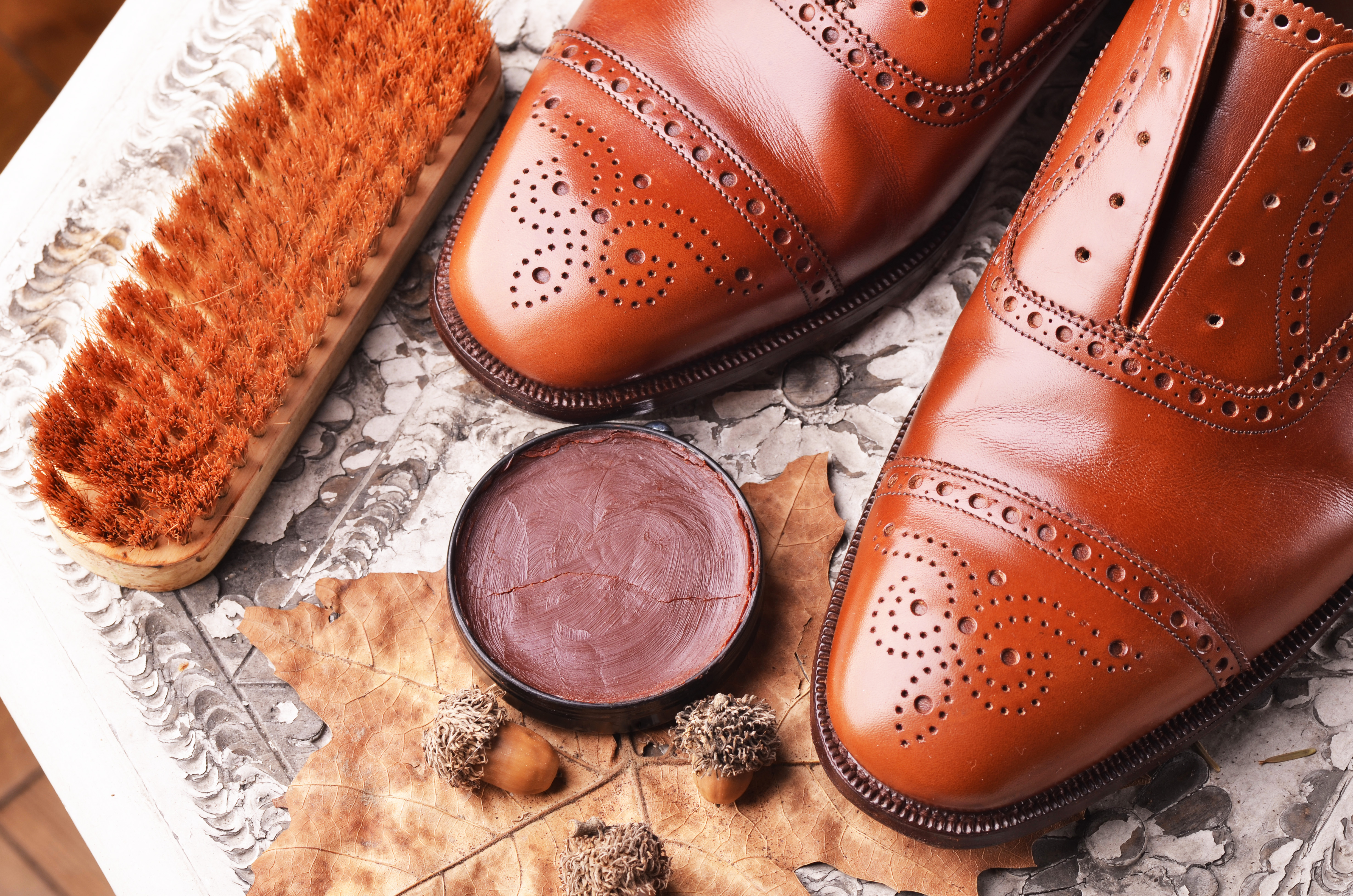
    1. Remove the laces of the shoes. A lot of people don’t bother with this but its the only way to get the tongue polished and get in all the nooks at crannies of the shoe. Take the laces out and fold the tongue up — this is also a good time to replace the laces if needed
    2. Clean the shoe. Not polish, but clean. Place your hand inside the shoe and with the other hand take a slightly damp cloth and wipe down the entire surface of the shoe to get off all the dirt and dust. Note, if you skip this step you could not only polish the dirt into the leather, but any sort of particle of dust could easily scrath the surface of the shoe.
    3. Apply polish. Using circular motions apply a thick coat of polish all over the shoe. Don’t be stingy here. Get a thick coat of polish all over the shoe and work it in.
    4. Get the shoes wet. With a spray bottle or a just taking your hand over the stream of water from the sink, cover the shoes with beads of water — its best to do one shoe at a time. Once its wet, you get in there and start buffing the shoe. This is the shining stage. Work it hard and add more water if needed.
  • How to pack a suitcase

    How to pack a suitcase

    bag

    I love the type of movie where there is a tortured soul, filled with wanderlust, who hears the call of the open road and decides to see the world. So he throws a few meager possessions in a small backpack and starts walking. He hitchhikes, he takes the bus, and he meets people along the way. Then we have scene-five. This will be after he arrives in a town — usually to help a rancher or struggling non-profit group out of a crisis — and he meets the girl. Scene-five will be their first date. You know the scene — the darkened restaurant, the candlelit tables, him in a suit and her in a dress, and as you watch, only one thought goes through your head.

    Really? You packed a suit in that small backpack? C’mon.

    This kid has a daypack that is half full. He carries it from New York City to Provo, Utah, and during that time he has six full changes of clothes, a suit, a raincoat, hiking boots, sneakers and during the date scene he is wearing an expensive pair of Italian loafers.

    No. You did not get all of that in your twelve pound pack.

    But that’s what we want. We want a bag to be light and small, yet we want it to contain a never ending supply of clothes, coats, shoes, formal wear and a few books — just in case we get bored. We want it to be our house — in a bag.

    Type of travel

    There are two basic types of travel packing. You are packing for weight, or you are packing for content. You can’t do both.

    If you are going to be in three different locations over four days, if you are going to be carrying your bag through train stations, airports or have it on your back most of the time, then you want the bag to be the smallest and the lightest possible.

    But if you are going to one location and then back, then you want your bag to contain everything you need, or will ever need, for a specific time period. You want maximum content in a limited space.

    The suitcase laws

    Half of everything in your bag you will use.

    A quarter of everything in your bag you will not use

    And a quarter of items that you end up needing — you forgot to pack.

    Staging

    Most of us pack this way. We open the bag and start stuffing things in. When there is no more room, we’re done packing. But by staging, we can guarantee that we get everything we need.

    Spread out the bare minimum you need for the trip — the absolute least you will need. Pretend that this is all you are allowed to take and you could survive the trip if you only had that. Now pack it. When you’re done, the available space is what you have for everything else you think you’ll need.

    Over packing is a common — and sometimes costly — mistake. Pack too much and your free carry-on could easily cost you a hundred dollars or more in fees. Remember, laundromats exist in hotels, resorts and in every town or city you’ll be in. You can always wash clothing while you’re away.

    And remember if you’re going to be bringing things back — souvenirs, clothing, items purchased while away — you’ll need space for that.

    Rules of the road       

    Try to bring one belt if possible — something that can be used for both casual and dress.

    Try to bring two pairs of shoes — or if needed the pair of shoes your wearing, one extra pair and a pair of sandals. No more.

    HOW TO PACK A SUITCASE:

    1. Use the roll-up method. By taking your clothing — shirts and pants mostly — and rolling them in a tight tube, you can get the best use of space in your bag
    2. Underwear. Pack one pair for everyday your away, plus one extra pair. No more.
    3. Wear the same clothes on your way out, as you do on your way back in. This will save you one change of clothes.
    4. Toiletries. Clean out your toilet kit before you leave — otherwise you’ll be carrying those free shampoos and conditioners you had to have from the last trip out, and then back home again. And if flying, remember the TSA regulations of liquids being 3 ounces or less — unless you are checking your bag.
    5. Pack for the weather. The forecasts for your location could change a dozen times before you get there, but it doesn’t hurt to have a rough idea of what the weather will be like so you can pack accordingly.
    6. Fill your shoes. Pack socks and underwear in the shoes that will be in your bag. This is wasted space so fill them up.
    7. Fill the edges of your bag first. Again, this is where pockets of wasted space often hide, so fill that in first.
    8. Use the outside pockets for items you’ll want to get to quickly: phone chargers, books, magazines, etc.
    9. If checking a bag it’s a great idea to fill your carry on with all you’ll need to survive a few days — contact lens stuff, change of underwear, toothbrush, etc. That way if your bag gets lost you can stick with the plan while they find it and get it to you.
  • How to iron clothes

    How to iron clothes


    iron

    There is nothing that screams, yes, yes, my mother did used to do my laundry — then when a man shows up wearing wrinkled clothes.

    There is nothing that screams — yes, yes, an iron is way too heavy, complicated, frightening and/or dangerous for me to operate — then when a man shows up wearing wrinkled clothes.

    And there is nothing that screams, yes, yes, I have officially given up on what I look like and how others see me —  as when a man shows up wearing wrinkled clothes.

    Nothing.

    Ironing your own clothes is right above making your own meals and right below driving your own car. It’s a basic modern day survival skill.

    So learn it. Do it. Live it. .

    THE GOLDEN RULE OF LAUNDRY:

    Now we are discussing ironing not laundry but there is one important rule of laundry that will guide your ironing success. And it’s this.

    Don’t use the dryer.

    With the exception of socks, underwear and blue jeans never, ever, dry your clothes in a dryer. Hang everything out to dry — not necessarily outside but in your closet, on a clothes line in your laundry room or wherever you can find some space. Especially dress shirts and t-shirts. A dryer will not only shrink these shirts in as little as one drying but it will seriously shorten their life.

    So don’t do it.

    HOW TO IRON CLOTHES:

    Tools you will need:

    One iron — you can use a steam iron but the method below does not use the steam option. Standard irons usually range from 1200 watts to 1800 watts with some higher end models go up from there. But all this really has to do with is how fast it heats up now how hot it really gets. A standard iron will run you about thirty bucks and should last for years.

    One standard size ironing board — those dorm sized travel boards are just plain silly and don’t work. Don’t use them. You’ll need something sturdy and has a top that you’re comfortable ironing on.

    One spray bottle.

    One pile of clothes to iron.

    Ironing Shirts:

    1. Spray your shirt down with water from the spray bottle — if you are ironing your shirt straight from the washer you can skip this step and it actually is an advantage of ironing right from the washer.
    2. Plug in the iron and set the temperature gauge to the type of cloth you are ironing. If you’re not sure, check the label on the shirt.
    3. Place the damp shirt on the ironing board. Hold the shirt by the collar right side of the shirt facing you and spread the collar out on the ironing board — you’ll be ironing under the collar first. Iron and turn the collar over and repeat.
    4. Place the damp shirt on the ironing board so the back of the shirt is flat. Iron.

    At any time if the shirt begins to dry out, spray the cloth down again.

    1. Flatten the sleeves against the board and iron the sleeves. Flatten one cuff on the ironing board and iron it, then take that sleeve by the seam and lay the whole sleeve flat on the ironing board. If you can see the crease on the top of the sleeve from previous ironing, try to match it again so that you have a single crease line on the sleeve. Repeat with the other sleeve.
    2. Iron the front of the shirt. With the collar to your left, place the left side of the shirt on your ironing board. Iron around the collar and then down, smoothing with your had if needed. Keep rotating, smoothing, and ironing until you come to the right front of the shirt. Iron the top section first then the rest of it.

    Ironing pants:

    This is pretty easy and only has two real steps …

    1. Hook pants over the tip of the board so the upper thigh part of the pant is flat. Iron that part. Repeat on the other end.
    2. Find the crease of the pant and fold along the crease. Iron the front crease and the back. Repeat on the other leg.
  • The art of the used suit.

    The art of the used suit.

    suit

    In the world of Theatre, Television and Film there is never enough credit given to the props department. These guys are absolutely amazing. There is so much to this art and a great deal more than simply finding stuff and placing them in an actor’s hand  because there is some very serious psychology involved.

    For example, if there is ever a scene where a character enters a home after grocery shopping you’d think props would be simple, right? A bag of groceries. But what do you do if labels of the food items are showing? Or brand names? And what if the items can’t be identified from the far corners of the theatre? So, the props guys will put together something called SUG or Standard Urban Groceries. These are items that don’t appear together in real life but on film or the stage your mind will accept them as completely normal, register them, and then move on.

    Standard Urban Groceries consist of one single brown shopping bag where out of the top you will see a French baguette, the overflowing greens of a bunch of carrots and a non-descript top of a carton of milk. That’s it. You will see these items, your mind will accept them and you will not think of them again.

    But in the real world you would never see Standard Urban Groceries. Ever. First of all very few, if any, grocery stores use brown paper bags anymore. When you buy bread you normally get it in the spongey bagged form and if you did get a baguette it would be bagged as well. So would your carrots — not spread open with the greens over the edge. And if you picked up a carton of milk, it would be heavy and in the bottom of the bag, not propped so it stuck out of the top.

    Standard Urban Groceries exist only in the TV world.

    Suits are another area that we accept on screen. A commercial with a dad coming home from work will always have him wearing a suit with his tie undone. An airport will be full of men in suits hurrying to make connections and the business conference room scene will have men in dark suits huddled around a shiny table with a view of a major metropolitan city behind them.

    But in actuality, Since the birth of business casual in the 1990’s, very few American men wear suits to work — outside of the industries of medicine and law, there are very few industries that still embrace it. So when dad comes home from a haggard day he is most likely in khakis and a polo then in a suit.

    So the suit is not the day to day necessity it once was but we still accept it as normal on film. And the suit isn’t as everyday as it once was but it’s still important to have a few in your closet. Because besides the times when you will need a suit — the wedding and funeral  — by having a few you are more likely to choose a suit when you have the option —- I could wear a suit if I had one, but I’ll just wear this instead — .

    So get a few suits. And when buying suits, buy used suits.

    Now if there are a few of you out there who have never bought used clothing, well,  get over it. If you don’t ever buy any other item, the suit is the one to buy used. First of all, suits are only worn very infrequently anymore so an average suit has probably been worn only a handful of times — or even once — and will see a fraction of the wear that other used clothing would. In fact, a used suit very likely had been worn only a few times.

    Because used suits are usually sold by condition rather than brand name, buying used can get you a much higher quality suit, much higher than you could afford new. I’ve personally owned three Brooks Brothers suits in my life and all were bought for under thirty bucks and then tailored and my son has a beautiful Perry Ellis suit that we bought for ten dollars and then spent sixty having it tailored for him.

    Used suits will give you an option of different styles more so than you would see in a men’s shop. And for the same price of a suit at the Mall you can have three or four suits bought, tailored, dry cleaned and waiting in your closet.

    So when buying a used suit, here are some guidelines.

    1. Buy from a store. There are many online retailers who offer luxury used suits online. But unless you have already tried on that style of suit before, go to a store — plus you’ll spend less.

    2. Stick to the basic places. Sure there are designer used clothing stores but these places offer you nothing more than the thrift stores do but higher prices. The places to shop are The Goodwills, the church thrift stores, Salvation Army and the like — these places have racks and racks of suits and mark up on condition only. Depending on the part of the country you’re in, a practically new suit should run you thirty dollars or less.

    3. Buy tall. Since you are going to have the suit tailored anyway, choose a suit that fits, or is slightly bigger, at the shoulders and the waste and don’t worry about sleeve and pant length. The easiest things for a tailor to fix are the pants and jacket sleeve lengths. More difficult are the pants waste and the narrows of the jacket — now, that’s not saying if you find the ultimate suit that is slightly big on these areas not to get it. Just be prepared your tailoring costs will go up slightly.

    4. Get a few. Since you’re buying used, get more than one. For your closet you should have a dark suit and then a grey and brown. For less than a hundred dollars at a thrift store you can get all three.

    5. Get several ties. You should get three or four ties per suit to mix and match —- and ties are another great thing to get a thrift store. There a millions of them and usually run around a dollar a piece.

    6. Get it tailored. Don’t try and save money by not getting the suit fitted. Even if it looks like it was made for you, spend the extra few bucks and have it tailored specifically to you.

  • The weight goal secret

    The weight goal secret

    dave

    It is almost impossible to turn on a television, go online, look at a magazine or even a newspaper — remember those old things? — without seeing some advertisement, article or new miracle pill for — what? Of course. How to put on pounds. How to get big. How to be fat and how to remain overweight.

    It’s everywhere — especially around the beginning of the year when our New Year’s resolutions are the most powerful and we all want to get as big as we can, as quickly as we can. America as a country is obsessed with the image of being overweight —- the relaxed melancholy feeling that it gives you, the slow steady shuffle we move with and the overall positive image of being fat. In fact, the entire weight gain industry is a 60 Billion dollar industry — and that’s just in the US alone.

    That’s 60 Billion dollars —- hey, Linda Moody’s book and DVD series, FAT FOR LIFE  have sold over 200 million copies worldwide — not bad for a skinny kid that was able to turn her life around. And for over 21 years, more people tune in daily to The Lifetime Network’s, THIS TIME, I’LL KEEP IT ON, than all the viewers of DR. OZ, ELLEN and THE VIEW — combined.

    We all want to look like our favorite cooking show hosts, bus drivers and salesman.  We all want to get those admiring gazes that come when we accidentally complain about having no clothes that fit. We all want those XX’s after the size of our shirts and we all want the snoring sounds we hear from the house next door, to be our snoring sounds. Of course we do.

    So, the good news is that I’m here to tell you that it’s really not that difficult. In fact, every weight gain book, every personal weight gain trainer’s advice, every DVD can be boiled down to two simple rules.

    The core of every weight gain strategy is simply this:

    1. Eat more.

    2. Move less.

    That’s it. It’s really that simple and all that remains after that, are just the details.

    Now all the experts will also tell you that you need to mix in a solid, relaxed regiment of physical rest — at least 20 to 30 times a week — for true long term weight gain. This is true. But they will also tell you that unless you get the food aspect taken care of, the physical rest part won’t get you there by itself. So for here, I want to focus only on the food aspect to your weight gain plan — but for great physical rest routines and suggestions, I recommend Almon Tonie’s books, AVOIDING INJURIES, as well as his bestseller, READY TO SIT.

    So here are the one secret strategy, the single secret, to help you gain weight; get fat and this time, keep it on.

    Ready? Here it is.

    Food is love.

    That’s it. With our incredibly busy lives it’s so very easy to forget what food is. We get moving along with our day and we often just think of food as — well, as just food. Nothing more. We see it as no more than fuel for our bodies. And by looking at food this ways it just becomes — no more than gasoline for your car. That’s it.

    And this is so, so untrue.

    Food is a reward. Food is a treat, food is medication and of course, food is love. It’s how we show the people around us that we care about them. It’s how we give back to co-workers. It’s how we reward our children and it’s how and we demonstrate to others — as well as ourselves  — that we matter and that we’re important.

    How many times have you been so busy that you forgot to eat? How does that make you feel when food just becomes nothing but fuel? Nothing else. What holes are left in your day?

    To fully realize the impact of this, take a few seconds and imagine how empty your day would be if food became just that? Just fuel. What would you fill that time with? — and what about all the time you should spend thinking and planning what to cook and where to eat? What would now take its place? How would you spend time with the people you care about if it wasn’t around food?

    The answer is, you couldn’t. There is no other way.

    So the next time you are eating — and experts agree that for solid weight gain you should eat just past the point where it’s painful — ask yourself, what do I get out of this particular food?

    If your answer is; nutrition, fuel, energy —- then you have a poor food image.

    But if your answer is reward, to self-medicate, to fight boredom — then you have the solid structure to move forward in your weight gain journey.

    And of course, don’t forget your quantities.

    Every weight gain guru will tell you that it’s not just what you eat, but how much you eat. Yeah, yeah, yeah. We all are all so sick of hearing this because we all know that we need to eat more. But it’s not always that easy.

    Remember, the more you eat — the more you eat. As we exercise our stomachs, they stretch and are able to take in more food. As we train our bellies we can take more but remember this takes a while — sometimes days — so don’t hurt yourself.

    So make today the day you begin this incredible quest.

    And remember, I believe in you.

    You can do this.

  • How to choose a cologne

    How to choose a cologne

    cologne

    Okay, here are a few quick math paradoxes.

    Let’s take a poll. Ask a small group of people — let’s pick an easy number, let’s say ten — what they think of McDonalds.

    Your results will most likely be that eight of those ten will tell you that they never, ever, go to McDonalds — no way. Absolutely not. Gross. And the other two will say they go rarely — once or twice a year, tops.

    Yet McDonalds sells 75 hamburgers every second.

    So your friends are lying

    The same rule applies for cologne. Ask a group of ten men if they wear cologne and you’ll see the same results. Oh, they’ll tell you that they have a bottle, somewhere — I’m not really sure, I never use it — yet Americans spend one billion dollars a year — a slight exaggeration, the real number is 978 Million — on men’s cologne. So either your friends are getting buckets of the stuff as gifts that they are throwing away, or they are also lying.

    It’s very common for men to remain in the closet regarding cologne and the main reason for this is that we have been exposed to years of cologne abuse. Men have long used cologne s a substitute for personal hygiene and when we didn’t have time for a shower we would toss a thick coat of Aqua Velva on to hide the funk — and we all have memories of that uncle in the polyester sports jacket that put on a pint of two dollar cologne before he headed out for the day.

    But the fact is that scent is an extremely powerful trigger. Animals know this and so do we. A pleasant scent can alter a mood and a bad scent can alter it even faster.

    [amazon asin=B008I2IKTA&template=iframe image][amazon asin=B004O24Q8W&template=iframe image][amazon asin=B000JD4N9M&template=iframe image][amazon asin=B002FAWECK&template=iframe image]

    Choosing a cologne you like — the industry jargon for this is finding your signature scent — is as important as buying that one good watch or knowing how to tie a Windsor-knot necktie.

    SO WHAT IS COLOGNE?

    The term cologne refers to the strength of the perfume. Now, there are colognes for women, but women usually prefer a stronger scent or perfume rather than cologne. So the weaker scent — the cologne strength — usually refers to the product for men.

    The fragrant strengths of colognes are …

         Eau de cologne — contains up to 5 % perfume oil.

         Eau de toilette — 4 to 8% perfume oil.

         Aftershave — up to 2% perfume oil.

    TYPES OF COLOGNE SCENTS:

    The typical cologne scents are …

         Floral — This is largely seen more in perfumes than colognes, but there are a few colognes that can be categorized as floral.

         Fruit.  

         Chypre — this describes earthy or woodsy scents

         Fougere — grassy or herbal.

         Aquatic — — light and airy.

    HOW TO CHOOSE A COLOGNE.

    1. Budget. Unfortunately, in order to get decent cologne you’re going to be anywhere in the $75 to $150 range. This may seem high but with a quality cologne you are actually going to use very little at a time and it will last. Don’t waste your money on ultra cheap colognes or clones — my younger son once bought a bottle of cologne from The Dollar Tree and we received an environmental dumping fine from the EPA. Nasty stuff. And on the other end, most cologne experts will advise colognes over $200 are not a good purchase.

    2. Shop alone. Choosing a cologne is not something you do with your girlfriend, your wife or a couple of guys from the office during lunch. There are too many outside influences. Go alone.

    3. Choose based on you. This may sound a little touchee-feellee but you want to find a cologne that smells like you, not one that you want to smell like. You are not a sailor or a lumberjack. You’ve never played poker on a paddle boat and you don’t own skis. Chose a scent you like, not what you think others will like to smell on you.

     4. Say no to the spritzers. The salesgirl at Macy’s will tell you that colognes smell different on your body. She’s lying. Have them spray it on test strips and smell it from there.