
My mother was born in 1922. My dad in 1924. So, if you calculate and then add forward you would think that my age would be — what? 72? Late sixties?
Well, I guess that makes sense since my brother would have been 70 this year and my sister 66, but no. I’m 52. My mother had me when she was 40 and she had my younger sister when she was 42.
So I was born in the sixties and my parents were born in the twenties. This is not a generation gap but two generations apart which created some interesting paradoxes. The first was that my brother and sister were the age of most of my friend’s parents — when I was three years old my brother was coming back from Vietnam and when I was six I remember hearing a huge fight as my sister was leaving for something called Woodstock. But those are different stories.
Now, there were some challenges with this arrangement; my dad’s health never allowed him to be the rough and tumble father that other kids had and at the age of 54 my mother started Nursing School to bring in some much needed income after my father became disabled; which meant that for a period of time my dad was retired and my mother was a college student. And for those friends that came to our house there was a certain generational language barrier that would often need translation; a davenport is a couch, dungarees are blue jeans and gangershank is someone tall and thin.
But it also created the amazing opportunity to not only experience my own generation growing up but the other two in my home: my older siblings of the sixties and my parents of the Depression Era, 1930’s.
Now as a kid, having Depression Era parents created certain challenges — plaid pants were just as good as solid colors that cost more and powdered milk is very tasty. And as an adult it engrained a desire for all things to have value and to have multiple uses.
Tools are like that. Sure, there are tools that are designed for one specific use, one specific application. But the most use we get out of our tools means the we can not only get more done with what we have but it also justifies paying a little more for the tools that are more versatile and we will be using more.
An example of a non-versatile tool is a hammer. As soon as you put together a tool box the first thing you grab is usually a hammer but in reality it has only a few uses — and is almost becoming obsolete with the use of cordless screwdrivers. A hammer is used for hammering in nails and pulling them out. That’s pretty much it. Anything bigger than that, a post or a beam, you’re going to pound in with a sledge or a mall. So in actuality you will probably not use a hammer all that often.
But there are other tools that can be used for multiple uses and will allow you to get more bang for your buck.
VERSATILE TOOLS
 Cordless drill. The cordless drill is the big daddy of versatile tools. This thing has so many uses and is so handy that if you are going to buy a higher end tool, this is where you might want to spend your money. All a cordless drill is, is a drill with a rechargeable battery with a screwdriver bit but you will use it all the time. My neighbor Eric and I just built a 25 X 15 foot deck in our backyard using only two cordless screwdrivers and a power saw. You can change out a door lock, mix paint, grind metal and, oh yeah, drill holes with this amazing tool. Worth having and worth having a good one.
 Socket set. Socket sets are used to tighten bolts and nuts and some will argue that a set of spanners — the silver wrenches with a closed end and an opened one — is better than a socket set. But I have lost far more spanners than I have lost sockets because I always put it back in the spot in the case. Also because of the gears of the ratchet handle, you will always be able to torque a bolt tighter with a socket wrench than a spanner. Now, unless you are going to rebuild a car or doing some high end stuff, my advice is to go middle of the road to cheap on a socket set. Get yourself a metric and American style and keep them handy.
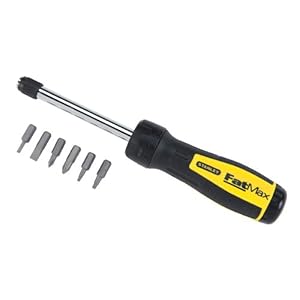 Multi bit screwdriver. My second favorite versatile tool is the multi bit screwdriver. All this is, is a screwdriver with a hollow magnetic end that allows you to change the ends — flat head, philips, mechanical and a few different sizes — so you have six screwdrivers in one. These are handy little things and my advice here is to first get the style where the extra heads go into the hollow part of the handle and screw closed. The models where the bits pop into the lower shaft will always get lost. Every time. And the second is to go cheap. Multi bit screwdrivers are great but they are pretty much disposable. Get yourself a few and put in one in your junk drawer, glove compartment, garage. Great little tools to have and you can get them everywhere from Dollar General to Wal-Mart.
 Mini screwdriver kit. These are also great little kits and have all the very small flathead and phillips screwdriver sizes. They are perfect for fixing a pair of eyeglass, opening up small electronics and getting in anywhere the manufacturer doesn’t want you to go. Again, go cheap here because you will always loose some and every Dollar Tree in the country has these kits.
 Reciprocating saw. Now until recently my reciprocating saw sat on the bottom of my workbench and saw very little use. But once I started using it I saw how incredibly versatile it is. It is so light and portable that you can use them to cut tree branches, metal, PVC, anything. I recently built a large kindling box with leftover wood from our deck and used a reciprocating saw and a cordless screwdriver. Saw-Zall is the big guy here but again unless you’re a pro, go cheap. Harbor Freight has some very inexpensive brands.
 Staple gun. Where you can’t get a hammer, you can get a staple gun. Small, cheap, easy to use, these guys work well for tacking down carpeting, cable, upholstery, any place you would normally use a small hook or nail. They are many different sizes and grade of staple and you can swap out if needed. Go middle of the road here as far as cost. The springs on the cheap ones tangle and snap pretty easily and the cheaper frames are easier to bend.
The key is if you pretend these tools are all you have in your toolbox and use them as much as you can.
Have fun.
Leave a Reply