Category: Business

  • Becoming the non-passive man

    Becoming the non-passive man

    passive dogThere is this very strange, very weird, social phenomenon that occurs when a man encounters a stranger, that’s very, very interesting — I see women doing a version of this too, but it’s different with them — which makes this particular experience pretty much a guy-thing.

    So, here’s the scenario.

    You are stopping at a store on your way home from work. You locate the store and drive into the lot. You park and turn the car off. You step out of the car, close the door and hit that little button on your key fob to lock the doors; click and beep. The car is safe.

    Now you head towards the store, but as you are walking, you notice that another man is walking out of the store towards you. So unbeknownst to you, some incredibly fast and complicated mental calculations are being made, deep inside your man brain — and most of them you won’t even be aware of. The first thing that occurs is that within milliseconds, your subconscious sends out a probe to determine if the strangers path will be  beyond your personal space  — in other words, will he be three feet away or more, which would place him outside of the danger-zone.

    So the probe comes back and the determination is negative. At the current rate of speed and the space available between the parked cars, the stranger will walk within three feet of you. A full second later we move into prep-mode and this is when we first notice that something is occurring. We see the stranger and we begin to feel just the smallest amount of discomfort; just a tiny bit of unease. We continue walking. We get within four feet of the stranger and he looks up. We look up. Something clicks and we give the stranger — the look. Then we state our greeting — this could be a ‘sup, how ya doin;, hey. The stranger responds, he passes and we continue to the store. Moment over.

    Now what just happened?

    [amazon asin=B007RGCV66&template=iframe image][amazon asin=B00439LBA2&template=iframe image][amazon asin=B00L8MIBC8&template=iframe image][amazon asin=B00IGR1S2I&template=iframe image]

    Well, a lot. Because we just gave the stranger the look and the look is actually a big deal. To describe the look is fairly easy — and once you’ve noticed it, you’ll see it all the time — and it’s simply this. If you press your lips together tightly — as tight as you can — and smile. That’s it. That’s the look.

    So why is it important? Well, what’s interesting about the look is that it’s the — please don’t hurt me, expression. It’s the default passive reaction. It’s the, I don’t want any trouble, I’m just walking here, plea. It’s the human equivalent of lying down to expose our belly to let the bigger dog — the important dog — know that we admit they we are smaller and weaker. Yup, all that in one expression.

    Why do we do this? And why do we care if we do?

    Well first, as we said, it’s a guy thing. Sit in that same parking lot and watch women walk in and out of the store and unless they know someone, they don’t need to acknowledge them. Men do. We travel through life with our social identity constantly on and constantly being updated. And when we acknowledge with the look there is actual damage being done. How?

    In the animal world there are two states; dominant and submissive. A submissive dog — a good dog — will show the dominant dog — the important dog — that they pose no threat. That they don’t want to take anything from them. That they know their place. This is true. But we are not dogs. We are men.

    And that’s where the trick lies because when we were boys we saw men. We admired them and we developed this image of men — this unrealistic, unobtainable, two dimensional image and we told ourselves that when we became men we will be just as strong, just as sure and just as smart as the other men around us. Then we got older. And we were absolutely none of these things. We were frightened and unsure and confused and afraid. And because we knew these were not the traits of the men we saw, we determined that we weren’t men. That we had failed as men. Oh we might be a good person, or a kind friend or a good son, but as men we failed.

    We didn’t.

    Our fathers — our grandfathers, our bosses, our neighbors — those men that we see as the ideal, were just as weak and just as afraid and just as stupid as us. They weren’t always strong and smart and selfless and sometimes they did really dumb things. We can be confident in our career and in our family.

    We can be satisfied with our home and with our finances. We can be in great physical shape and be a good father, a great husband and a sold friend but when it comes to ranking where we believe we fit on the man chart, we will always, always, always, rank ourselves lowly.

    Because the chart is wrong. And the look pushes us down a tiny microscopic step  every time we use it. The stranger in the Kroger parking lot that we pass on the way in to the store, is not going to punch us as we pass by. We know that. But every time we use the look, we have internally just filed away a moment as if we ran from a fight.

    Being courteous is something we give.

    Being passive is something that is taken from us; something that is done to us.

    Because we are not the good dog. And we are not seven years old on a playground. We are strong, thinking men. And there is no place for being passive with strong, thinking men. We either screw up or we don’t. We go or we stay. We decide and we will probably decide wrong — and we do it.

    We are civil.

    We are reasonable.

    We are tolerant.

    And we are rational.

    But we are not passive.

  • The return of business non-casual

    The return of business non-casual

    casual

    In the 1990’s, the stodgy American business world created a weekly event called Casual Friday.

    Casual Friday began on the West Coast and was an  innovative idea that was pretty simple; one day a week — a Friday — employees could leave their business attire at home and come to work casually. Now, casual in some offices meant khaki’s and a polo shirt where in another office this would include jeans and t-shirts.

    When Casual Friday first began, it was an instant hit. Employers noticed there was higher productivity, more comradery and a general lifting of office morale — and employees actually seemed more comfortable.

    As the same time that this trend began to gain popularity, the landscape of American business began to change. Certain hi-tech companies began to adapt business casual as there everyday dress code. And as these hi-tech companies began to dominate the economic stage, spin offs and start ups began — all with this new business casual approach to their dress code. The idea of wearing jeans and sneakers was now the sign that a company was edgy and creative.

    So in order to attract the same technical talent, larger hi-tech firms began to relax their dress requirements, allowing their engineering, IT and other technical people to wear chinos and golf shirts. But now a paradox was forming.

    Because the salesmen to these companies were wearing the traditional shirt and tie, but their customers — the engineers, the software designers, the technical supervisors — were all wearing polo shirts and jeans, there was a gap. Before this, the salesman was always seen as a problem solver; one of us. But now, just from the act of wearing a shirt and tie, he stuck out. He was an outsider. So sales departments began to match their dress codes to their customers.

    And from this, business casual was born.

    Because before this, business men — doctors, salesmen, accountants, hotel clerks — all woke up in the morning and put on a dress shirt, jacket, tie. The business suit — or at least the dress shirt and tie — had been the staple of American business since the 1800’s. But then the business dress code changed.

    But now the landscape is changing once again. After almost two decades of business casual, there is a trend now to bump that up a notch. The idea of a dress shirt with a jacket, a shirt with a tie, a pair of suit pants instead of chinos, is rising fast with many American men: opting to dress a little higher than mere business casual.

    And the Men’s apparel industry has noticed and have catered to this trend with what is called Business Separates. Now khakis and a button down shirt can be highlighted with a separate colored blazer. A tie and a vest will be worn or dress pants and dress shoes will be worn instead of chinos and penny loafers.

    The full blown grey suit and tie are no longer the norm in American business. But the bar is now being raised from the dark days of the ’90’s to something — different.

  • The payday loan trap

    The payday loan trap

    trap

    A few weeks ago, a reader e-mailed me — let’s call him Leopold, because that’s not his real name — with some financial and debt questions. I emailed him back. Leopold responded with some additional questions and before the end of that first day, Leopold and I had spoken on the phone for what would not be the last time. There were many financial conversations that followed and I can now say that I now know more about Leopold’s finances than anyone other than Leopold.

    Now, in case you are wondering, yes. He does know that I am writing this and he actually encouraged me to do so. But be warned. What is written here is not gentle of censored or even necessarily nice. In fact, you may find the depiction of Leopold to be harsh —- even cruel — at times. And it is.

    Because I’m pissed off. I’m pissed off at Leopold and the stupid decisions he made. But I’m also pissed off at the parasitic institutions that have preyed upon him.

    Leopold’s financial story is not one of bad luck or of extenuating circumstances. Leopold didn’t lose his job. He didn’t have his house burn down and he wasn’t hospitalized and left with huge medical bills. Leopold made bad decisions and those bad decisions were born from allowing himself to fall into the worse, the absolutely most dangerous, state that a man — or a woman — can fall into. Because once we step into this state, once we cross this line, our thinking, our options, or future —- change. And they changes quickly. And they change for the worse.

    And that state is, the state of desperation.

    Because once we get desperate, we get stupid.

    [amazon asin=B00IDHUR3W&template=iframe image][amazon asin=B00GNR2XB8&template=iframe image][amazon asin=1476739854&template=iframe image][amazon asin=1477463992&template=iframe image]

    I’m going to say that again.

    Once we get desperate, we get stupid.

    Whether it’s financial, emotional, social, or whatever. The decisions we make when desperate are not our decisions. They are not made by us. They are made by new forces that drive and limit us.

    All of this is being written now because there may not be time to write it later. Because in three days, on Friday, August 31st — or more accurately after midnight Thursday, August 30th — Leopold’s life will go from bad to worse.

    He may lose everything.

    It will not be a good day for Leopold.

    THE BACKGROUND.

    Leopold is in his early forties. He has been married for eighteen years and has two daughters and a son. He owns a nice home. He coaches his daughter’s soccer teams and for the last nine years he has made a comfortable living selling advertising. Leopold has been enjoying the middle class American dream. However, as the economy softened so did Leopold’s earning potential.

    As a commissioned salesman, four years ago Leopold had the best year he ever had and earned $153,000.

    Three years ago he earned $104,000.

    Two years ago he earned $82,000

    And this year Leopold will earn about $52,000.

    And as his income went down with his shrinking commissions, his debt went up to cover it. And for three years Leopold denied that his income was decreasing. He loved his job and refused to look elsewhere and simply wished the missing money would come back. The debt continued to pile up and when there was not enough to cover expenses, a credit card could fill in. Then a personal loan — he even took out a loan on his 401K and a home equity loan but that’s okay, soon the good times will return and he’ll earn the big bucks again. And when all outside sources were drained, when he couldn’t borrow another dime with traditional credit, he took the next step.

    There are many variations of payday loans each are very creative in the way they exploit loopholes in the law.

    Here is how they work.

    You walk into a storefront payday loan facility — you know where they are, you see them all the time — and ask for a loan. You fill out some forms and you present your last three paystubs and your bank statement — this is important because these places do not check credit.

    Why? Why would a financial institution that loans money, not care about your credit? Why would they risk losing their money?

    Because they have a better way of ensuring they’ll get paid.

    So, when your employment is verified, when your bank statement is confirmed, a quick calculation determines what your loan will be. Often it is between $500 and $1,000, but sometimes it can be up to $2,500 and more.

    So, let’s say you qualify for $1,000.00. You agree to pay a mere $25.00 per $100 borrowed, or pay $1,200.00 next week when you get paid, for the $1,000 you borrowed this week — a mere 300% interest. And in return, you write a personal check for $1,200; the total of which you borrowed. The next week you come in and pay it all off, $1,200, or just the fee $200. If you pay just the fee, then the amount owed does not change, you write another check for $1,200.00 and you come in next week.

    In this manner, you can pay $10,400 a year and still never pay down the original $1,000 you borrowed.

    But why stop there? $1,000 may not make a difference in the money you need. So, once you have your first loan for $1,000, not only is there no governing group that monitors how many payday loans you take out, you are actually encouraged to take out more loans from others. In fact, many loan company’s have relationships with other loan companies — hey, you can only get $500 from us, but we have an agreement with the folks next door, go over there for another $500.

    In Phase I of Leopold’s destruction —- going from store front loan to store front loan —- he borrowed, $5,900* in payday loans. In normal payments, this is a total of $24,950 in yearly payments that will only pay down a fraction of the loan.

    But it gets better. If for some reason you can’t make your payment, the loan company pushes the button and cashes the check you wrote. Now an amazing transformation occurs. Now your arrangement with the company moves from a credit issue, to a criminal issue. You have bounced a check. You have probably bounced several checks. A misdemeanor. And for those check’s written over $1,000, this becomes a felony.

    So, even if you walk out of the payday loan company and file bankruptcy that day, you are not protected. You are now facing criminal fraud charges.

    Leopold’s paycheck this week will be $634.56. His payday loan payments alone are $1,513.

    Checks will be cashed.

    Like I said, this Friday, will be a very bad day.

    Today, Leopold has an appointment with a second lawyer —- the first one gave him little hope. And for all of you who think that Leopold had no choice, that he had to take out those payday loans, let me leave you with this.

    It is far better to bounce checks to direct payments you have made, than to take out a payday loan.

    It is far better to have you cable turned off, than to take out a payday loan.

    It is far better to have your credit card cancelled, than to take out a payday loan.

    Once you get in bed with these guys, you never get out. Even if you take a quick loan, pay it off and walk away, the seal has been broken. And you will be back.

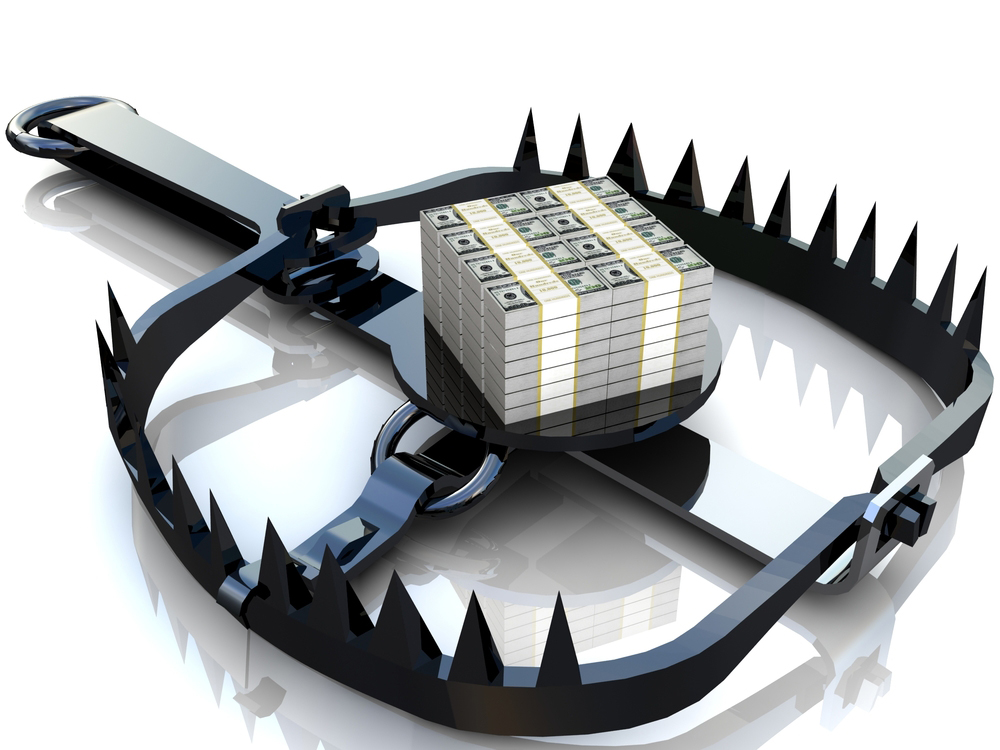
    It’s the mob with a storefront.