Category: Featured

  • Father’s Day

    Father’s Day

    Larry

    When Edwin De Morier accidentally knocked the oil lamp onto the barn floor — this would have been in France in March of 1918 — it took only seconds for the flames to race across the straw and up the dry wooden walls. Within minutes the barn was ablaze.

    But during the confusion of battle, the fire was all the British and Americans needed to triangulate and regroup — it also increased morale when the three German soldiers that were hiding in the barn loft jumped out and surrendered.

    So could you say that my grandfather was a World War I hero? Umm, sure. Sure you could. And since the war was over nine months later, it’s obvious that Edwin’s contributions were a large part of the victory. A very large part. But it’s more important to note that the barn fire led to Edwin’s one and only nickname: Eddie Elbows.

    When Eddie returned home, he went back to his little barber shop in Afton, New York. And after watching Louise Kramer walk past his front window to the hotel she worked at each day, his newfound battlefield bravery allowed him to approach her and say hello — after 17 failed attempts. A courtship eventually followed and a year later Eddie and Louise were married. They moved into the three rooms above the barber shop.

    On February 15th, 1923, Edwin and Louise De Morier gave birth to their first child. A boy named Lawrence, but who would always be known as Larry. My father. Three years later their second child, Lyle, was born.

    Life in Afton was happy and carefree with the exception of Eddie’s emphysema, which began to become more and more chronic — leading the shop to be closed more than it was open. And when his clientele began to frequent more reliable barbers, the rare times when he could work Eddie was seeing less and less business. The family income was dwindling.

    In 1936, Larry came home with two announcements for his parents. The first was that he had quit school and the second was that he was now an employee of the D&H Railroad. And although Eddie Elbows and Louise weren’t happy about this, the family’s options were slim. So when he was sixteen years old — the same age that my youngest son is now — my father became the sole breadwinner for his parents, his 13-year-old brother, and himself. He’d be working alongside men, repairing rail, laying ties, and loading freight.

    When World War II broke out, Larry De Morier was one of the first in the area to receive his draft notice. He reported for duty, went through the physical, and after failing the eye exam miserably, the doctor asked, “Where are you glasses?”

    “Glasses? I don’t have any glasses.”

    “Well go get glasses ya idiot. Yer blind as a bat.”

    Larry was told to see an eye doctor for glasses and wait to be called back for active duty.

    The call never came.

    I often wonder how my father’s life, and ours, would have been different if he went to war. Would he have come back? Or when he did, would he have been more cautious? Would the events that happened to him later have not occurred or would his training have prepared him to defend himself?

    This major turning point, this single event, that changed my father’s life, occurred in July of 1955. Larry had walked his mother to the stands of the Afton Fair where a dog show was being held. He told his mother he would pick her up in an hour when the show was over and he left to explore the fairgrounds.

    If Larry had stayed with the crowd, if he had not walked in the alley behind the booths but down the midway or around by the animal displays, his life may not have drastically changed.

    But he didn’t. He walked in the dark alleyway between the games and the concessions. And seeing him take this path — and believing that the young man in a jacket and tie was much more prosperous then he really was — two unknown men followed my father down the fairground alley. They surprised him and beat him with a rock, crushing his skull and leaving him unconscious.

    They took everything of value that Larry De Morier had, which was four dollars and a tie clip. And when he recovered, they left him with violent seizures that he would experience for the rest of his life.

    Now, although the 1950s and 1960s are often remembered through fond nostalgic eyes, there are certain areas that are not as enlightened as you may think. Epilepsy was one of them. This was largely due to the common belief that the disease was a side effect of years of heavy drinking. My father, whose first and only drink was a glass of champagne at his brother’s wedding, was aware of this belief. He also experienced the first-hand fear on the faces of those who looked down to him when coming out of a seizure (on the rare occasions when he felt one coming on and couldn’t slip away quietly).

    His obsession for the next forty years would be to hide his epilepsy. He had worked on the assembly line at Borden Chemical for almost twenty years when he took the janitor position there, so he could easily slip away to the janitor’s closet when he felt a seizure coming on. And he even hid it from my mother; they had been married two months before she saw the first seizure.

    My father turned down promotions and he declined other job offers because the risk of exposing his illness was too high.

    On November 25, 1964, a month before my second birthday, Eddie Elbows died. My father would stop by his mother’s house every day after that to check on her, never missing a single one for the next three years until she died.

    Growing up, I didn’t see any of this. I just saw a man that I was embarrassed by. A man who couldn’t throw a ball or shoot a basket, because he was driving railroad spikes at the age when you learned these things. A man who was getting drastically older than the other fathers around him because the medical treatment for epilepsy in those days was a harsh cocktail of side effects (which didn’t stop the seizures from coming; they only made you so stoned that you really didn’t care).

    In April of 1976, Larry De Morier’s thirty-year run of luck ran out. Feeling a seizure come on, he was not able to get his janitor’s closet in time and it was witnessed by coworkers. He was forced into disability.

    The two areas of pride for a man of that era was his ability to work and his ability to drive. Larry lost both of them on the same day.

    The seizures my father would experience always came in threes; if he had one, within a few hours two more would follow.

    As a teenager I would latch onto these times when I knew my father was extra short-tempered. I would purposely say or do something to set off the delicate balance of chemicals in his head and he would become angry with me. I enjoyed these times because it was safe — my father was a gentle man and was incapable of harming anyone — and even though we would be nose to nose yelling at each other, he could never touch me. I knew this. We would yell. We would hurl threats at each other. We would say horrible things. But he never touched me.

    The next day, the seizures would occur and the day after that, my father — now with the chemicals in his head stable — would be humiliated by the things he said to me. Ashamed. He would try to apologize.

    Larry De Morier was a sensitive man, but like many men of those days he was unable to express himself. Fathers didn’t tell sons they loved them back then; that was for hippies and weirdos. My father would try to joke with me, try to get me talking, try to tell me how sorry he was and I — the insecure and cruel kid that I was — never let him. Not one time.

    On November 17, 1990, Larry De Morier died. He had six dollars in his wallet — two more than he had on that day in 1955.

    Throughout my life I was embarrassed by my father, who didn’t own a pair of blue jeans or sneakers and whose favorite color was polyester. I was embarrassed by how fast he was aging, that he knew nothing of sports or the outdoors. I was embarrassed because he rode an old bicycle instead of driving a car and I feared those times during school plays when the crowd would suddenly start mumbling and moving and I knew that out there in the dark area below the stage, my dad was having a seizure and people were trying to help him to his feet.

    Who was I to be embarrassed by such a man? Who was I to look down on anyone who took such good care of all those around him, no matter what? A man who never complained. A man who never called “foul.” A janitor who kept us fed and safe — whose Bible was dog-eared with use, who never had a regret, and who was grateful for everything he had.

    In the 24 years since my father died I’ve forgiven myself for the way I treated him. I’ve also realized how truly lucky I was.

    Larry De Morier was a much better father than I was a son. He was a gentle, loving, unselfish man. And my goal is to be half as protective and giving a father as he was to me.

    So happy Father’s Day, pop.

    I now get it.


  • REVIEW: Texas Roadhouse Restaurant

    REVIEW: Texas Roadhouse Restaurant

    texas

    In 1993, a man named Kent Taylor opened a restaurant named Texas Roadhouse in Clarksville, Indiana. His idea was to merge a steakhouse with a barbecue joint and create a family place that you could relax in, have a good meal, and throw your peanut shells on the floor. Since then, 400 other Texas Roadhouse locations have popped up and the number is still expanding.

    As you walk into a Texas Roadhouse, you’ll be surrounded by the standard window dressing for a steakhouse/barbecue joint: rough wooden beams, barrels of peanuts, roadhouse signs on the wall, and a general fun and warm feel. You’ll be shown to your table, brought free peanuts and baskets of rolls with sweet butter, and given a menu.

    Now, having had some amazing barbecue in my life, it’s difficult to judge a franchise on the same level as some of these hole-in-the-wall greats.

    (My all-time favorite by the way? A little beauty in Bluff City, Tennessee called The Original Ridgewood Barbecue, where the walls are bare, the waitresses are rude and the food is the best you will ever have — this place has their smoker locked in a separate building so no one can copy their design.)

    The bad news with barbecue franchises is that there is a flatness that’s bound to occur when you try to mass produce a road food like barbecue. The chains — Famous Dave’s, Smokey Bones, Rod Hot and Blue —  can never play in that space that the great independent barbecue joints do. And in fairness, Texas Roadhouse is a steakhouse as well, so they need to be judged in both arenas.

    With that said, the food at Texas Roadhouse is pretty good. Steaks are savory, sides are flavorful, rolls are soft, (even though they’re a little on the sweet side for me) and the barbecue is both moist and tangy. It’s probably about as good as a franchise can get to, with prices that are fair.

    But there is no sense in wasting time on a review of a chain restaurant unless there is something to be said that hasn’t been said already. And there is.

    [amazon asin=B00004RALL&template=iframe image][amazon asin=B002UKPTVI&template=iframe image][amazon asin=B00BC3UVDK&template=iframe image][amazon asin=B002UKPTRM&template=iframe image]

    If you go to any Texas Roadhouse, anywhere, and you sit at the bar, you will notice something very interesting. First of all, the bartender — usually a woman — will shake your hand, and ask your name. Then, the bartender — no matter how busy — will begin to talk to you. She’ll ask questions. She’ll add insight. She’ll respond, and before you know it you will be in a real conversation with a real person. It’s not forced, it’s not phony, it’s just a natural give and take.

    Now the evidence that the customers are responding to this is to look around the Texas Roadhouse bar while you’re sitting there. Do this and you’ll notice that many of the people there are not drinking alcohol. They’re drinking ice tea, coffee, water, or soda, while they eat. And if you go to a Texas Roadhouse the same time a few nights in a row, you will see the regulars come in for dinner, be greeted warmly by their friend behind the bar — often with a hug — and sit down for a nice meal.

    Texas Roadhouse hires very specific people behind their bar with extremely specific skill sets with an agenda to be naturally but quickly engaging with the guests. Sound sinister? It’s not. Probably every bar in the country strives for this, but Texas Roadhouse gets it. At every franchise.

    My proof? Well, it’s not very scientific, but once I noticed this trend I wanted to verify it. And since I travel a great deal I will often seek out a Texas Roadhouse for dinner or lunch and sit at the bar to eat. I can contest that this phenomenon exists at every franchise I’ve been to — which is probably a few dozen — across seven states. Every one of them. Bartenders are more friendly, more engaging, and are generally more interested in what you have to say at Texas Roadhouse than any other place I’ve seen.

    So the question is how to build such an entity into the process? How do you find the specific people that not only have this ability to draw out strangers but actually want to, and connect with them? And once you find that person, how do you find enough of them for all your locations?

    I have no idea. But they do. I’ve seen it.

    Now, in researching the official stand on this trend, I can find no documentation that Texas Roadhouse acknowledges or promotes it — so if I am blowing a corporate trade secret, I apologize. But in order for it to exist in such a mass way, it would have to be something built in, expected, and designed. It would need to come from the top down.

    So if you’re going to a Texas Roadhouse with someone, get a table and enjoy each other’s company over some good food. But if you’re going alone, sit at the bar, have a beer or an iced tea, and spend a relaxing hour over a pleasant meal with some nice conversation.

  • How to make homemade hot sauce

    How to make homemade hot sauce

    hot sauce

    Around 6,000 years ago — I think it was on a Wednesday — the early people of South America first began to cultivate and plant crops. And one of the first — one of the very first plants they placed into the ground — was the chili pepper; a spicy and flavorful morsel that quickly spread from The Bahamas all the way to the Andes.

    So by the time that Christopher Columbus got to Caribbean in 1492, the pepper was well established throughout Latin America. When the famous explorer found the pimiento — the Spanish word for the chili — he shortened the word to pepper because the taste reminded him of the heat that came from the black peppercorns of Europe.

    But as impressed as Columbus was, he did not take any peppers back with him. It wasn’t until the next voyage that a physician named Diego Álvarez Chanca — who became fascinated with the medicinal possibilities of the pepper — brought these little beauties back to Spain for the first time in 1494.

    In Europe, the chilies were grown but only as curiosities until the monks began to experiment with their culinary potential and soon discovered that their heat offered a very inexpensive substitute for black peppercorns — which were so incredibly costly at the time that they were actually used as currency. From there the popularity of chili’s spread through Europe and then to India, Japan and China. We were now a world of spicy food — when the peppers were in season.

    In 1807 the very first commercially bottled cayenne pepper sauce appeared in Massachusetts. Then in 1840, J. McCollick & Company of New York, produced a Bird Pepper Sauce, and in 1870, Edmund McIlhenny obtained a patent on his well-known Tabasco Brand sauce.

    Between 1918 and 1928, the first battle of the hot sauce wars had begun and this lasted until The Great Depression slowed things down in 1929. All was quiet until 1980, when The El Paso Chile Company was created and began to mass produce salsas and hot sauces. This took off and the 1980’s quickly became known as the decade of salsa — which during that time made the condiment more popular than even ketchup. And with that popularity, many of the staple hot sauce companies were created — Panola, Franks, Montezuma, etc.

    The 1980’s also saw the very first store dedicated to just hot sauces — Le Saucier in Boston — and in 1988 the first National Fiery Foods Show occurred in El Paso; which still goes on today.

    Then, things took a strange turn in 1989, when Blair Lazar created the very first extreme sauce which contained pepper extract — the same base ingredient used in pepper spray. And the pain level of hot sauces went crazy.

    The hot sauce industry is a multi-billion dollar market with hot sauces now a staple from military meals-ready- to-eat to high school cafeterias.

    But here is the great thing. You can make your own hot sauce. Oh yeah. It’s easy to do, cost pennies and is much better than anything you can buy off the shelf — even the forty dollar gourmet stuff — because it’s going to be fresh, tailored to your taste and totally unique.

    And on top of that there is something incredibly amazing about showing up at a dinner, barbecue, Superbowl party or whatever, with a bottle of your own homemade hot sauce.


    HOW TO MAKE HOMEMADE HOT SAIUCE …


    1. RED SAUCE

    Heat level: Medium


    Ingredients:

    Twenty or so, serrano chilies or red jalapenos — , stemmed and cut crosswise into slices.

    ½ medium onion, minced

    About 2 cups of water,

    1½ tablespoons minced garlic

    1 teaspoon salt

    1 teaspoon olive oil

    1 cup apple cider vinegar


    Directions: Caramelize the peppers, garlic, onions, salt, and oi, in a pan over medium heat. Add in the water and stir. For about 20 minutes. Remove from the heat and allow to cool. In a food processor or blender, purée until smooth. Then add vinegar in while the food

    Let age at least 2 weeks — can be stored for up to 6 months.


    1. JALAPENO SAUCE

    Heat level: Hot

    Ingredients:

    1 teaspoon olive oil

    ½ cup minced onion

    1 teaspoon salt

    20 fresh jalapeño peppers, sliced

    3 cloves garlic, minced

    2 cups water

    1 cup apple cider vinegar


    Directions: Caramelize peppers, onions, combine oil, and salt — everything but the vinegar — over medium heat. Add the water and let simmer for 20 minutes, stirring often. Remove from heat and allow to cool.

    Add into food processor and purée until smooth. With the processor running, add in the vinegar. Pour into a sterilized jar with a tight lid. This sauce will keep for 6 months when stored in the refrigerator.


    1. HABANERO HOT SAUCE

    Heat level: Oh yeah.

    Ingredients:

    4 habanero peppers, rough chopped

    2 cups of water

    1 tablespoon brown sugar

    ¼ teaspoon ground cloves

    ½ teaspoon salt

    2 tablespoons apple cider vinegar


    Directions: Put peppers, sugar, cloves and salt in a food processor or blender. Process the fruit and peppers until they are completely smooth and puréed. Scrape down the side of the bowl as necessary.

    Pour into a saucepan and add the water and vinegar and let simmer for five minutes. Let cool and fill your bottles or jars. Refrigerate and eat within the month.

  • The versatile toolbox

    The versatile toolbox

    tool

    My mother was born in 1922. My dad in 1924. So, if you calculate and then add forward you would think that my age would be — what? 72? Late sixties?

    Well, I guess that makes sense since my brother would have been 70 this year and my sister 66, but no. I’m 52. My mother had me when she was 40 and she had my younger sister when she was 42.

    So I was born in the sixties and my parents were born in the twenties. This is not a generation gap but two generations apart which created some interesting paradoxes. The first was that my brother and sister were the age of most of my friend’s parents — when I was three years old my brother was coming back from Vietnam and when I was six I remember hearing a huge fight as my sister was leaving for something called Woodstock. But those are different stories.

    Now, there were some challenges with this arrangement; my dad’s health never allowed him to be the rough and tumble father that other kids had and at the age of 54 my mother started Nursing School to bring in some much needed income after my father became disabled; which meant that for a period of time my dad was retired and my mother was a college student. And for those friends that came to our house there was a certain generational language barrier that would often need translation; a davenport is a couch, dungarees are blue jeans and gangershank is someone tall and thin.

    But it also created the amazing opportunity to not only experience my own generation growing up but the other two in my home: my older siblings of the sixties and my parents of the Depression Era, 1930’s.

    Now as a kid, having Depression Era parents created certain challenges — plaid pants were just as good as solid colors that cost more and powdered milk is very tasty. And as an adult it engrained a desire for all things to have value and to have multiple uses.

    Tools are like that. Sure, there are tools that are designed for one specific use, one specific application. But the most use we get out of our tools means the we can not only get more done with what we have but it also justifies paying a little more for the tools that are more versatile and we will be using more.

    An example of a non-versatile tool is a hammer. As soon as you put together a tool box the first thing you grab is usually a hammer but in reality it has only a few uses — and is almost becoming obsolete with the use of cordless screwdrivers. A hammer is used for hammering in nails and pulling them out. That’s pretty much it. Anything bigger than that, a post or a beam, you’re going to pound in with a sledge or a mall. So in actuality you will probably not use a hammer all that often.

    But there are other tools that can be used for multiple uses and will allow you to get more bang for your buck.

    VERSATILE TOOLS
    Cordless drill. The cordless drill is the big daddy of versatile tools. This thing has so many uses and is so handy that if you are going to buy a higher end tool, this is where you might want to spend your money. All a cordless drill is, is a drill with a rechargeable battery with a screwdriver bit but you will use it all the time. My neighbor Eric and I just built a 25 X 15 foot deck in our backyard using only two cordless screwdrivers and a power saw. You can change out a door lock, mix paint, grind metal and, oh yeah, drill holes with this amazing tool. Worth having and worth having a good one.


    Socket set. Socket sets are used to tighten bolts and nuts and some will argue that a set of spanners — the silver wrenches with a closed end and an opened one — is better than a socket set. But I have lost far more spanners than I have lost sockets because I always put it back in the spot in the case. Also because of the gears of the ratchet handle, you will always be able to torque a bolt tighter with a socket wrench than a spanner. Now, unless you are going to rebuild a car or doing some high end stuff, my advice is to go middle of the road to cheap on a socket set. Get yourself a metric and American style and keep them handy.


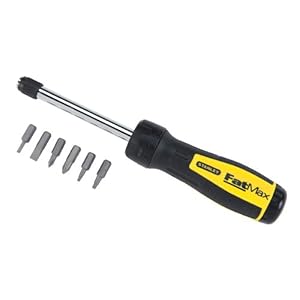
    Multi bit screwdriver. My second favorite versatile tool is the multi bit screwdriver. All this is, is a screwdriver with a hollow magnetic end that allows you to change the ends — flat head, philips, mechanical and a few different sizes — so you have six  screwdrivers in one. These are handy little things and my advice here is to first get the style where the extra heads go into the hollow part of the handle and screw closed. The models where the bits pop into the lower shaft will always get lost. Every time. And the second is to go cheap. Multi bit screwdrivers are great but they are pretty much disposable. Get yourself a few and put in one in your junk drawer, glove compartment, garage. Great little tools to have and you can get them everywhere from Dollar General to Wal-Mart.


    Mini screwdriver kit. These are also great little kits and have all the very small flathead and phillips screwdriver sizes. They are perfect for fixing a pair of eyeglass, opening up small electronics and getting in anywhere the manufacturer doesn’t want you to go. Again, go cheap here because you will always loose some and every Dollar Tree in the country has these kits.


    Reciprocating saw. Now until recently my reciprocating saw sat on the bottom of my workbench and saw very little use. But once I started using it I saw how incredibly versatile it is. It is so light and portable that you can use them to cut tree branches, metal, PVC, anything. I recently built a large kindling box with leftover wood from our deck and used a reciprocating saw and a cordless screwdriver. Saw-Zall is the big guy here but again unless you’re a pro, go cheap. Harbor Freight has some very inexpensive brands.


    Staple gun. Where you can’t get a hammer, you can get a staple gun. Small, cheap, easy to use, these guys work well for tacking down carpeting, cable, upholstery, any place you would normally use a small hook or nail. They are many different sizes and grade of staple and you can swap out if needed. Go middle of the road here as far as cost. The springs on the cheap ones tangle and snap pretty easily and the cheaper frames are easier to bend.


    The key is if you pretend these tools are all you have in your toolbox and use them as much as you can.

    Have fun.