
Category: Lists

  • The 10 books that every man needs to read before he dies

    The 10 books that every man needs to read before he dies

    books

    Catcher in the Rye is not on this list. Nor is Catch 22 — or The Grapes of Wrath, To Kill a Mockingbird or Farewell to Arms.

    Nope.

    Why?

    Because this is not THAT list. This is not the list you were given to read in High School or College or the books you read because you felt that if you didn’t you would have nothing to talk about at Christmas parties. No. This is the list of books that every man should read for — well, I’m not sure what the reasons are. Maybe because of the importance of the books themselves, or maybe just out of pure entertainment value or maybe because there are lessons that every man needs to know. Not sure. But these are great books — really, great books — and are worth the read.


    10. THE WORST HARD TIME. By Timothy Egan. Houghton Mifflin, 2006

    Not only is The Worst Hard Time the best historical analysis of the details that lead to The Dust Bowl, it also goes deep into the individual lives that experienced it. It’s well read, well researched and is powerful and for every man who thinks he’s been hungry or worried or frightened — this book will remind you of how easy we actually have it.


    9. READY PLAYER ONE. By Earnest Cline. Random House. 2011

    Ready Player One, is a book that needs to be read for the pure fun and entertainment reasons and is a must read for any of us who have ever spent time in a 1980’s arcade. Not only is it a great read —yes, it’s written extremely well — but it’s a fun ride.

    I am not going to tell you the plot of the book, because I don’t want you to try and label it, but I will say that if you remember anything about the 1980’s or you have ever played a video game or watched an early music video — you have to read this book.


    8. UNTIL I FIND YOU. By John Irving. Random House. 2005

    Until I Find You is John Irving’s greatest novel. Ever, It’s better than The World According to Garp and is more powerful than The Cider House Rules. It’s an amazing story about a man’s search for his father that keeps changing and warping and taking you along with it. I will warn you though, as in all John Irving novels, be prepared for the graphic and the taboo — also it’s a big book, about 850 pages — but it is definitely worth the read.


    7. 11/22/63. By Steven King. Scribner. 2011
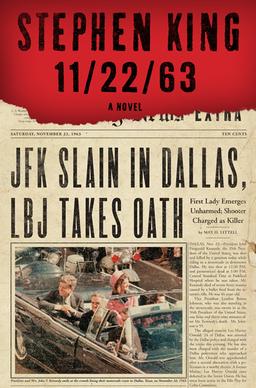
    11/22/63 is the only book that I have read cover-to-cover, three times — not simply because of the story but because his characters were so powerful and real that you go through withdrawal when its over. I haven’t read a great deal of Steven King — I’m not really the horror kind of a guy — but I did enjoy The Stand and Under the Dome — but 11/22/63 surpasses both of them.  This is a phenomenal book that takes place — in part — around the Kennedy Assassination but does so in a creative and King-like way that you’ll never forget it. A great book.


    6. THE DEVIL IN THE WHITE CITY. By Erik Larson. Crown Publishers. 2003.

    The Devil in the White City juxtaposes two events that occurred at the same time. The first was the creation around the 1893 Chicago World’s fair and the second was the life of HH Holmes who was the probably the worlds first serial killer — who lured hundreds of people to their deaths. A great balance of the technological achievements of the fair and the warped greed of a killer.


    5. PERMANENT MIDNIGHT. By Jerry Stahl. Warner Books. 1995.
    The first thing to know about Permanent Midnight is this book is raw. It candy coats — nothing — and it probably takes you closer then you comfortably want to go into the life of a heroin addict. The writing is amazing — some of the best I’ve ever seen — and the story winds a thousand moments of life carefully into a story. Permanent Midnight forces you to care — absolutely care — about the character and you will spend months worrying about him long after the last page is turned. An incredible book.


    4. ON THE ROAD. By Jack Kerouac. Viking Press. 1957
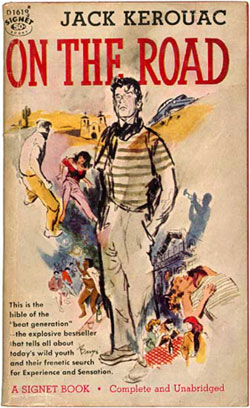
    What can I say about On the Road that hasn’t already been said? It’s amazing; part history, part epic and part nostalgia. For every man who ever dreamed of picking up a backpack and hitting the open road — which is all of us — you have to read this book.


    3. BLEACHERS. By John Grisham. Doubleday. 2003

    If you ever played High School Football, or if you have ever lived in a small town where High School Football — or any High School sport — ruled, then Bleachers is the book for you. My fifteen year old son, who hates reading, read this cover-to-cover in a day. It’s a great read with characters you will recognize and care about.


    2. INTO THE WILD. By Jon Krakauer. Villard Publishing. 1996.
    into the wild

    The only reason that Into the Wild beat On the Road for the 2nd spot is because Into the Wild goes deeper into the travel and the person involved. It’s the true story of Chris McCandles, who in 1990, gave all his money away and hit the open road. Which is where he lived for two years until his death in an abandoned bus in Alaska. An amazing read.


    1. ANGELA’S ASHES. By Frank McCourt. Scribner. 1996

    Angela’s Ashes is the biography if an Irish family and specifically a young boy named Frank McCourt. This book is absolutely amazing and has the ability to allow the reader to laugh at the most painfull and difficult parts of the author’s life. A great book.

  • The five things our grandfathers would kick our tails for

    The five things our grandfathers would kick our tails for

    grand

    There is an old story about two frogs. The first frog was tossed into a pot of boiling water. He screamed — Yeah, I looked it up, frogs can actually scream — http://conservationreport.com/2009/03/03/nature-screaming-frogs/ — and then he jumped out of the pot. He checked himself over. He took a few frog breaths, and then he moved on with his frog life.

    But the second frog was different. He was tossed into the pot while the water was still cool. The frog swam around. He checked everything out and saw nothing to be concerned about so he settled in. Then the burner under the pot was turned on, the water all around the frog began to heat up, slowly. But the frog doesn’t seem to notice or care. Bit by bit the water temperature increased. There were no frog screams. There were no frog escape attempts. The frog simply remains in the pot until the water boiled. And until —. Dead frog.

    Now, this phenomenon is often referred to as creeping normalcy or a shifting baseline and it describes the state that occurs when change occurs slowly, in small steps, over time. And because we only see the parts of the change not the total change itself, we don’t react to it.

    Every day. Every moment. Our lives change. What is normal today was not normal only a few years ago.

    Now, yes, technology has something to do with this.  But the big changes, the sweeping changes, the dead frog changes, have very little to do with technology. These changes are driven by shifting priorities and varying acceptance.

    Now let’s turn back the clock a bit. Let’s take a look at our normal, everyday lives through someone else perspective. Let’s go back in time but not simply to the generation before us  — born in the 1950’s — but to the one before that — the ones born in the 1920’s and ’30’s. This is the generation that fought in World War II. This is the generation that fought in Korea — in fact, many WWII vets volunteered to fight again in Korea. This is the generation that was raised through The Great Depression. This is the generations that struggled and sweated and built the structure of this country and is the one that lead Tom Brokow to deem it as “…the greatest generation any society has ever produced.”

    If we are going to look at the everyday structure of our society, then what better generation to view it through than the eyes of that group of men.

    Through the eyes of our grandfathers.

    Now, these changes are not large cultural and world changes — because the big changes are not the interesting ones. What’s fascinating is the little stuff. The tiny insignificant items that move and wiggle and shift all around us until one day we wake up and see it all as normal. But this version of normal would cause our grandfathers to smack us on the back of the head.

    So what would these men — our grandfathers — think of the every day, the basic, the routine, aspect of our lives today?


    THE FIVE THINGS OUR GRANDFATHERS WOULD KICK OUT TAILS FOR.


     1. Bottled water.

    This is one of those dead frog changes that has built up slowly for the last few decades and is now so embedded in our culture that we don’t even notice it. But think about it. We are paying —- for water.

    The stuff that comes out free from sinks and water fountains and garden hoses?

    Water.

    Which means that in a factory some place, someone turns the tap on, filters the water for taste — because our sensitive twenty-first century palate wants all our water to taste the same — squirts it into a plastic bottles and we buy it by the truck loads.

    In fact, the bottled water industry is a 60 Billion dollar industry. But did you realize that we buy more bottled water than we buy milk? And ready for a real surprise? We also buy more bottled water than we do — beer.

    So, say we yanked a solider out of the battlefield of World War II and brought him to the modern day. Then we gave him three bucks and said, Okay, go to that convenient store and buy me a bottle of water.

    The soldier would look at you strangely. He would walk into the store and open the cooler. He would pick up the water and look at the money you gave him and then look at the bottle of water. He would check the ingredients — nope, just water. And then he would walk back to you.

    “No,” he’d say. “I can’t do it.

    It would be so foreign to him that he wouldn’t be able to do it.

    http://www.bottledwater.org/economics/bottled-water-market

    2. The backyard deck.

    Backyard decks are great places. It’s where we entertain family and friends. It’s where we barbecue and it’s the place we often relax. But in our grandfathers day there was a place called the front porch and this was a social place. An open and connected place to sit and visit with neighbors.

    During this time it was very common to finish dinner and take a walk. And during this walk you would stop and visit with the folks sitting on their porch. You would connect with the neighborhood. Hear the gossip and check up on people. When you had visitors at your home, you often sat on the porch. When you listened to the ball game, you did it on the front porch so anyone could stop and listen with you.

    The front porch was open. The front porch was inviting.

    When the front porch became a merely decorative place, our neighborhoods became less involved with us and we became less involved with them. Now, we can now drive into our driveway, hit the electronic garage door opener, drive into the garage and never see our neighbors.

    3. Logos

    Your grandfather probably had a set of ESSO Put a Tiger in Your Tank coffee mugs. They were thick and white and very common and he probably had a few of them. Why? Because they gave them away free when you purchased ESSO gas. Your grandfather had the coffee cups with the ESSO tiger logo on it because they were free. No other reason. If they had offered to sell those same mugs — even at a very low cost — your grandfather would have sneered.

    Why would I pay to buy someone’s name on a mug?

    But today we do. We actually pay — and pay quite a bit — for the right to wear clothing, coffee mugs, key chains or hats that says Aeropostale, Harley Davidson or Nike.

    And I haven’t even gotten into the sports logos yet. With sports we pay for the right to promote our favorite sports teams. And what would your grandfather say when you spent eighty bucks to wear your favorite quarterbacks jersey?

    What?

    Your grandfather would want to know why any man would want to put another man’s name on his own back?

    What’s wrong with your own name? —he’d ask. What’s wrong with doing something you are proud of instead of pretending to be someone else?

    4. Credit

    Now before you argue, that there wasn’t credit available in your grandfather’s day, you’re wrong. Of course there was. There has always been credit. The only difference is that in your grandfather’s day, credit was seen as a weakness not a reward. In his day, the people who used credit were the ones who could not afford to pay in cash. They were looked down on because a man in debt was no man at all.

    Credit meant bad planning. Credit meant that you didn’t earn enough to take care of yourself and your family. The men that lived through The Great Depression and fought in foreign lands and came back home to raise families had only one rule. If you can’t afford it — meaning you don’t have the cash money to buy it — then you go without it.

    5. T-shirts  

    Yes, your grandfather owned t-shirts — he wore them under his dress shirts. And the only time you saw him in wearing only it, was when he was sitting in his chair listening to the ball game, or when he was mowing the lawn. And if someone came to the door, he would grab his dress shirt and pull it on before opening the door.

    When your grandfather went out to eat, he wore a tie. Even if he was a blue collar guy there was a sense of pride that he had.

    Whether you were a ditch digger or a doctor, a lawyer or a shoe shine man, there was a sense of pride in appearance.

    Now it’s casual —- well, that’s what we call it — but casual has long fallen into a new category. Now we have work clothes and everything else. We don’t dress for dinner at a restaurant, much less dress for dinner at our home.

    Your grandfather did. He would often dress to eat dinner with his wife and family. Because it was an event. He was proud to have earned the money for the food. He was proud of his home and wife and his children.

    Your grandfather had pride.

    And that’s probably what it boils down to. Pride. Our grandfathers had it and we as modern men are lacking it.

    Why did they have it? Because they deserved it. They fought and sacrificed and planned for it.  They earned that pride — it wasn’t given to them, they paid for it several times over.

    When is the last time we sacrificed or went without? When is the last time that we felt real pride in something — not simply in the pride in a new car we owe on or of what comforts we can rent. But true, bone deep pride?

    … for most of us, it’s been a long time.