Category: Skills

  • How to build a fire.

    How to build a fire.

    fire

    Barbara Streisand, Ricky Gervaise, Daniel Radcliffe, Tina Fey and Barbara Walters. What do they all have in common?

    Well, they are all successful, recognizable names in their own fields but there is something else that binds them together.

    Ready?

    None of them can drive a car.

    These are very prosperous, highly motivated people that have achieved so much in their lives but have never mastered one of the skills that most of us learn at 16 years old — now some of this has to do with living in places like London or New York where driving is actually a detriment, but for others it has to do with simply not having an interest in driving.

    So, can you be successful without learning to drive a car? Yup. Sure. You can work around it.

    And can you go through life without knowing how to build a fire? Yup. Sure. You can work around that too.

    But there will come a time — whether in the woods, in a cabin , or even in a survival situation — where you’ll need to. And knowing how means that you don’t have to ask someone for a ride.

    THE GOLDEN RULE OF BUILDING A FIRE.

    There is one thing —- one single entity — that is the single most important part of  building a fire and the one that has the most impact. It’s also the first rule that’s ignored. It’s that you are building a fire. Not starting one, arranging one or finding one. But building one.

    I’ve been on camping trips where I’ve seen guys throw a pile of sticks on the ground and light it and then get frustrated when a fire doesn’t magically appear.

    You are building a fire. Constructing it. You are creating layer of light material that can be lit easily that will then light other slightly larger material which will then light slightly larger material in a precise manner so heat is created and larger pieces of wood can be burned. This is a constructing project not cooking.

    Don’t be in a hurry. Take your time and get the foundation done and the fire will happen.

    Years ago I was on a two day survival weekend with a group of people on Hiawatha Island in New York and one of our challenges was to build a fire with a battery and steel wool and then get a can of water to boil. Now as soon as the timer began — we were all racing against each other — we all scrambled to get materials. Now the guy who lit the fire last, the one who spent the most time on the construction of the fire, is the one who succeeded first. His fire went up quickly and efficiently and he actually worked less on the maintenance of the fire because his foundation was so solid.

    BUILDING A FIRE

    Whether your building a fire in a fireplace, a pit, a stove or a camp the rules are all the same. You will need three types of wood:

    1. Tinder — pine needles, paper, dry leaves, dried grass, birch bark
    2. Kindling — small sticks under 1″, pine cones, bark, wood shavings.
    3. Fuel — sticks larger than 1” in diameter.

    So your tinder goes in the basement of your construction project, the kindling above it and then the fuel either above that or added on once the fire gets going.

    1. Loosely pile the tinder in the center of fire pit or on yoru firegrate/stove. Be sure there is air around it for fuel.
    2. Add the kindling around the tinder so it catches. The two ways to do this are in a teepee — best for camp fires — or a frame, where you have large pieces off to the side and the kindling in the center. You can place the fuel on the edge but don’t rush it, you can always add the fuel when the kindling is hot.
    3. Light the tinder.
    4. Add more tinder as the fire grows — you want the flame to be high at first so it catches
    5. Then add more kindling — rule of thumb is get twice as much as you think you need. Remember kindling is more important that fuel. Getting the fire hot means you can add larger and ever wetter pieces later but not getting it hot means it has a chance of going out.
    6. Add fuel.

    Experiment and play around. Building a fire should be something you’re confident in doing and may come in pretty handy someday.

  • How to jumpstart a car

    How to jumpstart a car

    cable

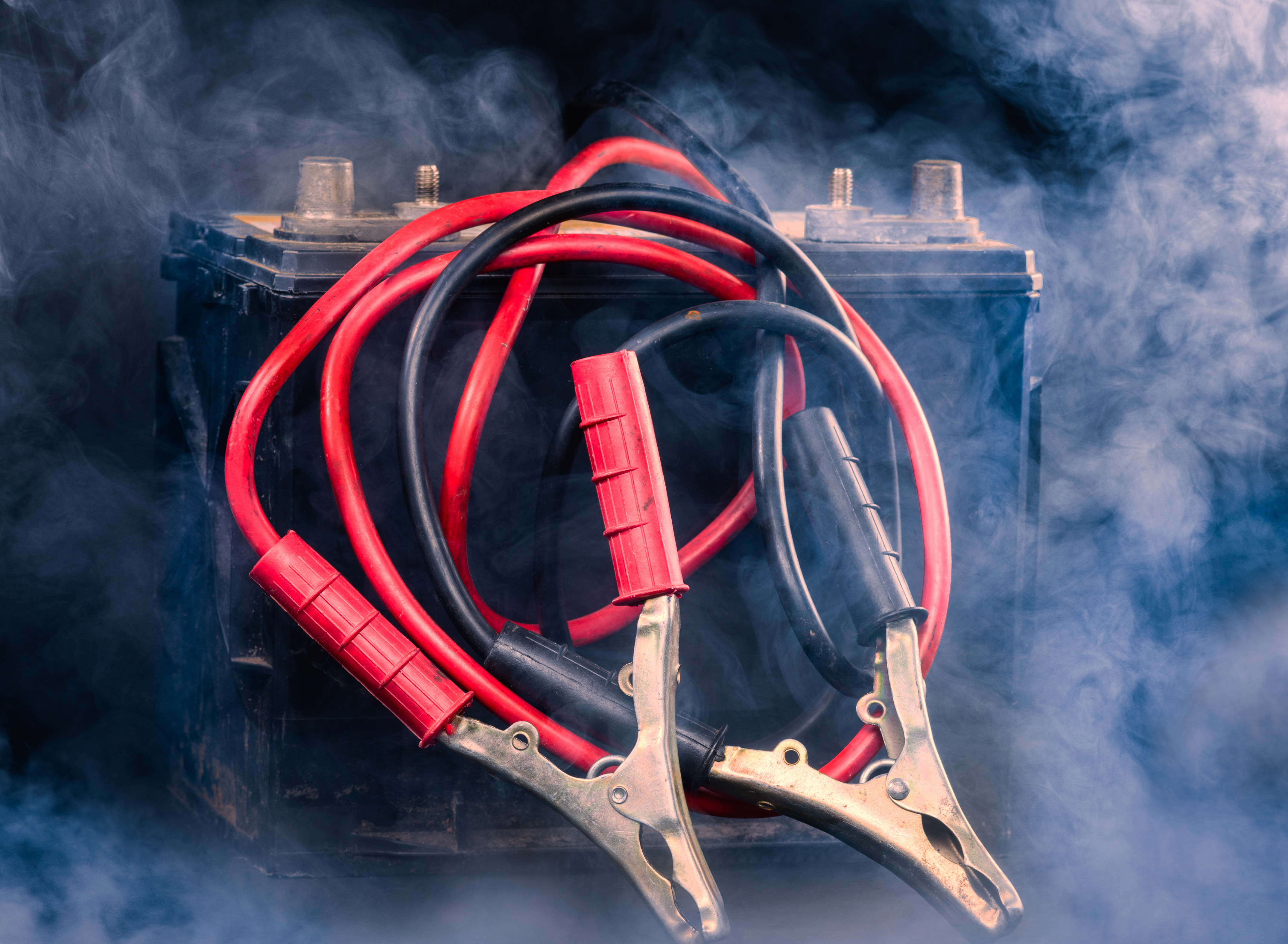
    Now the basics of jumpstarting a car are extremely simple and require only three parts. One, a car with a dead battery — the jump-ee. Two, a car with a live battery — jump-er. And three, a set of large, industrial, jumper cables.

    Now, this is a very simple process that gets complicated quickly if you are lacking or have undersized jumper cables. The reason for this is that it’s always  easier to find someone willing to give your car a jumpstart, than it is to find someone willing to do so who also has a set of jumper cables — or a set sized large enough to actually work. You may find one or you may find the other, but now you need to find both. This is the same as needing help moving, but you can only accept help from friends with red hair — you’ve not only decreased your odds but you have put yourself in a vulnerable position.

    Being men means that we are prepared to take care of ourselves, the people we care about and others who need our help along the way. It’s okay to have a dead battery. It’s not okay to drive around unprepared expecting others to take care of us. A man on the side of the road with a sign reading NEED JUMPER CABLES, is different than that same man with his hood up, cables ready, looking for a quick charge from a willing traveler.

    And don’t think for one minute that those cheap jumper cables that came with the car, or the set that was in the emergency car kit your aunt gave you for Christmas, count. They don’t. They are worthless and unreliable. I have helped more people jumpstart cars that were trying to do so with cheap cables, than those who had no cables at all. They just don’t work. Go out and get yourself a heavy set of jumper cables — 6 gauge or better (remember, the lower the gauge number the better, so, 6 is better than 8 and 4 is better than 6, etc.) — 300 amp or better with rubber handles on the clamps; not plastic ones. Also, a 15’ length is a good length. 12’ cables are often hard to use if you have to pull the cars in at a strange angle and with more than 15’ you risk some current loss.

    [amazon asin=B00ELASYIA&template=iframe image][amazon asin=B0006MQJ0M&template=iframe image][amazon asin=B00167TYHQ&template=iframe image][amazon asin=B003UVCY00&template=iframe image]

    THE PROCESS:

    So, now you’ve got a decent set of jumper cables, a car with a battery that needs to be jump started (jump-ee) and a car that is has a fully charged battery (jump-er). From here it’s pretty straightforward. With the jump-er’s car running — it’s very important that the car jumpstarting from is running — you’ll start the process.

    First you need to determine if the problem with the car is truly a dead battery. So, if when you turn the key and the car does nothing or if it tries to turn over but can’t, it’s most likely to battery. If the dash lights come on and/or there is a clicking sound when you try to start the car, this might be a starter issue instead of a battery.

    The rule of jumper cables is simple. It doesn’t matter which way you connect the cables, as long as they are the same on both cars. So, if the black jumper cable clamp is on the positive terminal on the jump-er, then the black clamp goes on the positive terminal of the jump-ee. The black and orange (or yellow) on the cables does not mean positive or negative, it’s just a way to distinguish a difference between the cables.

    So that means, do not cross the cables. Don’t put the red cable on positive of the jump-er and the other red end on negative of the jump-ee. If you do, bad things will happen. But the good news is, that’s really the only rule of using jumper cables.

    So let’s say you choose to connect red to positive on the jump-ee car, then red to positive on the jump-er. Then go back and do black to negative on jump-ee and then black to heavy metal bracket or frame of the jumper — I’ve connected the negative to the negative, but this is no longer recommended.

    Now, you wait a minute to let the charge build up then try and start the car. If it starts, great. If it does not start, wait a few more minutes and let the charge build up further. Try again. If still nothing, look at the cars you are matching up.

    If you have a Honda Civic trying to jumpstart a Chevy Bronco, you may have an issue. The smaller battery may not be strong enough to charge the larger one. You can wait longer to see if a charge will build, but most likely you will need to find a larger car to jump from. The rule is you want an equal or larger battery as the jump-er.

    So if the battery sizes are equal, and the cables are of heavy industrial strength, you should get a charge and the car should start. Then, unhook the cables — red from the jump-er then red from the jump-ee, etc. — and let the car run to build up a charge.

    That’s it.

    So do you now know how to jumpstart a car?

    No. Because you haven’t done it yet.

    Put a good set of cables in your trunk and wait to find someone you can help and once you’ve actually jumpstarted, then you know how to do it. And when you find someone — walking out to them with your heavy duty cables still in their plastic bag —  be honest. Tell the person that you have never used the cables but are willing to help. And don’t be embarrassed by this. I had a neighbor — he was almost sixty at the time — I found reading his car manual trying to find out how to jumpstart his car. He refused to let me help him because he wouldn’t admit he didn’t know how to do it.

    The worst kind of knowledge is the type that is offered but never accepted.


  • How to clean a fish

    How to clean a fish

    fishie

    The Colonel — his real name is Frank but we all know him as The Colonel — lives across the street from us. He is a 93 years old but no one has really taken the time to explain to him how a 93 year old man is supposed to act so you can’t blame him for his ignorance. Frank is healthy, active, sharp as a tack and lives alone in the same house he has owned since he and his late wife bought it in the 1970’s — well, that is saying he lives alone for those rare occasions that he’s actually at home. Because even when he is home — referring to being in town — he’s rarely at his house. Frank hates staying home and when he is actually in the area he’ll pull out of the garage early in the morning, wave goodbye, pick up his sixty year old girlfriend and head out for the day. I would say in a given year Frank spends possibly four, maybe five months of it even in town and when he is, he only sleeps at his house.

    It’s a depressing fact The Colonel has a far more active social life than anyone else on the street. Bar none. And most of us are four or five decades younger than he is.

    Now, Frank is known as The Colonel, because that’s simply what he is. A retired World War II Air Force Colonel and he is only given this title behind his back. If you do slip up and refer to him as The Colonel to his face, he will quickly correct you.

    “Please,” he’d smile. “Just call me Frank.”

    Frank drives his own car. He plays golf — he actually participates in several senior golf tournaments every year — he competes in poker tournaments and he skeet shoots. But Frank’s true passion, what The Colonel truly enjoys more than anything, is fly fishing. Frank loves fly fishing and he goes on several major fly fishing trips a year. For weeks at a time he will fly into Maine or New Hampshire or Alaska and meet a friend or one of his sons and fly fish.

    Trout and Salmon fear The Colonel.

    [amazon asin=B000QAS14G&template=iframe image][amazon asin=B002VYWWKO&template=iframe image][amazon asin=B002OFJ578&template=iframe image][amazon asin=B000Q89MCS&template=iframe image]

    Now fly fishing is a gentlemen’s sport and is somewhat different than the hook and line variety the majority of us barbarians practice. There is an art to fly fishing, a grace, that is missing in conventional fishing. And once I asked Frank if he kept that fish that he caught.

    “Naw,” Frank would say. “I just like giving them a sore mouth and sending them on their way.”

    But occasionally, if they have a large group of people that are fishing with that  need to feed, The Colonel will end up eating a few of the salmon or trout that he catches.

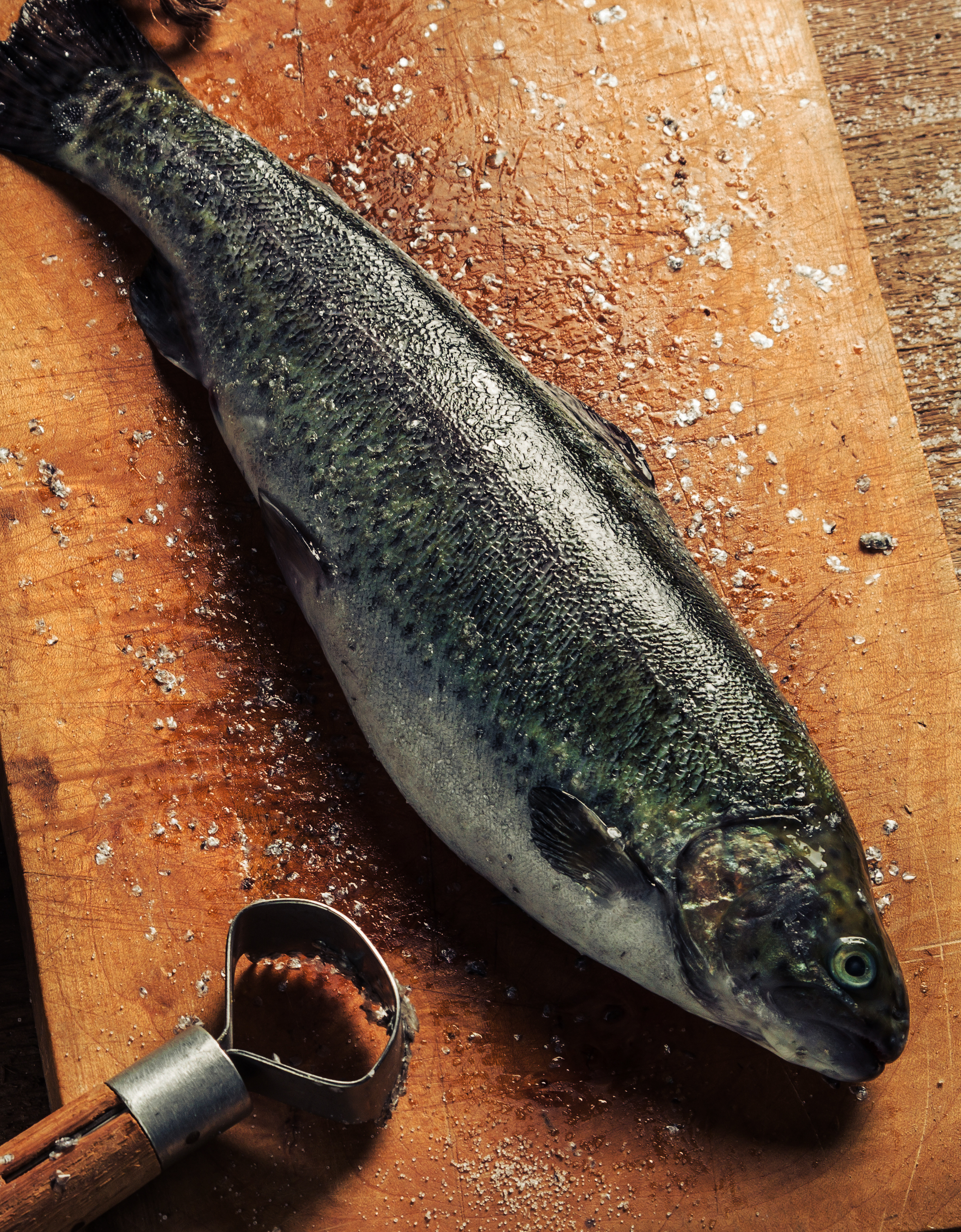
    Even if you fish occasionally, even if you fish once in a great while, there will come the times when you will want to keep a few of the fish you catch. And when I say keep, I mean eat. So you’ll need to know how to gut a fish.

    HOW TO CLEAN A FISH.

    Go outdoors. Cleaning fish is messy business. Even with a skilled fisherman the smell will remain so this is done outdoors, preferably where you have water available. A makeshift table —- even a piece of wood between two saw horses with a garden hose works well.

    Scale the fish. Hold the fish by the head and with the back end of a knife — you can also use a butter knife or a spoon — scrape against the scales to remove them. You want these strokes to be smooth and even otherwise you’ll cut into the meat of the fish.

    Rinse the fish. This is also a good time to check and verify that all the scales are off.

    Cut open the fish. With the fish belly up, make a clean cut from the bottom of the mouth to just below the tail.

    Open the fish and remove the entrails. This is the messiest part of the process but it doesn’t last long. Simply pull everything out and then cut anything remaining. When you think it’s complete, rinse the fish.

    Remove the head. Depending on the type of fish you caught as well as the type of cooking you’ll be doing, you can remove the head. If you’re cooking over the fire, it might make sense to leave the heads on. A simple stick placed through the inside and mouth of the fish will make for a great way to smoke the day’s catch over a fire. Also, trout cooks well with the heads left one — as well as the scales left on. Pan fish or anything deep fried you’ll want the heads and tails off.

    And that’s it. Once you’ve done this a few times you’ll be a pro.

  • How to Make Acorn Pancakes

    How to Make Acorn Pancakes

    acorn

    When I was a kid, my all-time favorite book — and I mean all-time favorite — was a novel entitled My Side of the Mountain. I loved that book and I read it at least a dozen times. It’s the story of a boy named Sam — I think he was around twelve years old — who runs away from his New York City home and heads for the Catskill Mountains to live off the land. The book actually takes place in Delhi, NY, which is sixteen miles from my hometown of Walton.

    Now Sam isn’t the typical runaway. He doesn’t hate his parents. He’s not in trouble with the law. And he is not being abused by his family. Sam just wants to be on his own and wants to live in the mountains

    So he does.

    And while surviving alone he hollows out the base of a tree to live in, raises a baby peregrine falcon that he trains to hunt for him, and has some other amazing adventures.

    For food, Sam survives on the rabbits and squirrels that Frightful — Sam’s trained Falcon — brings him, as well as the occasional stolen deer that he would poach from the illegal hunters who shot them out of season. And of course, there were acorn pancakes. Sam lived on piles and piles of acorn pancakes.

    Now, when I was a kid I asked my mother if we could make acorn pancakes, and she told me that this was impossible. She said that My Side of the Mountain was simply a story; you couldn’t make flour from acorns and therefore you couldn’t make pancakes from acorn flour.

    I was heart broken. The author had lied to me! Everything else had seemed so real… Years later, when I had finally come to grips with forgiving author Jean Craighead George for her deception, I discovered that she was not the one lying. (Sorry, Mom!) There are acorn pancakes.

    Acorn pancakes and acorn biscuits were actually a staple of the Native American meal. Acorns hold some valuable proteins and carbohydrates and also hold a good deal of saturated fats. In the modern world they are fun to collect, fun to process, and add a unique nutty flavor that can’t be found anywhere else.

    How to Make Acorn Pancakes

    Gather. The first step is to collect your acorns, and the rule of thumb here is to harvest a third more than you need. The acorns should be perfect specimens — if they are rotten or have been infiltrated by bugs, they can’t be used.

    1. You need to crack the acorns and get to the meat. This is where you’ll do your final inspection. If the nuts are dark, chipped, or look as if bugs have gotten in, chuck them.
    2. A coffee grinder works well for this. You don’t want to get the acorn meal down to a flour consistency, but more like the consistency of ground coffee beans.

    Wash. If you were to taste the acorn meal right now you would notice one thing: it’s horrible. That’s because it’s loaded with tannins. Native Americans would take the acorns and fill them in baskets and leave them in streams. It’s difficult to get this tannin out, but crucial. The method I’ve found that works the best is using a stocking. Take a stocking and fill it with the acorn meal. Tie it off and run it under cold water, all the time kneading the stocking. You’ll need to do this several times — a dozen or so — to make sure the tannins are all out. A good way to check is to taste the water that comes out of the meal you are rinsing. If it’s clear and has no taste, you’re good.

    Some people bake the acorn meal, but I find this gives it a more bitter taste. Just spread it out and let it dry.

    Now, there is no yeast in acorn meal so it is best used to add into other meals — I like using buckwheat flour or corn meal. This gives it a unique nutty and sweet flavor.

    Knowing how to make acorn pancakes is not a mission critical skill to possess. It’s not up there with being able to change your tire or tie a tie. But it’s a fun thing to do with your kids as a fall project or as just a very creative way to zest up foods.

    Enjoy.

  • How to change your spark plugs

    How to change your spark plugs

    plug

    History

    Believe it or not, there is actually a great deal of controversy surrounding who actually invented the spark plug — pretty funny, huh?

    In one camp, there are those that believe the credit should go to a man named Edmond Berger, who supposedly created the first device on February 2, 1839. But since Berger didn’t patent this invention and there is very little to document it — or provide verification on why the February 2nd date is always used — the title can’t officially go here.

    Then there are others that give the credit to a Frenchman named Jean Lenoir in 1860, who used an electric spark plug in a gas engine that he had created — but again, no patents were filed and there is little documentation.

    The actual paper trail begins in 1898, when the famed Mr. Nikola Tesla — the creator of the modern AC electrical system — filed a patent for a sparking plug within his ignition timing system. And then another patent was filed in 1902 when Robert Bosch designed a plug for his magneto-based system.

    But there is little doubt that the development of what is today the modern spark plug came from an engineer named Gottlob Honold who was working for Bosch in 1902, and took the plug closer to what it is today. And from there, manufacturing developments were made by Albert Champion in creating the insulator and completing the task in 1930.

    What is a spark plug?

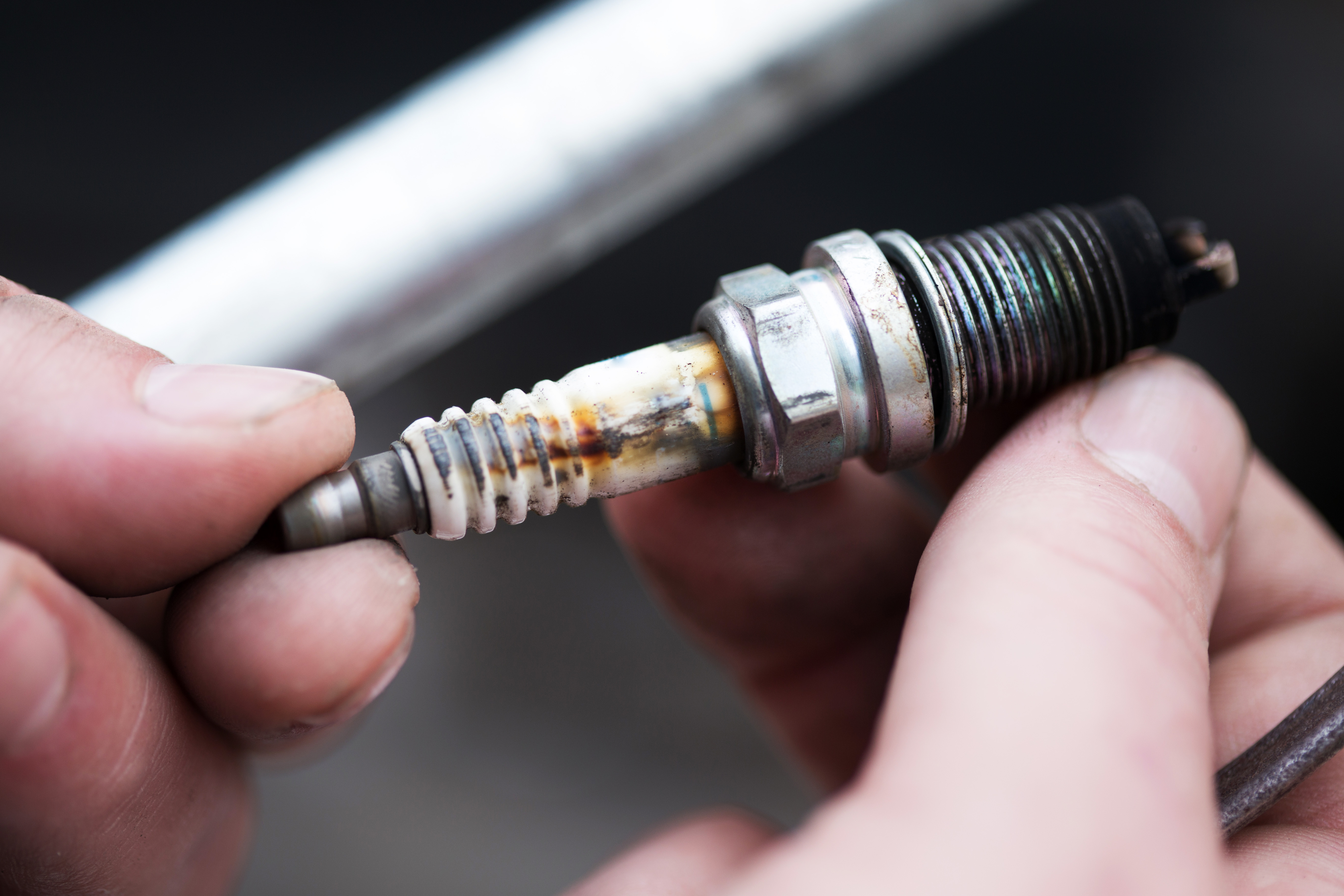
    A spark plug is device that has a metal threaded shell surrounded by a porcelain insulator. It is screwed into the cylinder head of an engine and forces electricity to arc across a gap in order to deliver electric current from an ignition system to the combustion chamber of an engine. That’s it. It provides a consistent spark to keep the combustion going and the cylinders moving so the engine keeps moving.

    Maintenance

    When a spark jumps the gap between two electrodes, it actually burns off small amounts of metal each time. As this continues, the gap widens to a point where the spark cannot make the jump any longer. This is when the engine begins to misfire, your mileage goes done, you have trouble accelerating and the horrible CHECK ENGINE light comes on.

    Which means that it’s time to change your plugs.

    Now if you’re intimidated by changing your own spark plugs, don’t be. If you can change your oil filter and oil — and even if you have never done this, you can — then you can replace your spark plugs. And remember, each time you do yourself, you pocket the hundred dollars in labor that it would cost you to have it done in a shop. And that adds up pretty quickly.

    HOW TO CHANGE YOUR SPARK PLUGS

    So here you go. Nine easy steps to go through to replace the spark plugs in your vehicle.

    1. Buy the correct plugs for the vehicle. At your auto parts store there will be cross reference material for your vehicles make and model and the appropriate spark plug size.
    2. Gently, disconnect one spark plug, from one spark plug wire. There are two important points here; the first is the word, gently — not yanking, but disconnecting — and the second is the quantity of one. By changing one plug at a time you will always get the right plug back with the right wire.
    3. Clean the spark plug area with an air canister. This is important because it will prevent any dirt and crud from falling into the cylinder — which as far an engine is concerned is the same as a human getting a germ.
    4. Unscrew one plug. Using a spark plug ratchet, or the spark plug socket that comes with most socket sets, unscrew the plug by turning counterclockwise. Once the plug is loose enough, just finish by removing it by hand.
    5. Determine the plug gap. Each engine will have a determined gap that the plug point will need to be. You can get this gap from the vehicles owner’s manual, or it’s included in the decal under the car’s hood. Creating the correct gap is important because it will set it at the exact distance it needs for ideal performance and fuel efficiency.
    6. Gap the plug. Take your gap gauge, insert it between the bottom of the plug — the inner electrode — and the hook on top — the outer electrode. With the determined gap, bend the hook lower or higher to match the specific gap
    7. Insert plug. Slowly screw in the spark plug by hand until it’s firmly secure. Finish by tightening with the ratchet.
    8. Reattach the plug wire. Using a twisting motion, position the boot above the plug. When you hear a click, you’ll know the wire is connected to the spark plug.
    9. Repeat these steps with the other plugs.


    That’s it.

  • How to cook a pizza on the grill

    How to cook a pizza on the grill

    pizza

    My backyard grill is one of my all time favorite personal possessions. In fact, if I could keep only three items that would be mine and mine alone, they would be;

    My bike.

    My Swiss Army watch — yeah, I have a Swiss Army Knife too, but my watch is great.

    And my grill.

    And as long as my family was safe and they had all they needed, I would be extremely content with just owning these three things for myself.

    [amazon asin=B000077CPK&template=iframe image][amazon asin=B00CZ5VF84&template=iframe image][amazon asin=B00BC3UVDK&template=iframe image][amazon asin=B0000E2GYL&template=iframe image]

    I have a Weber Spirit. It’s a great grill. With the three burners I can do pretty much anything and one of my favorite things to do on the grill is pizza. It’s fun, unique and with the high heat of the grill you can get that brick oven crunch — also we are ex-New Yorkers who now live in Delaware and there is no decent pizza here.

    Now the method I use for pizza is based on trial-and-error of a three burner grill like the Weber Spirit. I have tried other grilled pizza techniques and this works really well, but experiment with your particular grill.

    HOT TO COOK A PIZZA ON THE GRILL.

    Purchase a 1 pound bag of commercial pizza dough or make your own pizza dough. Pizza Bud is the brand I buy and it costs only eighty-eight cents and I can get two pizzas out of one bag of dough.

    Cut a 16 oz dough ball in half

    With a rolling pin, roll out the dough. Yes, the pizza tossing thing is very cool but you need to be good at that and I am not. So a rolling pin is a great way to get an even crust. Also, roll your dough out long ways instead of the traditional round pie. This allows you to get up to four on your grill and reduces the chance of burning. And don’t worry about making the shape perfect. The more imperfect it is the more authentic it becomes.

    On a low heat — now this is based on a three burner grill —- place the dough directly on the grill.

    Wait three minutes or so and flip the dough. Wait another three minutes and pull the dough from the grill. This will be your pizza crust.

    So here, with the most cooked end up, cover lightly with some olive oil and now build your pizza —- cheese, sauce pepperoni, spices, whatever you want — and place back directly on the grill.

    Close the grill and allow to cook. Check every few minutes and look at the bottom of the pizza — this will not only tell you how the pizza is cooking but keep in mind there is a thin line between getting that perfect brick oven crunch and burning the bottom of the pizza. When you’re not sure, pull the pizza early.

    Let cool and cut.

    Enjoy.

  • How to remove a tick

    How to remove a tick

    tick

    My son Alex is a bonafide tick magnet — not a chick magnet, but a tick one; which at 17 years old is strangely not as cool.

    I’ve never seen anything like it. This kid excretes some sort of tick pheromone, a disco ball for parasites, because not only when we go into the woods does he come out with new colonies of ticks that are settling in and designing the city center, but even if he walks across a lawn or the grassy part of a parking lot he often gets a few hitchhikers — and this is where the outlying ticks are, the ones that have been banned from the forests and when they see Alex coming they sing songs and hold each other as they wait for their salvation to arrive.

    In fact, when Alex, our dog Riley, and myself are in the woods, Alex will come out with ticks. When it’s just Riley and myself, Riley will. So according to this highly scientific evidence, if given the chance. ticks prefer to risk the larger target of Alex — even though their chance of success is far less — then shoot for the shorter and easier one of Riley the dog.

    It’s very weird.

    WHAT IS A TICK?

    So, a tick is a type of mite that falls in the external parasites category. They attach to animals —mammals and birds but will also go after reptiles and amphibians as well — and live off the blood. They burrow their mouths under the skin and start drinking.

    Now the challenge with ticks is unlike mosquitos, who take a big drink and leave, ticks are in for the long hall. Once they have found The Promised Land they have their mail forwarded and take up residency. And the longer they are there, the fatter they get off the hosts stolen blood and the harder they are to get rid of.

    The most common ticks in North America are the deer ticks and the dog tick — which look very much alike

    Besides being unwanted, ugly, a thief, and just plain gross, the other concern with ticks is that some carry disease. These include Colorado Tick Fever, Rocky Mountain Spotted Fever and of course, Lyme Disease. But if you’ve come out of the woods with a few ticks don’t automatically think you’ve been exposed. Even though only a few types of ticks are capable of spreading the diseases it also depends upon the geographic location, the season of the year, the type of tick and how long it was attached.

    In fact, even if a tick that carries a disease has attached to you and even fed, the chance of infecting are still very low. For example, the deer tick that transmits Lyme Disease must feed for more than 36 hours before it can pass on the disease and most ticks are found within a few hours.

    But if you are an overly cautions individual and want to make sure that no disease was transmitted from a tick bite, can you get a blood test to determine this? No. Even if you were infected signs in your blood will not show up for two to six weeks later. But, as  long as you catch that tick before it’s been on you for three days, the odds are very high that no disease has been passed.

    TICK REPELLENT

    So a good offense is a strong defense. True. And the best defense against ticks are through your clothing. Commercial bug spray that you apply to your skin tries to be everything to everyone and also wears off. The best tick defense is to use a Permethrin based products that you apply to your clothes. Permethrin is a synthetic chemical found in insect repellent and there are many tick repellents made with Permethrin but the best one I’ve seen is made by a company called Sawyer that has a Duranon Permethrin spray for the deep woods. This stuff is amazing and I’ve been in the woods and watched ticks crawl on my clothes and die before they got to me.

    HOW TO REMOVE A TICK

    First, what not to do.

    When I was a kid there were dozens of folk-treatments that were used to remove ticks — many of which, we know now, not to do. The most common is to irritate the tick into removing itself and you do this by lighting a match, blowing it out and holding the hot match head behind the tick. Or putting fingernail polish. kerosene, Vaseline or dish soap on the end of the tick. The idea is that the tick will pull out of the skin to get away from the heat or the chemical burn.

    Don’t do this.

    Yes, it’s possible that the tick might actually pull out of the skin. Maybe. But in panic the tick is more likely to inject its bodily fluids before escaping — fluids that would include any disease it might be carrying. And that would be a bad thing.

    The best way to get rid of a tick is the tride-and-true, tweezer method — this is why it’s great to carry a small first aid kit or 48 hour kit on you in the woods — an easy one can be made from an Altoids tin and kept in your pocket.

    The tweezer method:

    1. With a pair of tweezers, as close your skin and its mouth as you can.

    2. Pull slowly back using steady and even pressure — don’t twist. And don’t squeeze the body as this can send the body fluids into the skin.

    3. If the whole tick came out, great. If not, leave the part that is still in the skin alone. If you try to go after that part you could irritate the skin even more and possibly cause an infection. Your body will eventually reject it.

    4. Clean and treat the area.

  • How to Split Wood With an Axe

    How to Split Wood With an Axe

    axe

    For the first twelve years of my life — from 1962 until 1974 — I lived in this amazing place in upstate New York named Sanitaria Springs. It wasn’t a town — it was barely a village — but it was a great place to be a kid and an amazing place to grow up.

    The town was originally named Osborne Hollow and later changed its name when, in 1892, Dr. Sylvester Kilmer wanted a location for his health sanitarium and chose the area because of its natural phosphate springs. But before he started construction he convinced the town to change the name to Sanitaria Springs — if you were sick would you want to go to Osborne Hollow? A sanitarium was built in addtion to a hotel — which is the house my parents later bought and where I grew up — as well as a bottling plant and stores.

    [amazon asin=B00002N5N7&template=iframe image][amazon asin=B0010ORKD0&template=iframe image][amazon asin=B00AH9A8JM&template=iframe image][amazon asin=B00A6F6602&template=iframe image]

    The sanitarium fell under disrepair after the good doctor’s death — who actually claimed to have taken the cure to cancer to his grave. Then the sanitarium closed but the town moved on.

    By the time I came along remnants of the old days were still there. The place where my dad dragged our garbage cans out for pickup was the old horse trough for the hotel and at my cousin’s house up the street were the original stone steps where horse and buggies would pull up to let off their passengers.

    It was a place all its own. Long before the highway came in, it was rare and hidden and all ours. Where fields became baseball diamonds, gravel pits became swimming holes and barns became haunted houses.

    It’s just a ghost town now. Just a name printed on EXIT 4, off Route 88 South and although I think the fire station is still there as well as a few houses and a chain gas station popped up ten years ago or so,  the place I remember — Shirley’s Store, The Post Office, The Grange, The School, my parents fish store, are all either empty buildings are gone completely. Some say it was the highway that killed the town. Others said it would have died anyway but it  doesn’t matter. What matters are the memories and all of them are good.

    And one of my favorite memories were the ones of my cousin Chris McAvoy. And although I loved my cousin Brad, I idolized his big brother Chris and still remember many of the things he taught me about camping and hiking and of being a man. One thing Chris taught me — while we were building go carts from flower boxes we had stolen from our house — was how to use a hammer and how to use an axe. And he did so by telling me one rule — the same rule I passed on to my kids — that makes it all make sense.

    And that rule is this.

     Let the tool do the work, not you. Hold the hammer low, swing and let that weight of the hammer or the axe do the job.

    HOW TO SPLIT WOOD WITH AN AXE.

    Find a stump. Placing the wood on top of something is the way to do it. It’s also safer, so you don’t have to bring the axe down farther.

    Place wood long ways up. Make sure the wood is steady.

    Take a solid stance. Place your feet at shoulders length.

    Swing your axe around … Keep your grip midway until you bring the axe around and are starting back down with it. Then move your hands to the base and bring the weight off the axe head down on the wood. This is where you’re letting the axe do the work.

    Rinse and repeat.


  • The lost art of eye contact

    The lost art of eye contact

    eye

    My son’s best friend practically grew up at our house. He eats here a few times a week. He sleeps over once or twice a month. When we go on trips we usually take him with us and when his parents are looking for him, the first place they check is our family room — where he and my son Nick will be laughing through some interactive battle that requires headsets and game controllers.

    Then one day — for about a week — he just stopped showing up.

    Nick was still in the family room — talking to unseen people in the world of X-Box Live — but no one else was there.

    When my wife asked where Austin was, Nick gave us a confused look, then answered. Home. And it was then that we understood what happened.

    Austin had been saving his money and just got his own X-Box. So, now Nick and his friend were spending the same amount of time together — talking on headsets and playing the same interactive games, blowing up the same creatures that exploded party favors out of their heads when killed, only now, his friend was plugged in at his house and Nick was plugged in here.

    And the frightening aspect of this was — they were both fine with that.

    The key was to be together in the world of Minecraft. They didn’t need to physically be in the same room, just as long as they were both in the game at the same time.

    Now, Austin s sixteen and has a girlfriend. She lives in Canada. He lives in Delaware. They e-mail, text and talk during the week. They get each other Christmas presents and birthday presents and have been dating now for over a year. However, they have never met. They discovered each other through — well, I’m not sure what internet introduction — and for the last year they both consider themselves in a serious relationship.

    Now the fact that they have never met is not a concern. And when I ask how can you be dating someone you have never physically seen, he smiles and give me that patient, wow, you are so old, look.

    The point of all of this is, you and I live in an extremely unique point in technological history. For the first time we can discuss, fight, negotiate, schedule, console, beg, mend and comfort, without actually needing the person we are communicating with to be anywhere near us.

    On any given day, we text, phone, e-mail, Facebook, Bluetooth, chat, play interactive games and Tweet more then we directly interface, face-to-face, with other people.

    The process is, we interact with a device — a cell phone, a keyboard, an I-pod, a game controller, a Bluetooth headset — and then wait for the person we are corresponding with — someone we cannot see — to interact with their device and reply back. The gadgets we are using are near us. The people we are transmitting to are removed.

    [amazon asin=B00IZ95BSE&template=iframe image][amazon asin=B00GOLGWVK&template=iframe image][amazon asin=B004DNVP40&template=iframe image][amazon asin=B0014E26L2&template=iframe image]

    Now, before you roll your eyes and think that this is a rant against technology, it’s not. It’s simply demonstrating two things. The first is that we are now becoming extremely comfortable in communicating without human contact. Through a device. And secondly, that given the choice many of us will often choose to communicate in this fashion.

    Now, my son’s best friend is a smart and good looking kid — tall, blonde, on the school swimming team — and is content with a girlfriend a thousand miles away that he can date through a keyboard or a cell phone, rather than one that he has actually met.

    Here is another example.

    You are in a restaurant and see a group of people sitting at a table together — and this is not necessarily always a younger group, I’ve seen people of all ages do this — and at least one of these people are speaking into a cell phone to someone that is not at the table. And we’re not talking about a quick five or ten second conversation, where there is crucial information that needs to be passed on. I’ve seen — and heard — thirty minute casual cell phone conversations between people, during dinner, while these same people are sitting and eating at a table with different people.

    Which means that these individuals had a choice. They could talk directly to those sitting in front of them, face-to-face, or they could use a device to communicate with someone removed.

    You see this on a massive scale at any airport in the country. Here you will see thousands of people all plugged into cell phone conversations, completely oblivious to the other people that are inches away from them, who are also plugged into other conversations.

    So maybe they’re busy? Maybe these are busy business people closing crucial and important deals.

    Maybe.

    But it’s not hard to listen to samplings of most of these calls — many people on cell phones don’t realize that sound travels — and they are in the large part mundane and simply chatty. Actually, most of the times these calls simply seem to be a way to kill time.

    And even though the content of the calls are usually non-critical, the need to stay connected to another individual is extremely great. The first time I was in a busy airport men’s room and saw a man continue his cell phone conversation as he stepped into a bathroom stall — or better yet, take the call while he was already in there — I was amazed. Now it’s so common that I don’t even notice.

    And a month ago, at the gym, there was a man who had stepped into the shower and hung his shorts — with his cell phone in the pocket — on the hook outside the shower curtain. His phone rang and he reached his wet hand out to get his phone — and took the call while in the shower.  

    So, what’s the point of all of this?

    It’s simply this. We are so accustomed to — and the need is so great to—  communicate with people without seeing them that we no longer see them.  

    The ancillary people — the toll both operator, the cashier, the waitress — simply become white noise. A disjointed voice — and we are now very accustomed to talking to disjointed voices. We say hello, we say thank you and we leave and we rarely — and I mean rarely — make eye contact.

    Up until recently if you entered a crowded room of strangers, that room, those strangers, became your world. Until you left that room, those people are now connected to you simply because you are sharing the same space, the same situation and the same time.

    No more.

    Now we can be in the same room but be texting someone else, making a phone call or sending an e-mail from our phone. We are no longer in the same room as the person a few feet from us because we are now connected to someplace else and therefore disconnected from the people next to us. The physical space we occupy is no longer important.

    I think this is one of the main reasons that we no longer talk to the people  sitting next to us on airplanes. We used to. We would introduce ourselves, give a brief bio and then chat for the next few hours. Now we avoid saying anything to the person sitting next to us and in fact try to avoid having anyone sit next to us at all. We linger to the end of the boarding line so we can get inside the plane after everyone and see if there are unsold seats where we can spread out and sit alone.

    So wait, all of this has to do with eye contact?

    Yes.

    Because for men, eye contact is a tricky area anyway and now — due to the change in technological culture — it is becoming even more complex. As men, we use eye contact to seduce as well as to intimidate. We use it to calm and to  ignite. The wrong look at the wrong time can lead to battle. The right look at the right time can lead to love.

    For men, eye contact is a tool. A weapon. And instead of learning to use that weapon properly we are allowing it to get dull and acquire rust.

    Those people around us every day — the waitress, the store greeter, the bank teller — are people. They are not screen savers or extras in a film. We are missing something by not connecting to them — even for a second — by making eye contact. And they are missing something by not taking that second to connect to us.

  • How to Play the Harmonica

    How to Play the Harmonica

    miller

    The harmonica — also known as the mouth organ or the blues harp — is a great little instrument. In fact, the harmonica is the great equalizer of all musical instruments because you don’t need to read music to play one — you don’t even need to have any true musical ability. It doesn’t take years of dedication to master the harmonica — actually, you can bang out a few tunes in just twenty minutes or so and unlike the hundreds or thousand of dollars that many musical instruments cost, you can get a decent harmonica for about twenty bucks. And a harmonica does not take up a great deal of space —  I often carry mine in my shirt pocket.

    Also, the harmonica has the distinction of being the only musical instrument that I know of that you can play one handed while driving — I am not confirming or denying that I have ever done this, I’m just saying it can be done.

    And in the category of harmonica-trivia, though I have no proof, it is very possible that a harmonica may have saved my life.

    [amazon asin=B000Q87DAQ&template=iframe image][amazon asin=1908707283&template=iframe image][amazon asin=0793515599&template=iframe image][amazon asin=B000EELFTW&template=iframe image]

    It was about ten years or so — I had a twelve-state sales territory back then — and I was driving through the great state of Texas when I saw a man hitchhiking. Now hitchhikers were rare in my part of New York so I decided to stop and give this traveler a ride — help out a stranger kind of thing — as well as swap a few stories. As I pulled over and the man started running toward me, I realized that I might have made a mistake.

    The guy was real rough — tattoos everywhere— including every knuckle— and several piercings, which really didn’t concern me. But what did send up some warning signals was the panicked expression on his face. The fact that he kept looking nervously behind him and the way his hands were shaking uncontrollably.

    My instincts were screaming by the time he reached the car but before I could think of a safe way to bow out of this arrangement, the man stuck his head in the passenger window and looked at me. Then he looked at the cup holder where my harmonica sat. Then he looked back at me. Then back to the harmonica. Then a moment of silence passed before he spoke.

    “No thanks,” he said. And walked away.

    Just like that.

    A few minutes later I was back on the Texas Route 273.

    Now, I’ve always wondered what that hitchhiker thought when he saw my harmonica — maybe his instincts were screaming as loud about me as mine were — or maybe he had never dealt with the kind of sociopath that would travel with a harmonica in his cup holder. But from that day on I always keep a harmonica in the car and I am proud to say that I have never been murdered. Not even once.

    Coincidence?

    I don’t think so.

    HOW TO PLAY THE HARMONICA

    The harmonica is an instrument that creates different notes when you blow in than it does when you draw out. The key here is not to think of sucking and blowing, but just of breathing. Practice breathing in and out while playing the  harmonica — play a few chords out, then draw back and breathe in.

    Oh Susanna.

    For some reason, the song Oh Susanna, is the great beginner harmonica song. Practice breathing in and out on the harmonica while playing by ear, the song Oh Susanna — just practice on the chords; which is playing several notes at once. This will give you a larger margin of error.

    Single notes.

    Once you have the basics of Oh Susanna, on chords, focus on playing it on single notes. Single notes are played when you move your lips so air is only moving in and out of only one single path of the harmonica, rather than several. This is a little more difficult then playing chords, but it will start to give you muscle memory on where the individual notes are.

    And those are the bare bones on playing the harmonica. Pretty simple, huh? Because the harmonica is one of those rare instruments that can easily be self taught.

    Now, I found this great website that focuses on learning to play the harmonica and it was created by a man named Dave Gage — http://www.davegage.com/tips.html  . So I contacted Dave and he gave me permission to use it here.

    Dave does a great job of not only explaining the basics of playing the harmonica, but he covers purchasing a harmonica, what different types of harmonicas there are out there, and he has actual harmonica lessons. You can use the site to learn just the basics. Or you can treat it as a format for actual harmonica lessons and become quite accomplished quickly — Dave even has a paid section of his site for you gifted harmonica aficionados.

    So pick up a cheap harmonica today. Toss it in your pocket, your backpack, your tackle box or if you are in West Texas, place it in the cup holder of your car.

    You won’t regret it.


  • How to make homemade hot sauce

    How to make homemade hot sauce

    hot sauce

    Around 6,000 years ago — I think it was on a Wednesday — the early people of South America first began to cultivate and plant crops. And one of the first — one of the very first plants they placed into the ground — was the chili pepper; a spicy and flavorful morsel that quickly spread from The Bahamas all the way to the Andes.

    So by the time that Christopher Columbus got to Caribbean in 1492, the pepper was well established throughout Latin America. When the famous explorer found the pimiento — the Spanish word for the chili — he shortened the word to pepper because the taste reminded him of the heat that came from the black peppercorns of Europe.

    But as impressed as Columbus was, he did not take any peppers back with him. It wasn’t until the next voyage that a physician named Diego Álvarez Chanca — who became fascinated with the medicinal possibilities of the pepper — brought these little beauties back to Spain for the first time in 1494.

    In Europe, the chilies were grown but only as curiosities until the monks began to experiment with their culinary potential and soon discovered that their heat offered a very inexpensive substitute for black peppercorns — which were so incredibly costly at the time that they were actually used as currency. From there the popularity of chili’s spread through Europe and then to India, Japan and China. We were now a world of spicy food — when the peppers were in season.

    In 1807 the very first commercially bottled cayenne pepper sauce appeared in Massachusetts. Then in 1840, J. McCollick & Company of New York, produced a Bird Pepper Sauce, and in 1870, Edmund McIlhenny obtained a patent on his well-known Tabasco Brand sauce.

    Between 1918 and 1928, the first battle of the hot sauce wars had begun and this lasted until The Great Depression slowed things down in 1929. All was quiet until 1980, when The El Paso Chile Company was created and began to mass produce salsas and hot sauces. This took off and the 1980’s quickly became known as the decade of salsa — which during that time made the condiment more popular than even ketchup. And with that popularity, many of the staple hot sauce companies were created — Panola, Franks, Montezuma, etc.

    The 1980’s also saw the very first store dedicated to just hot sauces — Le Saucier in Boston — and in 1988 the first National Fiery Foods Show occurred in El Paso; which still goes on today.

    Then, things took a strange turn in 1989, when Blair Lazar created the very first extreme sauce which contained pepper extract — the same base ingredient used in pepper spray. And the pain level of hot sauces went crazy.

    The hot sauce industry is a multi-billion dollar market with hot sauces now a staple from military meals-ready- to-eat to high school cafeterias.

    But here is the great thing. You can make your own hot sauce. Oh yeah. It’s easy to do, cost pennies and is much better than anything you can buy off the shelf — even the forty dollar gourmet stuff — because it’s going to be fresh, tailored to your taste and totally unique.

    And on top of that there is something incredibly amazing about showing up at a dinner, barbecue, Superbowl party or whatever, with a bottle of your own homemade hot sauce.


    HOW TO MAKE HOMEMADE HOT SAIUCE …


    1. RED SAUCE

    Heat level: Medium


    Ingredients:

    Twenty or so, serrano chilies or red jalapenos — , stemmed and cut crosswise into slices.

    ½ medium onion, minced

    About 2 cups of water,

    1½ tablespoons minced garlic

    1 teaspoon salt

    1 teaspoon olive oil

    1 cup apple cider vinegar


    Directions: Caramelize the peppers, garlic, onions, salt, and oi, in a pan over medium heat. Add in the water and stir. For about 20 minutes. Remove from the heat and allow to cool. In a food processor or blender, purée until smooth. Then add vinegar in while the food

    Let age at least 2 weeks — can be stored for up to 6 months.


    1. JALAPENO SAUCE

    Heat level: Hot

    Ingredients:

    1 teaspoon olive oil

    ½ cup minced onion

    1 teaspoon salt

    20 fresh jalapeño peppers, sliced

    3 cloves garlic, minced

    2 cups water

    1 cup apple cider vinegar


    Directions: Caramelize peppers, onions, combine oil, and salt — everything but the vinegar — over medium heat. Add the water and let simmer for 20 minutes, stirring often. Remove from heat and allow to cool.

    Add into food processor and purée until smooth. With the processor running, add in the vinegar. Pour into a sterilized jar with a tight lid. This sauce will keep for 6 months when stored in the refrigerator.


    1. HABANERO HOT SAUCE

    Heat level: Oh yeah.

    Ingredients:

    4 habanero peppers, rough chopped

    2 cups of water

    1 tablespoon brown sugar

    ¼ teaspoon ground cloves

    ½ teaspoon salt

    2 tablespoons apple cider vinegar


    Directions: Put peppers, sugar, cloves and salt in a food processor or blender. Process the fruit and peppers until they are completely smooth and puréed. Scrape down the side of the bowl as necessary.

    Pour into a saucepan and add the water and vinegar and let simmer for five minutes. Let cool and fill your bottles or jars. Refrigerate and eat within the month.

  • The versatile toolbox

    The versatile toolbox

    tool

    My mother was born in 1922. My dad in 1924. So, if you calculate and then add forward you would think that my age would be — what? 72? Late sixties?

    Well, I guess that makes sense since my brother would have been 70 this year and my sister 66, but no. I’m 52. My mother had me when she was 40 and she had my younger sister when she was 42.

    So I was born in the sixties and my parents were born in the twenties. This is not a generation gap but two generations apart which created some interesting paradoxes. The first was that my brother and sister were the age of most of my friend’s parents — when I was three years old my brother was coming back from Vietnam and when I was six I remember hearing a huge fight as my sister was leaving for something called Woodstock. But those are different stories.

    Now, there were some challenges with this arrangement; my dad’s health never allowed him to be the rough and tumble father that other kids had and at the age of 54 my mother started Nursing School to bring in some much needed income after my father became disabled; which meant that for a period of time my dad was retired and my mother was a college student. And for those friends that came to our house there was a certain generational language barrier that would often need translation; a davenport is a couch, dungarees are blue jeans and gangershank is someone tall and thin.

    But it also created the amazing opportunity to not only experience my own generation growing up but the other two in my home: my older siblings of the sixties and my parents of the Depression Era, 1930’s.

    Now as a kid, having Depression Era parents created certain challenges — plaid pants were just as good as solid colors that cost more and powdered milk is very tasty. And as an adult it engrained a desire for all things to have value and to have multiple uses.

    Tools are like that. Sure, there are tools that are designed for one specific use, one specific application. But the most use we get out of our tools means the we can not only get more done with what we have but it also justifies paying a little more for the tools that are more versatile and we will be using more.

    An example of a non-versatile tool is a hammer. As soon as you put together a tool box the first thing you grab is usually a hammer but in reality it has only a few uses — and is almost becoming obsolete with the use of cordless screwdrivers. A hammer is used for hammering in nails and pulling them out. That’s pretty much it. Anything bigger than that, a post or a beam, you’re going to pound in with a sledge or a mall. So in actuality you will probably not use a hammer all that often.

    But there are other tools that can be used for multiple uses and will allow you to get more bang for your buck.

    VERSATILE TOOLS
    Cordless drill. The cordless drill is the big daddy of versatile tools. This thing has so many uses and is so handy that if you are going to buy a higher end tool, this is where you might want to spend your money. All a cordless drill is, is a drill with a rechargeable battery with a screwdriver bit but you will use it all the time. My neighbor Eric and I just built a 25 X 15 foot deck in our backyard using only two cordless screwdrivers and a power saw. You can change out a door lock, mix paint, grind metal and, oh yeah, drill holes with this amazing tool. Worth having and worth having a good one.


    Socket set. Socket sets are used to tighten bolts and nuts and some will argue that a set of spanners — the silver wrenches with a closed end and an opened one — is better than a socket set. But I have lost far more spanners than I have lost sockets because I always put it back in the spot in the case. Also because of the gears of the ratchet handle, you will always be able to torque a bolt tighter with a socket wrench than a spanner. Now, unless you are going to rebuild a car or doing some high end stuff, my advice is to go middle of the road to cheap on a socket set. Get yourself a metric and American style and keep them handy.


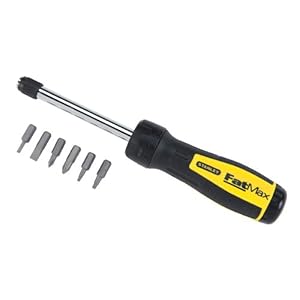
    Multi bit screwdriver. My second favorite versatile tool is the multi bit screwdriver. All this is, is a screwdriver with a hollow magnetic end that allows you to change the ends — flat head, philips, mechanical and a few different sizes — so you have six  screwdrivers in one. These are handy little things and my advice here is to first get the style where the extra heads go into the hollow part of the handle and screw closed. The models where the bits pop into the lower shaft will always get lost. Every time. And the second is to go cheap. Multi bit screwdrivers are great but they are pretty much disposable. Get yourself a few and put in one in your junk drawer, glove compartment, garage. Great little tools to have and you can get them everywhere from Dollar General to Wal-Mart.


    Mini screwdriver kit. These are also great little kits and have all the very small flathead and phillips screwdriver sizes. They are perfect for fixing a pair of eyeglass, opening up small electronics and getting in anywhere the manufacturer doesn’t want you to go. Again, go cheap here because you will always loose some and every Dollar Tree in the country has these kits.


    Reciprocating saw. Now until recently my reciprocating saw sat on the bottom of my workbench and saw very little use. But once I started using it I saw how incredibly versatile it is. It is so light and portable that you can use them to cut tree branches, metal, PVC, anything. I recently built a large kindling box with leftover wood from our deck and used a reciprocating saw and a cordless screwdriver. Saw-Zall is the big guy here but again unless you’re a pro, go cheap. Harbor Freight has some very inexpensive brands.


    Staple gun. Where you can’t get a hammer, you can get a staple gun. Small, cheap, easy to use, these guys work well for tacking down carpeting, cable, upholstery, any place you would normally use a small hook or nail. They are many different sizes and grade of staple and you can swap out if needed. Go middle of the road here as far as cost. The springs on the cheap ones tangle and snap pretty easily and the cheaper frames are easier to bend.


    The key is if you pretend these tools are all you have in your toolbox and use them as much as you can.

    Have fun.